
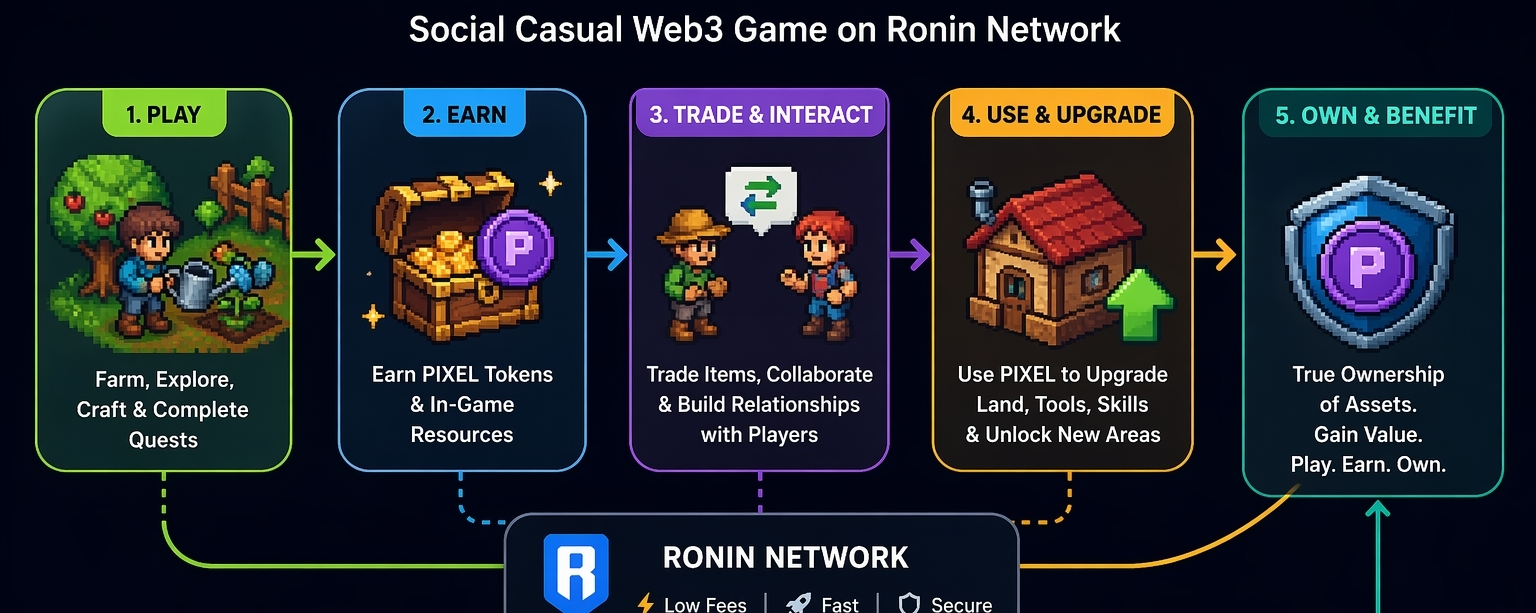

I’ve been thinking about Pixels way more than I probably should, like it’s one of those games that just sticks in your head even when you’re not playing it, and not because it’s flashy or technically insane or anything like that, but because it’s weirdly… simple. Almost suspiciously simple. You log in, you plant stuff, you walk around, you talk to people, and that’s it. That’s the loop. And yet somehow, it keeps pulling people back in, including me, which honestly surprised me because I’ve seen this whole Web3 gaming thing go sideways so many times that I thought I was done with it.
But Pixels isn’t trying to be clever in the way most of these projects are. That’s the first thing that hit me. It’s not screaming “financial opportunity” in your face every five seconds. It’s not trying to turn every mechanic into some kind of yield strategy. It just… exists as a game first. And yeah, I know that sounds like the bare minimum, but in this space, it’s actually rare. Most of the stuff we saw between 2021 and 2023 was basically spreadsheets disguised as games. You’d log in, do repetitive tasks, extract value, and leave. No soul. Just grind.
Pixels feels different. Not perfect. Not even close. But different.
Let’s be honest here, a huge part of why it’s working right now in early 2026 is because it landed on Ronin at the right time. That matters more than people admit. Ronin already has this built-in audience from Axie, but also this weird second chance energy after everything that went down in the past. People want something new there, something that doesn’t feel like a rerun of the same play-to-earn cycle that crashed before. Pixels kind of slides into that gap. It’s casual enough that you don’t feel pressure, but there’s still that underlying economy humming in the background.
And yeah, the economy… that’s where things get messy.
Because on one hand, the PIXEL token and the whole resource trading system are what make the game feel alive. You’re not just farming for the sake of farming, you’re farming because someone else actually needs what you’re producing. There’s demand. There’s movement. Prices go up, prices go down, and suddenly your little patch of virtual land starts to feel like it matters in a weird way. You start thinking in terms of efficiency without even realizing it. Like, “okay, if I plant this crop now, I can flip it later when demand spikes.” That mindset creeps in fast.
But then there’s the other side of it, and this is where I get a bit skeptical. Because the moment players start optimizing too hard, the whole vibe shifts. It stops being this chill farming game and starts feeling like a low-key job. You see it in Discord. People min-maxing routes, calculating yields, talking about ROI like they’re running a small business instead of playing a game. And I get it, I really do, because the system kind of invites that behavior. If there’s money on the table, people are going to chase it. That’s just how it works.
Actually, wait… this reminds me of the early Axie days. Not in terms of gameplay, but in terms of psychology. That same moment where something fun starts getting wrapped up in financial expectations. The difference is Pixels is trying to slow that down. It’s not throwing insane rewards at you right away. It’s more gradual, more subtle. But I’m not convinced it can fully escape that cycle if the player base keeps growing and the token keeps getting attention.
And speaking of attention, the hype around Pixels right now is kind of wild if you step back and look at it. Not explosive hype like meme coins or whatever, but this steady, persistent buzz. People keep talking about it. Streamers are picking it up. Not the huge ones, but enough mid-tier creators to keep momentum going. And that’s usually a good sign. It means the game is sticky, not just trending.
I almost forgot to mention the social side, which is honestly one of the strongest parts of the whole thing. It doesn’t force interaction, but it kind of nudges you toward it. You see other players running around, you trade, you chat, you end up recognizing names. It feels closer to old-school MMO energy than most modern games, which is funny because visually it looks like something out of a 16-bit era. That contrast works in its favor. It lowers expectations visually so the interactions stand out more.
But yeah, it’s not all smooth.
There are moments where it feels clunky. Movement isn’t always perfect. Some mechanics feel half-baked. You can tell the game is still figuring itself out. And that’s fine to a point, but there’s always this risk that players run out of patience if updates don’t keep up with expectations. Web3 audiences are weirdly impatient. They’ll hype something up like crazy and then drop it the second it slows down.
And then there’s onboarding. This is still a problem. Even now in 2026, even with better wallets and smoother UX, there’s still friction. You tell a normal gamer, “hey, come play this farming game,” and then you hit them with wallet setup, tokens, maybe a bit of bridging, and suddenly they’re like… yeah, never mind. Pixels tries to hide a lot of that, and to be fair, it does a decent job, but it’s not invisible yet. Not really.
Another thing that keeps bugging me is sustainability. Not in the vague “is this good for the future” way, but in a very practical sense. Where does the value actually come from long term? Right now, it’s a mix of new players coming in, existing players trading, and general interest in the ecosystem. That works while the game is growing. But what happens if growth slows? Do people keep playing purely for fun? Some will. Not everyone.
And that’s the real test, isn’t it? Strip away the earning angle, even just mentally, and ask yourself if the game still holds up. For me, it mostly does, which is why I’m still paying attention. The farming loop is relaxing. The world is simple but not empty. There’s just enough going on to keep you engaged without overwhelming you. It’s not trying to compete with AAA games, and that’s actually a smart move.
But I’m also not naive about it. I’ve seen how quickly sentiment can flip in this space. One bad economic tweak, one security issue, one wave of players cashing out, and suddenly the narrative changes. People go from “this is the future” to “this was obvious all along” in like a week. It’s brutal.
Anyway, I think what fascinates me most about Pixels isn’t just the game itself, but what it represents. It’s like this ongoing experiment in whether you can blend casual gaming with real ownership without breaking the core experience. And honestly, I don’t think anyone has fully cracked that yet. Pixels is closer than most, yeah, but it’s still walking a tightrope.
Some days it feels spot-on. Other days it feels like it could tip either way. And that tension… that’s kind of the whole story right now.
