

 Since @Pixels the straightforward resource sales were completely revamped into a dynamic Task Board mechanism, complemented by a complex skill tree level wall, I no longer view it as a 'decentralized simulation management game.' On the surface, it promotes 'more work, more rewards' and 'freedom to explore,' but when you cross-reference the task refresh weight logic with the total network resource consumption (Sink), you'll realize this isn't a free market at all. Essentially, it’s a micro-economy highly controlled by an 'algorithmic central bank' that continuously extracts player liquidity through the 'Red Queen hypothesis.'
As a data enthusiast who’s used to scraping on-chain interaction data and token circulation rates with Python, I didn't bother analyzing which crop yields the highest profit per plant. Instead, I pulled the order generation probabilities from the task board over the past couple of weeks, looked at the marginal costs of energy conversion for VIP players, and assessed the market depth of core materials like Watermint and Ironite. I ran a stress test model. The cold logic behind these numbers is more chilling than a simple pet blind box.
Dynamic task board: A 'targeted reaper' dressed in random clothing.
Pixels' surface gameplay involves farming, processing, and delivering orders to earn $PIXEL, but the real controller underneath is that seemingly random task board. The officials package it as a tool to prevent scripts and balance the economy, but from a data perspective, it’s an extremely sophisticated liquidity recovery tool.
Let's look at a set of calculated data targeting 'professional gold farmers':
Sunk Cost Trap: Currently, players need to forcefully deliver (or actively cancel waiting for 24 hours) about 12-15 low-tier 'garbage orders' to generate a high-return 'golden order' (for example, an order with a single reward exceeding 5 PIXEL) on the task board. These garbage orders often require submitting a large amount of low-value but extremely energy-consuming materials.
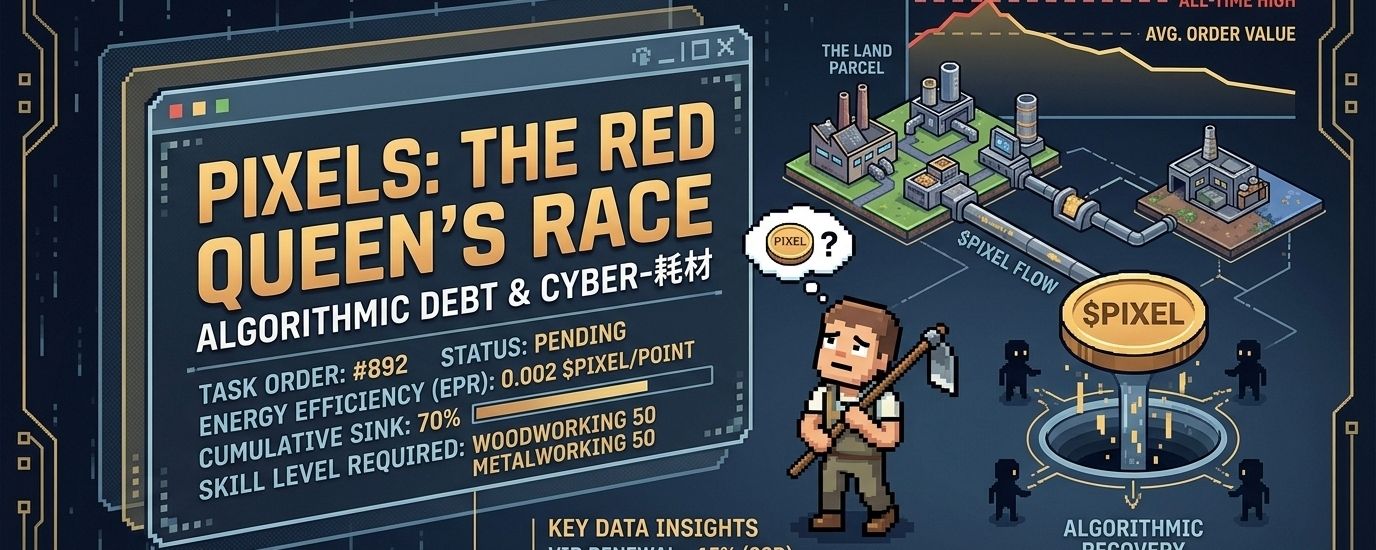
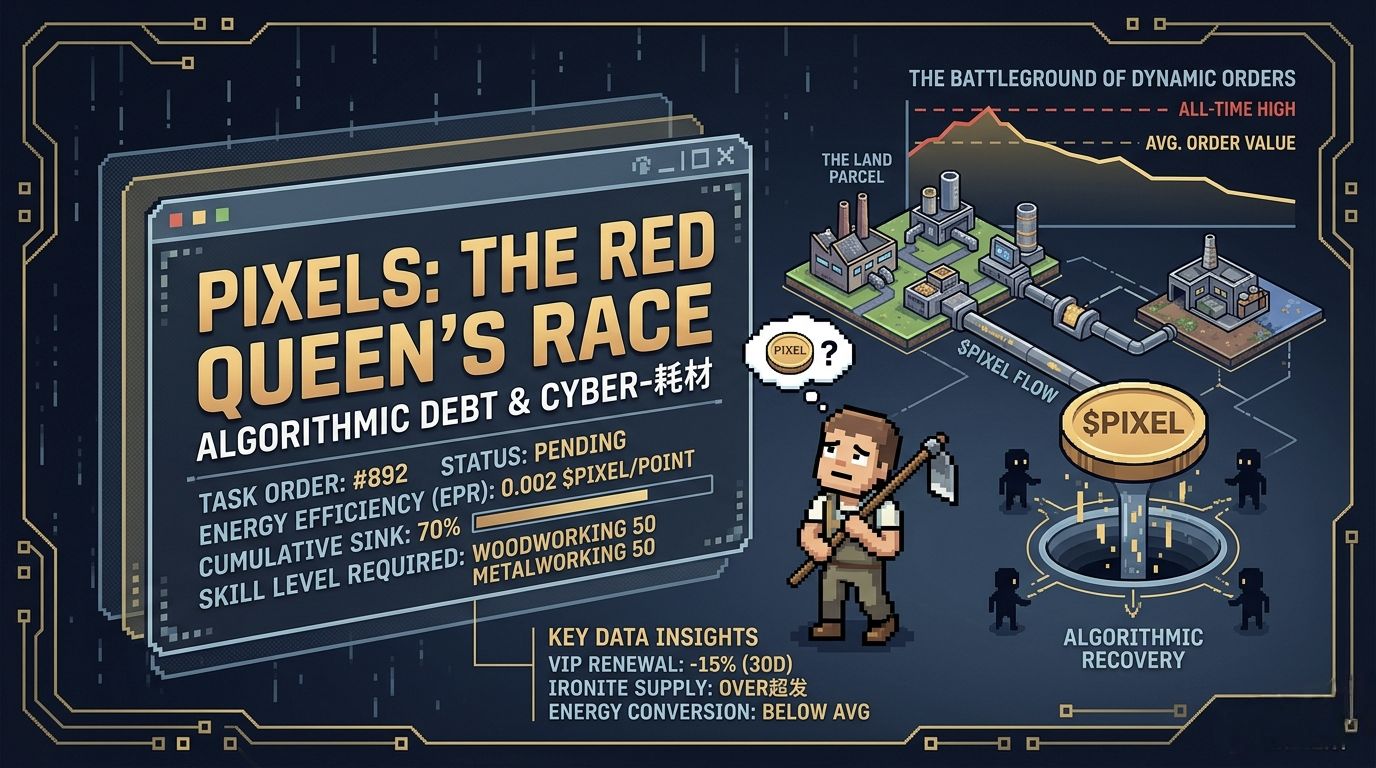
The cliff-like drop in Energy Conversion Rate (EPR): Players must continuously consume energy to maintain the flow of the task board. According to my data slices, the actual conversion rate (EPR) for ordinary players handling front orders has already fallen below 0.002 $PIXEL , with some even 'losing' resources. This means that nearly 70% of the energy you automatically recover each day must be paid as 'toll' to the system to destroy those surplus garbage resources across the network.
The 'liquidity black hole' of the skill tree: Without considering $PIXEL price fluctuations, players strive to unlock high-tier, high-profit orders by improving skills like woodworking and metalworking. However, going from level 30 to level 50 requires raw materials worth nearly 1500-2000 $PIXEL in secondary market value. The marginal benefit of a level 50 order increases by a paltry 15%. This equates to retail players spending heavily to buy a 'high-tier labor license,' with the payback period stretched to over 800 days.
From a traditional macroeconomic perspective, this is akin to a central bank (official project team) excessively printing money while forcing the bottom-tier civilians to destroy surplus resources in the market through extremely costly 'compliance processes' (upgrading skills and clearing low-tier orders). Retail investors think they are accumulating experience points, but in reality, they are just acting as 'biodegradable machines' for official inflation control.
Endless involution: The system's absolute crushing of 'micro-operation arbitrage.'
I've further tracked the trading slippage and order depth of core consumables (like energy drinks and high-tier fruits) in the aggregated market, trying to see the real competitive landscape between players. The 'involution index' revealed by the data is extremely brutal:
Dynamic profit margin suppression: Once the profit margin of a certain resource exceeds the average by 5%, within two hours, the task board algorithm will automatically reduce that resource's $PIXEL reward weight or significantly increase the difficulty of producing front materials. Over 90% of retail players see their labor surplus value exploited cleanly by this millisecond-level adjustment algorithm.
The false 'middle class': Among the seemingly active hundreds of thousands of daily active users across the network, the only ones able to achieve positive cash flow through the task board are the 'landlords' with a large amount of Land resources and those 'cyber foremen' managing energy and materials through extreme organization. Ordinary players (even those who have invested in a single VIP) spend three to four hours each day meticulously calculating, only to find their net profits barely cover their costs for buying high-tier seeds in the secondary market.
In traditional Web2 trading games, ordinary people can complete arbitrage through information gaps and grinding; but in Pixels, the algorithm is an omniscient deity. It not only denies you any arbitrage space but also constantly raises task thresholds (like suddenly introducing extremely difficult specific insects or ores), forcing you to buy the goods dumped by whales in the secondary market. As long as you remain fixated on 'clearing the task board,' your identity in this game will always be that of a 'data consumable' controlled by the system.
The illusion of ecological prosperity's 'pseudo-demand.'
From the perspective of token economics auditing, the most fatal flaw in the current task board system is that the seemingly huge trading volume in-game heavily relies on players' anxiety of 'missing out,' rather than creating genuine play value.
Although countless players are buying, synthesizing, and completing tasks in the market every day, which indeed creates a temporary prosperity in on-chain data, it fundamentally exploits players' 'sunk cost fallacy.' Once these daily players, who clock in like machines, discover that their painstakingly leveled 60 skills have suddenly turned into worthless paper due to a minor algorithm adjustment (like the officials suddenly reducing the refresh rate of certain high-tier skill orders), this pseudo-demand built on 'expected returns' will collapse instantly. Without buyers for core materials needed to level up, Pixels' use cases will be completely hollowed out.
Conclusion: Awaiting the moment to break the 'algorithmic dictatorship.'
My current judgment is: don’t be deceived by the bustling order activity in the Pixels trading hall every day; what truly determines the lifespan of its economic model is the system's limit on the 'minimum wage' exploitation of bottom-tier gold farmers, as well as the algorithm's lagging response to inflation control. I'm currently monitoring two core indicators: first, whether the VIP players' renewal retention rate sees a month-on-month crash; second, whether the liquidity of core raw materials in the secondary market starts to dry up (Bid/Ask spread widening).
Likewise, breaking these down is not to completely dismiss Pixels. It dares to embed the most complex 'dynamic supply-demand balance' and 'algorithmic macro-control' directly into the game loop, which is itself a bold economic experiment, also showing us the evolution of Web3 games from 'simple dual-token Ponzi' to 'complex behavioral Ponzi.' But what I look forward to is the day when a player logs in to brew a bottle of wine solely because 'this bottle can trigger a special Easter egg when given to a friend in the virtual tavern,' rather than coldly calculating 'this bottle's task can earn 0.5 more tokens than selling the materials directly.' Only then can we say that chain games have truly escaped the cage of 'algorithmic servitude.'#pixel