
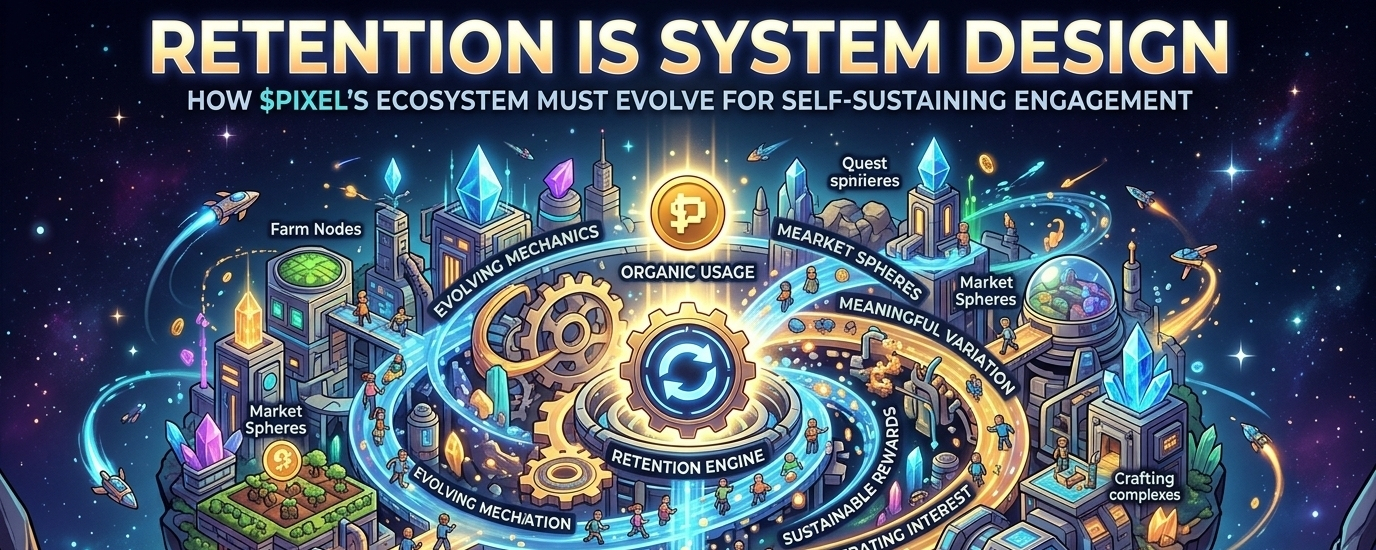
In most Web3 gaming discussions, retention is treated as a user behavior issue. But in reality, retention is often a system design outcome rather than a user decision.
When engagement drops, it’s not always because users lose interest — sometimes it’s because the ecosystem stops offering meaningful variation. Repetitive loops, diminishing rewards, or lack of evolving mechanics can gradually reduce participation without any single visible failure point.
This is why analyzing early performance can be misleading. A system can look healthy during its initial phase simply because novelty is doing most of the work. Over time, however, novelty fades and structural design becomes the dominant factor.
When applying this lens to Pixels, the key focus shifts. Instead of asking whether users are active now, the deeper question becomes whether the ecosystem is built to continuously regenerate interest without external stimulation.
This is where $PIXEL becomes indirectly tied to design quality. If engagement is self-sustaining, token activity reflects organic usage. If not, the system relies on constant external attention to remain relevant.
This distinction matters because it separates temporary ecosystems from self-maintaining ones — and that difference usually only becomes visible after momentum slows down.