
I've seen way too much infrastructure for GameFi, too many 'platforms opening up for devs', too many promises that this time will be different, and then the familiar cycle returns: games can’t retain players, tokens can’t hold their value, and the systems are just... sitting there, looking pretty on paper.
What keeps me coming back to think isn't the tech but the behavior. GameFi, at least from my perspective, has never lacked tools; it's just missing something much simpler—a space where players stick around long enough for everything else to matter.
This problem isn't new, but it's persistent.
Previous GameFi systems often started with tokens; they designed rewards first and then thought about gameplay, optimizing cash flow before considering user experience. The result is a pretty predictable loop: players come for the profits, not for the game, and when profits drop, they leave faster than they arrived. Too many systems repeat this.
Too many games 'that can earn money' but have no reason to play if you take the money aspect out, and when each game is a separate silo, everything gets worse. Players can’t carry anything over, studios can’t leverage anything. Liquidity, attention, and even community... are all fragmented, and each project has to 'burn' it all again from scratch. More marketing, more incentives, another old loop, and that’s the part I always come back to.
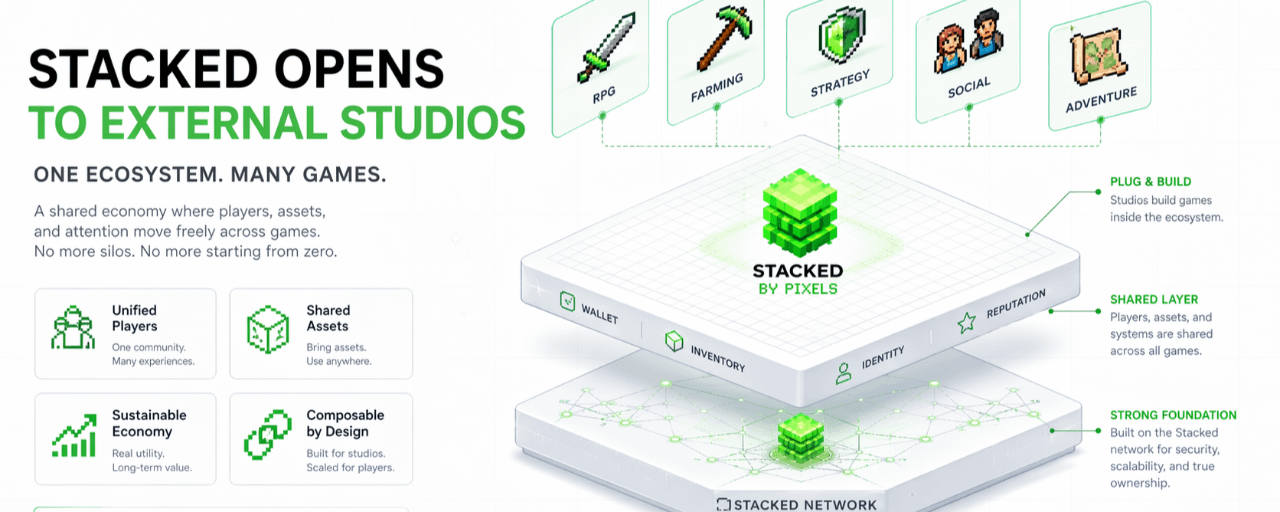
Stacked, in the way Pixels is opening up for outside studios, seems to be trying to hit the right point here. Not by making another game but by creating a layer underneath where other games can plug in.
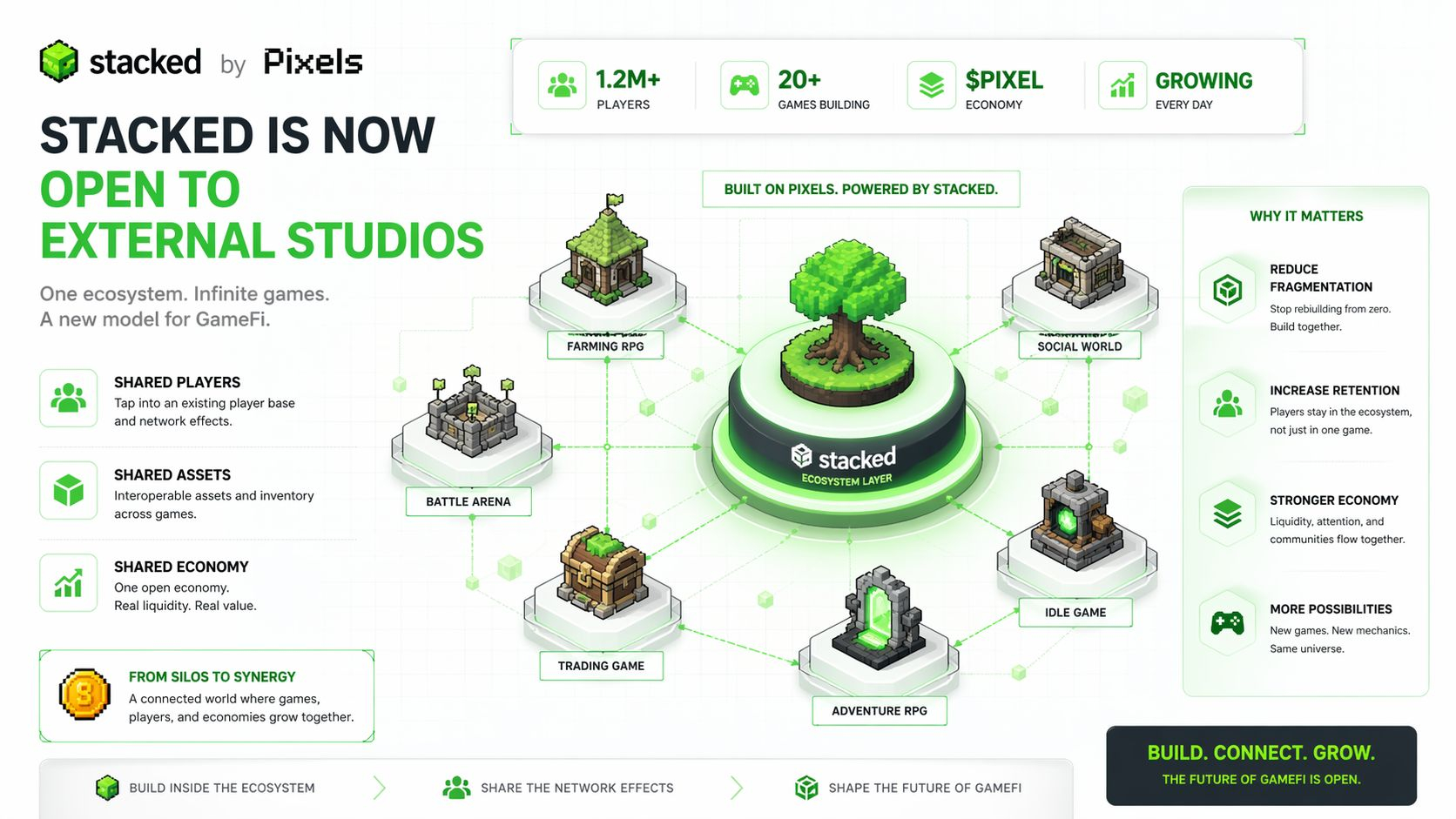
Sounds familiar, very familiar, but it seems they’re not going for a purely technical infrastructure approach. Not the kind of heavy SDK or a toolset that devs have to learn all over again, but rather they seem to be trying to turn the Pixels ecosystem itself into an open economy where new games don’t start from scratch.
It's not X, a new chain, a new engine, a new standard, but Y, an environment that already has players, cash flow, and behaviors.
Studios aren’t just 'building games'. They’re building within an existing system; players don’t need to leave to try something new, they move around within the same space. Assets, attention, even habits... can be retained.
At least in theory, this addresses part of the old problem: fragmentation.
But theory is always pretty, reality check is much simpler.
Do players really care, or are they just chasing short-term rewards? Are studios really leveraging this network effect, or are they still having to drag users in like before, and more importantly, does the gameplay keep players engaged, or is it all just an overlay on top of an old incentive system?
It seems Pixels is betting that retention doesn’t come from a single game but from an ecosystem where players have multiple reasons to stick around. This sounds reasonable but is also much harder.
Because now they’re not just building a game, they're trying to build an environment, and environments can't be faked. It has to be sustainable, there must be people sticking around even when rewards drop, there has to be activity not directly tied to tokens, there needs to be things... that are not measurable by dashboards.
I don’t think opening Stacked to outside studios is an immediate game-changer. It feels more like an experiment, a way to see if GameFi can transition from each game being its own standalone to a system where multiple games coexist.
It seems reasonable but also fragile because ultimately everything circles back to an old question: why do players stick around?
It's not about the system, not about the narrative, not about the whitepaper, but because they want to stick around.
This part doesn't have a clear answer yet, and that's why I'm still keeping an eye on it.