
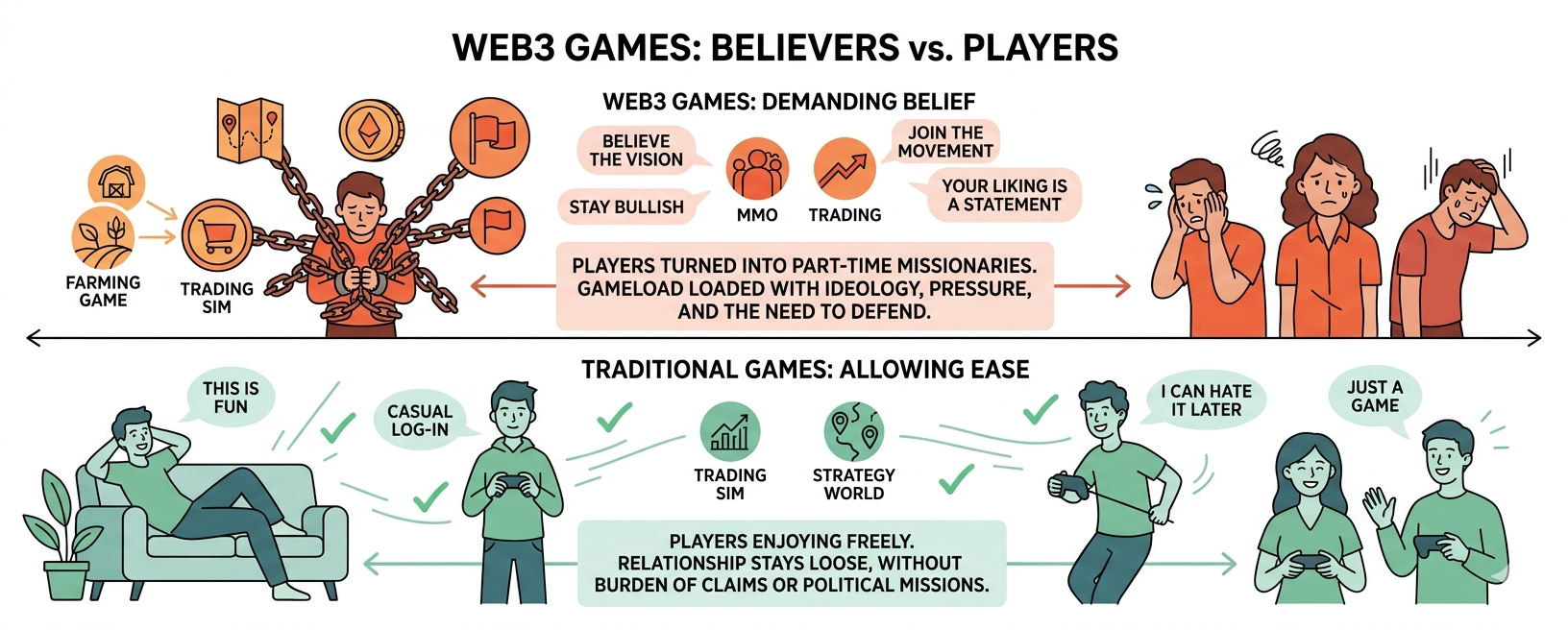
There is a very specific kind of pressure that hangs over a lot of Web3 games, and once you notice it, it is hard to ignore. It is not just asking you to play. It is asking you to believe. Believe in the roadmap. Believe in the token. Believe in the long-term vision. Believe in the community. Believe in the idea that this awkward, half-finished thing in front of you is secretly the early version of something huge, and that your patience is not just patience, it is foresight. That whole vibe wears me out.
Because most people do not open a game looking for a belief system.
They want something they can like without having to defend it. Something that feels solid enough, fun enough, interesting enough, that they do not need to become part-time missionaries just to justify spending time there. A normal game can simply be good. It can be messy and still good. Rough and still good. But a lot of Web3 games feel like they are asking for emotional credit before they have done the work. They want you to commit to the story of what the game might become before the current version has earned the right to just be enjoyed in peace.
That is such a bad instinct.
The minute a game starts needing faith, it is already in trouble. Faith belongs in religion. Maybe in politics if people want to ruin their own week. It should not be the fuel source for a farming game, an MMO, a trading sim, a strategy world, whatever. Games are supposed to make their case through experience. Through the way they feel in your hands. Through the weird pull they create in your brain after an hour or two. Not through this constant soft pressure to stay bullish, stay patient, stay aligned, stay early.
And that is part of why so many Web3 games end up feeling embarrassing to like.
Not because the players are embarrassing. Because the relationship itself gets loaded with too much ideology. The game is never allowed to just sit there and be a thing. There is always a surrounding atmosphere telling you it matters in some bigger way. That it represents a new model. That it is pushing gaming forward. That it is changing incentives. That it is giving power back to players. Even when some of those ideas are interesting, the effect is still exhausting. It turns ordinary enjoyment into a statement. Suddenly liking a game becomes tied up with endorsing a whole pile of claims.
A lot of people do not want that burden. Fair enough.
They want the freedom to say yeah, this is fun, without sounding like they are joining a movement. They want to play something without inheriting a speech. That is one reason traditional games still have such a massive advantage. You can like them casually. You can hate parts of them casually. You can log in, log out, shrug, complain, get obsessed, get bored, whatever. The relationship stays loose. In Web3, the culture around these games too often tries to tighten everything. Your attention becomes symbolic. Your presence becomes a signal. Your criticism becomes dangerous. Your enthusiasm becomes labor.
That is where things get weird.
Because once a game starts turning players into believers, it becomes much harder for the game to feel comfortable, and comfort matters more than people admit. A player should be able to settle into a world without feeling like somebody is quietly evaluating their conviction. A game should not feel like a loyalty test. It should feel like somewhere you can mess around, get attached, leave for a while, come back, and not have to explain yourself. Belief-heavy environments make all of that harder. The atmosphere gets tense. Too many people start talking like they are protecting an idea instead of enjoying a thing.
You can see it in the way some communities react to totally normal criticism. Not even mean criticism. Just normal stuff. This system feels shallow. That update was weak. The grind is annoying. The economy seems off. In a healthy game culture, those are just opinions. Maybe people argue, maybe they do not, but the world keeps turning. In a belief-heavy Web3 culture, those same complaints can get treated like cracks in morale. Like the person speaking is not just criticizing a feature, but undermining the mission. That is such a bad sign. It means the game has stopped trusting itself to survive ordinary disappointment.
And honestly, a game that needs protection from ordinary disappointment probably has bigger issues than its fans want to admit.
The sad thing is there may be genuinely good ideas buried inside some of these projects. Real design ambition. Real effort. Real creativity. But all of that gets smothered by the way the space frames itself. Instead of saying here is a game, try it, see if it works for you, it says here is the future, join us early, understand the thesis, trust the long game. That framing changes how people experience the thing before they even touch it. It makes the whole relationship heavier than it needs to be.
And heavy is bad for games. Really bad.
Games need room for lightness. Room for unserious attachment. Room for liking something in a way that is playful, not ideological. Once every interaction starts carrying symbolic weight, the texture changes. The fun gets self-conscious. People stop sounding like players and start sounding like reps. Even the praise gets flatter. Less about what felt good and more about what the project represents. That is how you end up with communities full of people who are technically enthusiastic but somehow do not sound like they are having much fun.
That should worry more people than it does.
Because a game that feels embarrassing to like has a ceiling. Even if the systems improve, even if the economy stabilizes, even if the chain gets smoother and the onboarding gets easier, there is still that social feeling hanging over it. That feeling that to like this thing openly, you have to absorb too much extra baggage. Too much context. Too much belief. Too much defense. Normal players do not want that. They want to like things cleanly.
And maybe that is the real shift Web3 gaming still has not made. It keeps trying to build conviction when it should be building ease. It keeps trying to create believers when it should be creating players. It keeps asking for loyalty too early, too loudly, too often. The better path is probably much simpler and much less flattering to the industry’s ego. Make something people can enjoy without needing to become weird about it. Make something that does not require a personal thesis. Make something that can survive being treated casually before it asks to be treated seriously.
That would be progress.
Because the strongest games do not need belief to hold them up. They do not need players to carry the meaning on their backs. They feel solid enough to be liked without ceremony. You can just show up, get pulled in, and let the thing speak for itself. No mission. No faith. No constant reminder that you are supposedly early to some grand transformation.
Just a game. Which, in this space, would already be a pretty big achievement.
