

I didn’t think Ronin had anything to do with rewards at first.
It felt like background. Just the chain Pixels happens to be on.
That stopped making sense when I noticed something simple: players weren’t just completing missions and stopping. They were moving value out, swapping, coming back in, and repeating it without friction. Not perfectly, but smoothly enough that the loop didn’t break.
That’s where the connection clicked for me.
Because reward systems don’t fail only because of bad design. They fail when value can’t move the way the system expects it to. Either it gets stuck, or it leaves too fast, or it leaks into places the system can’t see.
And that part isn’t solved inside the game.
That’s where Ronin enters the picture.
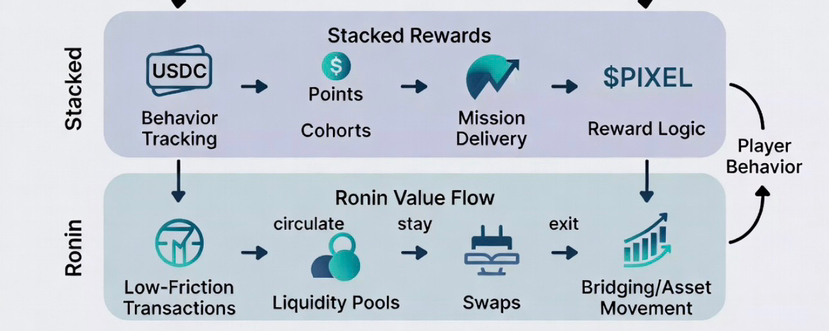
If Stacked is the layer deciding which behavior deserves to be rewarded, then Ronin is what determines what happens to that reward once it exists.
That sounds like a small distinction, but it changes how the entire loop behaves.
Inside Pixels, Stacked is doing something very specific. It’s turning player behavior into structured events, grouping players into cohorts, assigning missions, and attaching different types of rewards depending on what the system is trying to reinforce.
That’s the visible part.
Underneath, there’s a second layer that doesn’t get talked about as much: what those rewards actually do once they leave the mission.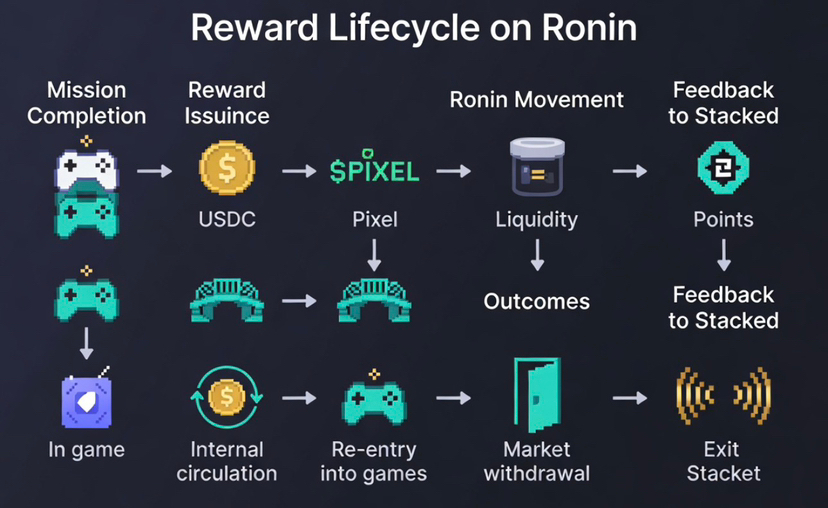
If a player earns something and can’t easily use it, trade it, or re-enter the system with it, the loop ends there. The reward becomes a dead endpoint.
If a player can immediately move that value swap it, spend it, bridge it, bring it back into another game or loop then the reward becomes part of a continuous system instead of a one-time payout.
That’s the difference between a reward and a flow.
Ronin is what makes that flow possible in practice.
Not in a theoretical way, but in a way that doesn’t interrupt the player.
Low friction transactions, assets that are already native to the environment, liquidity that’s accessible without forcing players through complex steps these things don’t show up in mission design directly, but they decide whether mission design actually works.
Because once rewards become liquid, the system has to deal with something harder.
Players are no longer just completing tasks. They’re making decisions.
Do I hold this?
Do I sell it?
Do I use it in another loop?
Do I come back tomorrow because this was worth it?
Stacked can measure behavior, but Ronin shapes the outcome of those decisions.
That’s why Pixels being on Ronin isn’t just context. It’s part of the mechanism.
If you think about what Stacked is trying to do optimise reward spend, reduce waste, identify which incentives actually lead to retention or meaningful activity it only works if the system can observe the full lifecycle of a reward.
Not just distribution, but movement.
Where does the value go after it’s earned? Does it stay inside the ecosystem? Does it exit immediately? Does it circulate between players?
Those signals are only visible if the underlying infrastructure allows them to exist cleanly.
On a fragmented or high-friction chain, that visibility breaks. Players either don’t move value at all, or they move it in ways that are hard to track and connect back to behavior.
On Ronin, that loop is tighter.
Assets move inside the same environment where the behavior happens. That gives Stacked a clearer picture of what rewards actually do after they’re issued.
And once you have that visibility, reward design changes.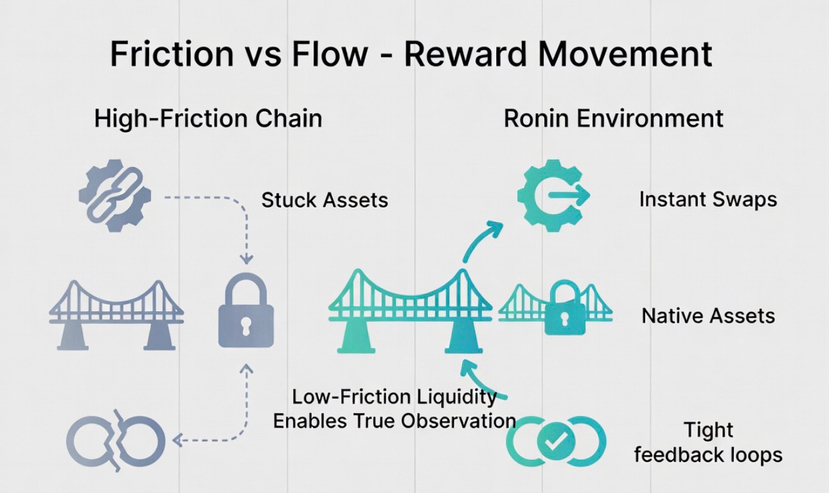
You’re no longer guessing whether a mission worked. You’re seeing whether the value it created stayed, circulated, or disappeared.
That feeds back into how the system allocates rewards next time.
Which is where the “return on reward spend” idea becomes real.
It’s not just about whether players completed a mission. It’s about whether the value spent on that mission produced something that lasts beyond the moment of payout.
Did it keep the player in the loop? Did it push them into another game? Did it create activity that other players interacted with?
If not, then from the system’s perspective, that reward didn’t work.
Stacked adjusts based on that.
Ronin makes that adjustment meaningful because the data behind it isn’t isolated it reflects actual value movement, not just in-game actions.
That’s also why the reward mix matters more in this setup.
When Pixels uses different reward types stable assets like USDC, native tokens like $PIXEL and points it’s not just about variety. It’s about controlling how value behaves once it enters the system.
A stable reward tends to exit faster. It’s closer to cash, so players treat it that way.
A native token might circulate more inside the ecosystem, depending on what it can be used for.
Points are even more contained. They let the system test behavior without immediately creating external pressure.
Now combine that with Ronin’s environment.
Each of those reward types doesn’t just exist they move differently across the same network. That gives the system multiple ways to observe and influence value flow without breaking the player experience.
And that’s where this starts to feel less like a game feature and more like infrastructure.
Because at that point, Pixels isn’t just designing missions or rewards.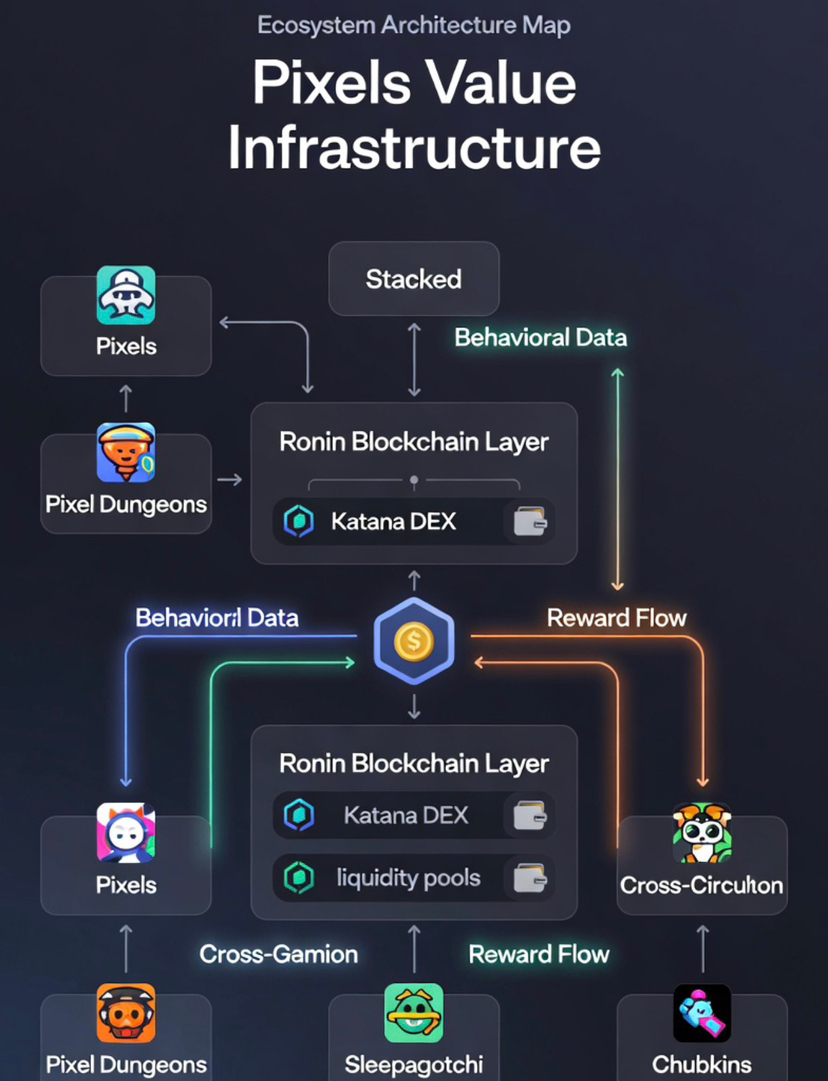
It’s managing a system where behaviour, incentives, and liquidity are all connected and where changes in one layer show up in the others almost immediately.
The slow rollout starts to make more sense from this angle too.
Expanding Stacked across Pixels, Pixel Dungeons, Sleepagotchi, and Chubkins isn’t just about adding more content. It’s about increasing the number of environments where this loop can be observed.
Different games create different behaviors. Different behaviors create different reward patterns. And those patterns feed back into how the system evolves.
But scaling that too fast would blur the signal.
If too many variables change at once, you can’t tell whether a reward worked because of the mission design, the game context, or the way value moved afterward.
By keeping it inside a controlled set of titles on the same chain, Pixels can isolate those effects more clearly.
That’s how you turn a reward system into something that actually learns instead of just reacts.
If I step back, the reason Ronin matters here isn’t because it’s “good for gaming” in a general sense.
It matters because it allows rewards to behave like real assets without breaking the loop they came from.
And once rewards behave like real assets, the system has to take them seriously.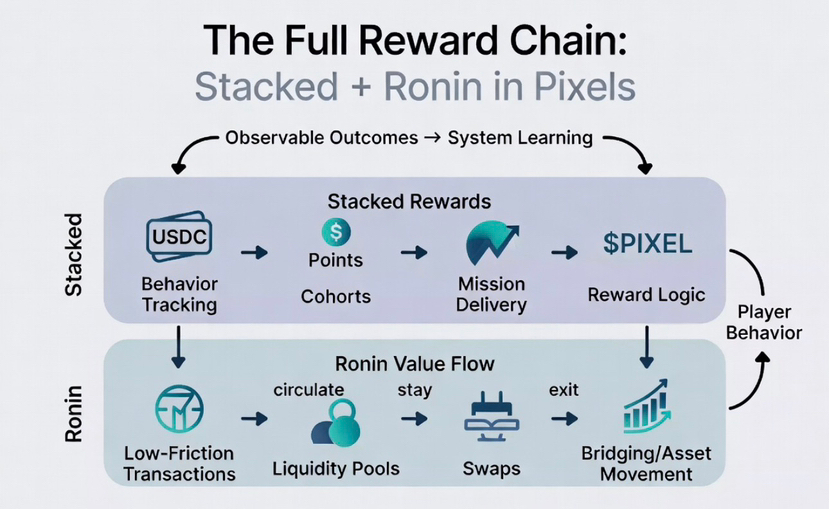
You can’t hide behind inflated engagement numbers or surface-level activity anymore. If players can move value freely, they will expose whether your incentives are actually worth something.
That pressure forces the system to become more precise.
Stacked is Pixels’ way of dealing with that pressure.
Ronin is what makes that pressure real.
So even though the article is about rewards, it’s hard to separate the two.
Because once rewards leave the mission, they stop being game design.
They become economic signals moving through an environment.
And in Pixels, that environment is Ronin.