
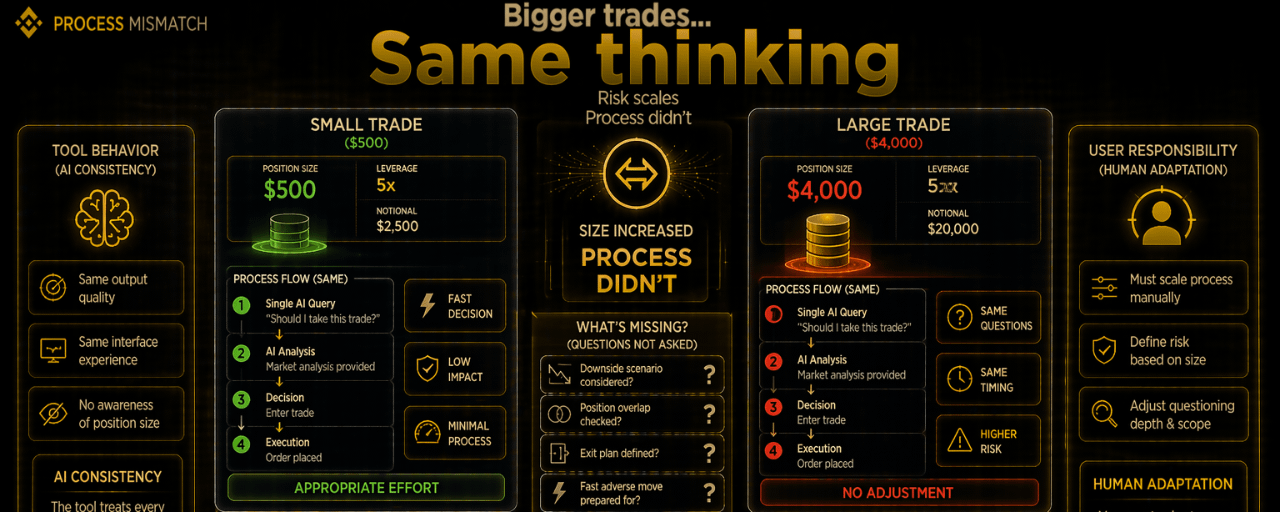
I didn’t catch this right away, which is probably why it matters.
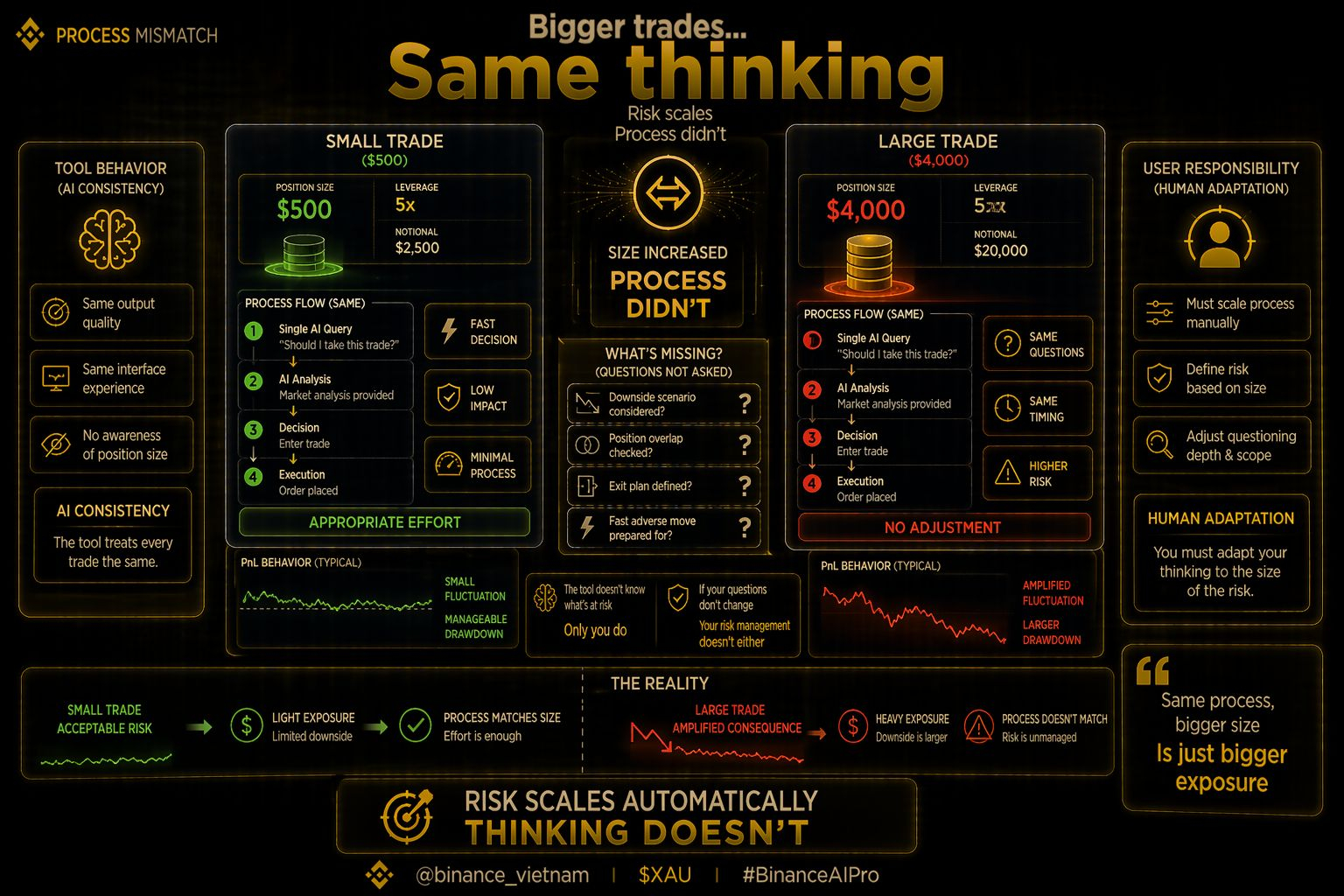
A few days ago I took a small XAU trade, around $500. Nothing serious. I opened AI Pro, asked one question, read through the answer, thought “yeah this makes sense,” and entered. Whole thing took maybe three minutes.
Then, for some reason, I thought back to an older trade. That one was closer to $4,000. And the weird part wasn’t the outcome. It was the process.
It was basically the same.
Same kind of question. Same amount of time. Same feeling before entering, like the answer sounded reasonable enough to act on.
That’s when it started to feel off.
Because the size difference is big. But the thinking behind both trades… wasn’t.
And the more I sat with that, the more it became clear that the issue wasn’t the tool. AI Pro doesn’t know if you’re trading $500 or $10,000. It gives you the same level of output either way. That consistency is actually useful.
But it also means something else.
It won’t slow you down when the stakes get bigger.
So if your process doesn’t change, nothing forces it to.
Looking back at my sessions, I noticed I wasn’t really adjusting how I used it. Bigger trades got maybe one extra question, but nothing that actually reflected the increased risk. I was still asking the same things I always ask. Structure, levels, general context.
All valid, but also… incomplete.
What I wasn’t asking were the questions that only really matter when the size starts to hurt if you’re wrong.
Things like what happens if price moves against me quickly. Not in theory, but in terms of what I’ll actually do in the first hour. Or how this position overlaps with others I might already have. Or whether I’ve already decided where I’m getting out before I even get in.
Those questions didn’t show up in my process.
And that’s the part that doesn’t scale automatically.
I think part of the reason is how smooth everything feels when using AI Pro. Same interface every time. Same flow. You ask, it answers. Nothing in that interaction changes when you go from a small trade to a large one. There’s no friction, no signal that says “hey, this one matters more.”
So you end up carrying the same behavior across different levels of risk without realizing it.
That’s where the mismatch comes from.
Recently I started trying something simple, not even inside the tool, just before opening it.
I label the trade first.
Small, medium, or large.
If it’s small, I don’t overthink it. I run the basic questions and move on. That’s fine.
If it’s medium, I add one extra layer. Usually something about context or correlation, just to make sure I’m not missing something obvious.
But if it’s large, I force a different kind of question.
Not about where price might go, but about what happens if I’m wrong.
That one always feels a bit uncomfortable, which is probably why I avoided it before. But it changes the way the trade feels. It makes the downside more concrete before I commit, instead of after.
And sometimes, just asking it is enough to slow me down.
I’m still figuring this out. It’s not like every large trade suddenly becomes perfect because I asked one more question. But at least now the process reflects the size a bit more honestly.
Because AI Pro doesn’t scale the process for you.
It gives you the same tool every time, no matter what’s at risk.
The difference has to come from how you use it.
And I think that’s the part most people, including me until recently, don’t adjust enough.
@Binance Vietnam #BinanceAIPro $XAU $SPK $CHIP
Trading always carries risk. AI-generated suggestions do not constitute financial advice. Past performance does not reflect future results. Please check product availability in your region.