


I keep coming back to one basic question: after years of world building, what is Pixels actually producing when you strip away the narrative? That is the real test. Not whether the project has lore, not whether it has a community, but whether the infrastructure is creating behavior that lasts when the excitement cools down.
The market is not exactly treating PIXEL like a solved story. CoinGecko shows PIXEL trading around $0.007436, with about $8.34 million in 24-hour volume and a market cap near $5.73 million at the time of reading. That is liquid enough to trade, but still small enough to say the market is pricing this like a fragile game economy rather than a fully validated digital property system.
To its credit, Pixels did not stay stuck in the “future utility” phase forever. The official site frames the game around ownership, rewards, and a player-built world, and it says players can earn rewards, build their own world, and own what they build. It also claims over 10 million players and says the project is shipping updates every two weeks, which tells you the team still wants to present Pixels as an active, evolving economy rather than a one-time campaign.
That matters, because the project’s strongest argument has always been infrastructure, not hype. The whitepaper says Pixels uses a two-token system, $BERRY and $PIXEL, with each currency serving different purposes. The gameplay docs also say certain resources only exist on specific land types, and that land with better and rarer utility can produce rarer resources. In other words, land is not just cosmetic ownership; it is a production layer.
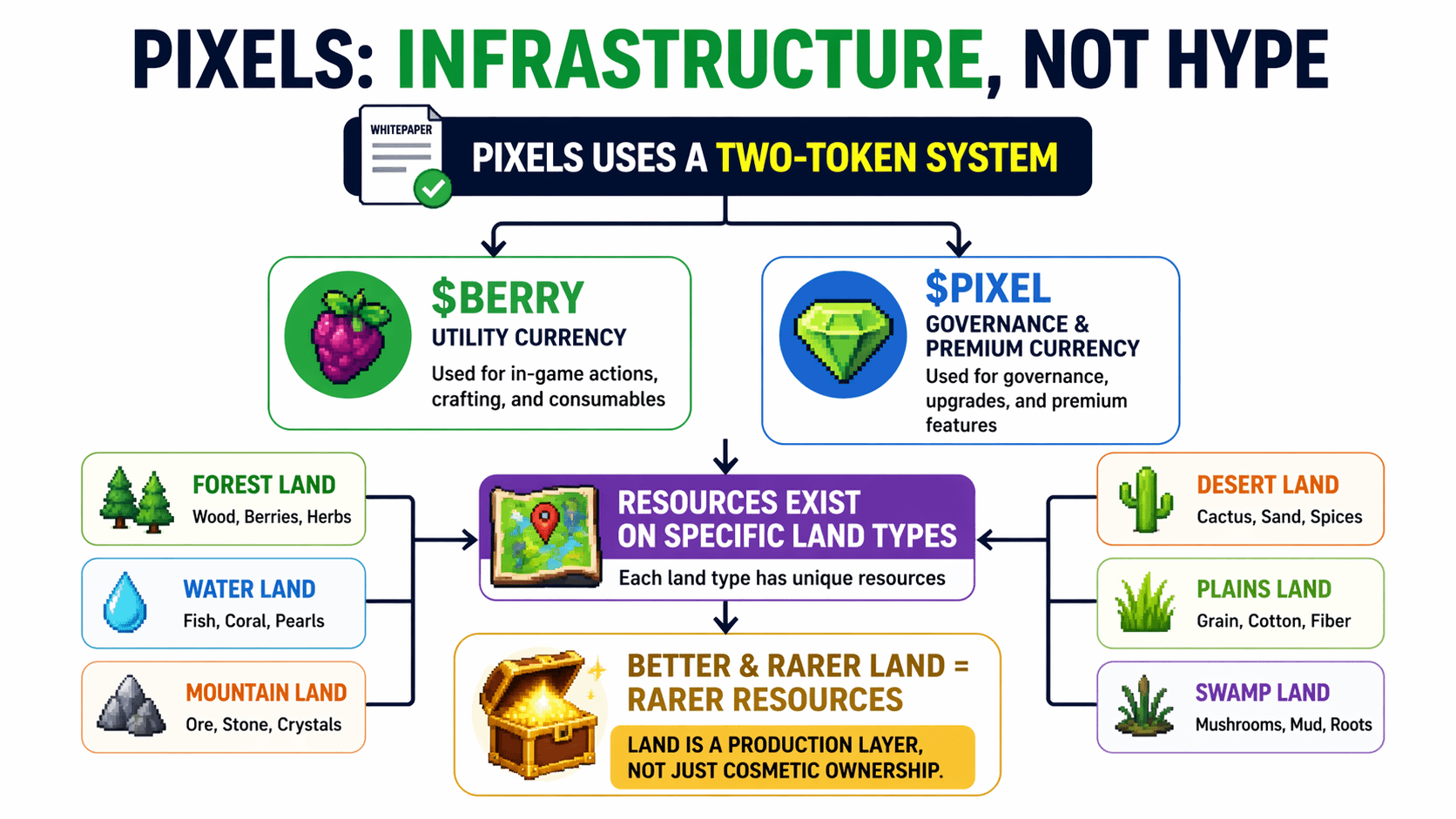
So yes, the upgrade path looks real. The game gives you a ladder: basic access, better access, then owned land with more control over what you can produce. That is a meaningful design choice. It creates scarcity, specialization, and a reason to care about where you build. But a ladder is not the same thing as a durable economy. It only matters if players keep climbing it.
That is where the gap starts to show. The official token page is old; it was last updated three years ago, which is not ideal for a live token economy that still trades every day. The same page says PIXEL has been designed as part of a two-token system, but it does not read like a living economic manual for a market that is still trying to decide what the asset really is. Stale docs do not kill a project, but they do make the story harder to trust.
CoinGecko’s current description is useful here because it shows how the market still frames PIXEL: as the native utility and governance token, used for things like creating and joining guilds, minting pets, and unlocking VIP-style perks. That is real utility, but it is still mostly a convenience-and-access token, not a token whose demand is obviously anchored to deep, unavoidable economic necessity. That distinction matters more than people admit.
And that is the central tension. If PIXEL is mostly a premium layer, then demand depends on players continuing to care about the world itself. If the world is active, the token has a role. If the world cools off, the token becomes optional. Optional demand is not worthless, but it is fragile. It tends to rise when sentiment is strong and fade when attention shifts elsewhere.
The bull case is still straightforward. Pixels has a functioning world, a recognizable economy, and a land system that is tied to actual resource differences. The official site says what you build can be owned and can earn rewards, while the docs show land can influence which resources exist and how valuable they are. That is not empty branding; that is a real production stack. If user activity stays healthy, then land can act like the workshop and PIXEL can act like the grease that makes the workshop run faster.
The bear case is just as simple. A game economy can look sophisticated and still rely too heavily on continued player enthusiasm. The more the system depends on repeated engagement, the more it has to prove that people are staying for the experience and not just the incentives. If users churn, then even good infrastructure starts to look like expensive unused capacity. At that point, the project stops being a story about productivity and starts being a story about retention. That is the real pressure point.
What would change my mind in a stronger direction? I would want to see evidence that the land and token stack are producing repeat behavior without constant hype support. I would want clearer signs that players are spending PIXEL because the system genuinely improves their experience, not because the market or a reward cycle is temporarily pulling them in. I would want the infrastructure to show itself in quiet months, not just in good ones.
So my read is cautious but not dismissive. Pixels has built something real, and the land layer clearly does more than decorate the map. But real infrastructure is judged by what survives when attention rotates away. Right now, PIXEL still trades like a market that wants proof, not poetry. And that is why the project remains worth watching: not because the world was built, but because the world still has to prove it can hold people inside it.