
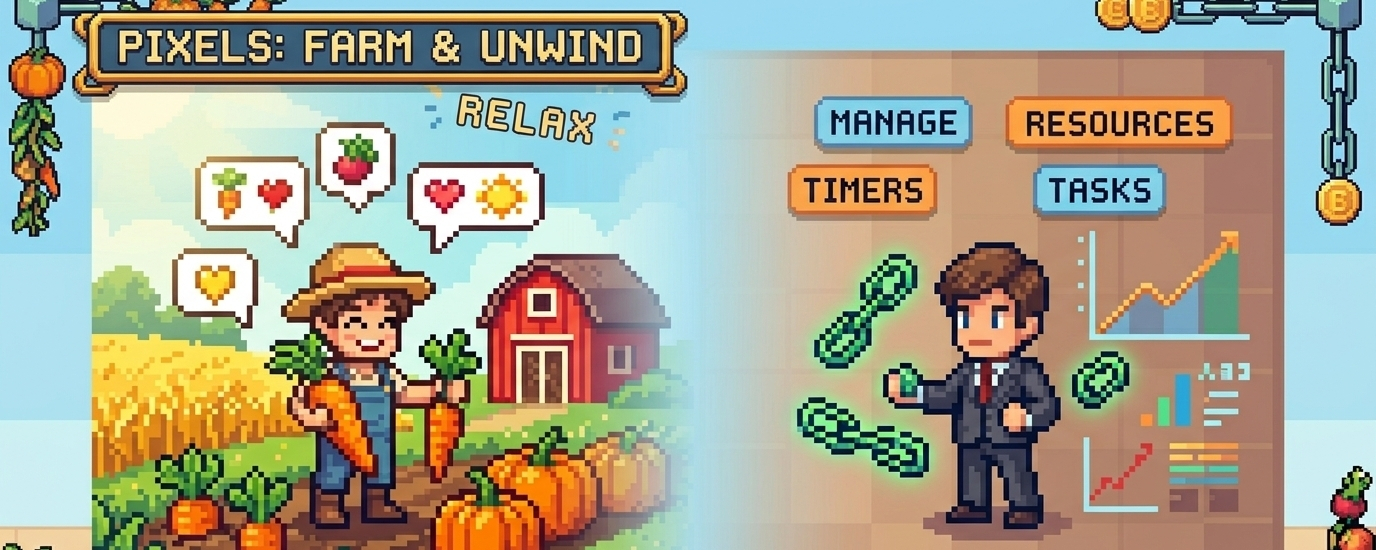
Have you ever logged into a game just to “relax,” and then realized you’re actually managing tasks, timers, and resources like it’s a second job? It’s a strange shift that has happened quietly over the years. Games used to feel like escape. Now, in many online worlds, they often feel like systems you need to keep up with.
For a long time, online games followed a simple idea: developers build the world, and players borrow it for a while. That structure worked, but it had an obvious limitation that players eventually started to feel. People would spend months or even years building progress, collecting items, and shaping their in-game identity, but none of it truly belonged to them. If a server shut down or a policy changed, everything could just disappear. No warning, no ownership, just loss of time and effort.
Before blockchain came into gaming, there were attempts to fix this. Games added marketplaces, trading systems, and cosmetic economies. Players could exchange items, sometimes even for real money through third-party platforms. But the control was always still in the hands of the game companies. They could change rules, restrict trading, or shut systems down whenever they wanted. So even if players felt like they owned something, it was still fragile.
When blockchain games first appeared, they tried to solve this by giving real ownership of digital items. On paper, it sounded like a big shift. Players could finally hold assets outside the game itself. But in practice, many early projects went in a direction that felt more like finance than play. The games started to revolve around earning, trading, and speculation. For a lot of people, the fun part got lost somewhere in between.
This is where Pixels (PIXEL), built on the Ronin Network, fits into the picture. It presents itself in a much softer way compared to those earlier experiments. Instead of focusing on complicated systems, it uses simple, familiar gameplay like farming, exploring, and building. At first glance, it doesn’t feel like a “crypto game” trying to overwhelm you with financial mechanics. It feels closer to older casual games where you just log in, do a few tasks, and slowly grow your world.
But underneath that simple surface, there is still a blockchain layer handling ownership and in-game assets. The idea seems to be that players don’t need to constantly think about it. You just play, and the system quietly records ownership in the background. The Ronin Network helps with this by making transactions faster and cheaper, so the experience doesn’t feel too technical or slow.
Still, this design raises some quiet questions. When ownership is hidden in the background, how many players actually understand what they are holding or how it works? If something has value outside the game, but the game itself doesn’t make that very visible, does the player really feel that ownership in a meaningful way?
There is also the nature of farming-style gameplay itself. It’s calm, repetitive, and easy to get into—but it can also start to feel like routine. Planting, waiting, collecting, repeating. In a normal game, that loop is just part of relaxation. But when digital assets are tied into it, the feeling can shift a bit. Some players might enjoy it as a casual experience, while others might start treating it more like a task with outcomes that matter beyond the game.
Pixels tries to sit in the middle of all this. It doesn’t fully turn into a financial system, but it also doesn’t remove ownership mechanics. It’s trying to keep things light while still offering something new compared to traditional games. Whether that balance works depends a lot on the player’s expectations. Someone looking for pure entertainment might experience it one way, while someone focused on digital ownership might see it completely differently.
There is also an uneven experience hidden inside these kinds of systems. People who understand the ecosystem deeply often interact with the game in a very different way than casual players. So even though everyone is technically playing the same game, the way they experience it can be quite different.
In the end, Pixels is not really trying to answer all the problems of Web3 gaming. It feels more like an experiment in making blockchain less visible inside gameplay, rather than putting it at the center. That alone makes it interesting, even if it doesn’t solve everything.
But it also leaves us with a simple thought that keeps coming back: if games start blending ownership, economy, and repetition into everyday play, are we still clearly separating entertainment from work—or are we slowly getting used to not noticing the difference anymore?