
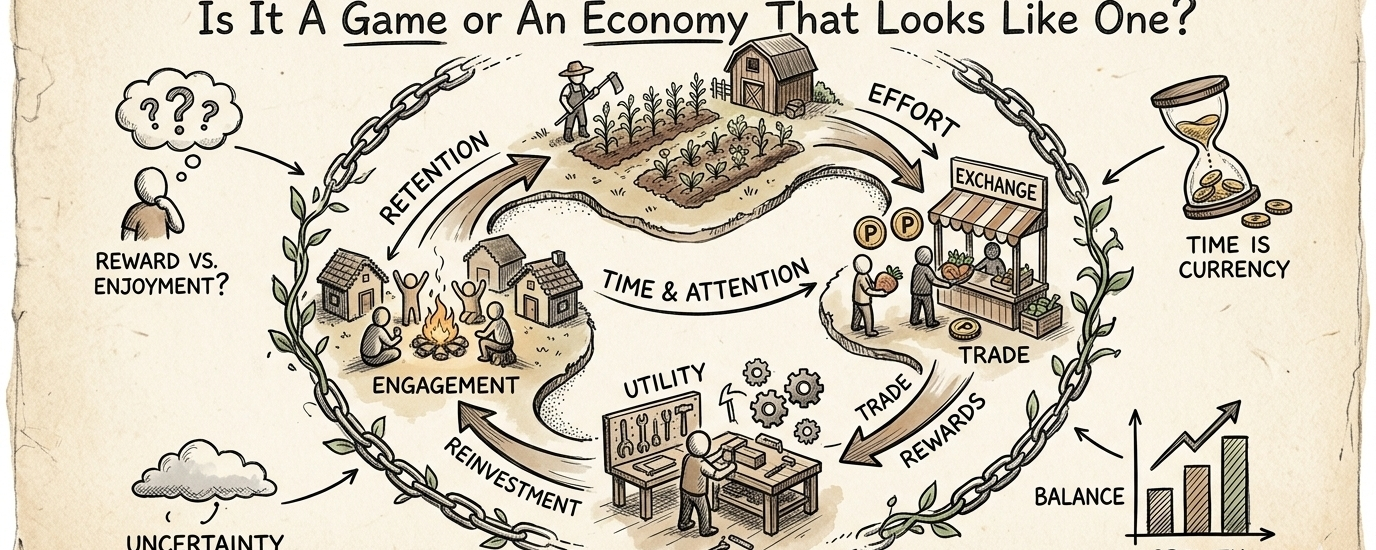
The first time I looked at Pixels, I did not immediately see something revolutionary. It felt familiar. Another farming game, another token layer, another attempt to turn time spent into value. But the more I sat with it, the more it started to feel less like a game with tokens and more like an economy that happens to look like a game.
At its core, Pixels is simple to explain. You farm, gather resources, complete tasks, and interact with a shared world. In return, you earn rewards that can be tied back to a token. That loop is not new. What matters is how tightly the system connects effort, reward, and progression. A useful way to think about it is like a small town market. Players are not just completing isolated tasks. They are producing, trading, and consuming within a shared environment where their actions affect others.
The mechanism underneath is where things get more interesting. Time and attention are the primary inputs. Players invest hours into repetitive but structured activities. In return, they receive in-game assets and tokens. Those tokens have value because new players enter the system and because existing players continue to engage. The economy depends on circulation rather than just issuance. If players earn but do not spend, the system stalls. If they spend but do not earn enough, they leave.
Pixels seems aware of this balance. There is a deliberate push toward utility rather than pure extraction. Resources are not just farmed and sold. They are used, upgraded, and looped back into gameplay. That creates friction, which is actually a good thing. It slows down the outflow of value and encourages reinvestment. Many projects ignore this and end up as short-lived reward machines.
One thing Pixels does better than most is how it blends progression with participation. It does not rely only on financial incentives to keep people engaged. There is a sense of building something over time, even if it is simple. That matters more than it seems. When players feel like they are growing within a system, they are less likely to treat it as a temporary opportunity.
Still, there is uncertainty here that should not be ignored. The entire model leans heavily on consistent user activity. If attention drops, the economy weakens. This is not unique to Pixels, but it is more visible here because the system is so dependent on daily engagement. A farming loop works when it becomes routine. It breaks when it starts to feel like a chore.
There is also a deeper layer tied to player psychology. Pixels walks a fine line between game and work. If rewards are too strong, players optimize and strip the experience down to efficiency. If rewards are too weak, players lose interest. The tension between enjoyment and productivity is constant. Most players will not say it directly, but they feel it. The moment a game starts to feel like a job, retention becomes fragile.
One insight that stands out is how Pixels quietly shifts the definition of value. It is not just about the token price. It is about how long a player is willing to stay inside the loop. Time becomes the real currency. The token is just a reflection of that time. If the system can hold attention, it can sustain value. If it cannot, no token design will save it.
There are clear strengths. The system is accessible. The economy has some built-in circulation. The progression feels steady rather than forced. But there are also weaknesses. It depends heavily on new and returning players. It risks becoming repetitive. And like many tokenized ecosystems, it is sensitive to external market sentiment even if the core game remains stable.
Pixels is not trying to be overly complex, and that might be its advantage. But simplicity also means less room to hide structural flaws. Over time, the real test will be whether the economy can evolve without losing its balance.
For now, it feels like a system that understands its own constraints but has not fully proven it can operate within them at scale. This could work but depends on execution.