
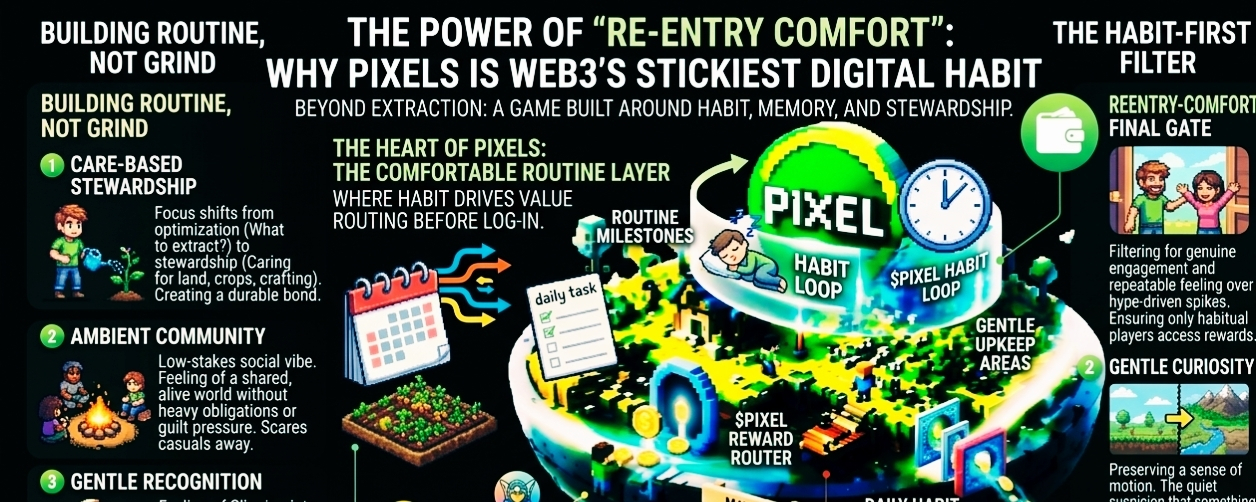
What really gets me about @Pixels is how it quietly exposes a truth most Web3 games desperately try to ignore: getting players through the door is easy. Keeping them coming back—without relying on frantic hype—is the actual challenge.
For years, the crypto space has confused attention with attachment. We’ve all seen projects draw massive crowds with crazy incentives, wild token narratives, and the classic promise that "early adopters win big." That formula generates a ton of noise very quickly. It inflates metrics and makes a game look booming. But honestly? It tells us absolutely nothing about whether players actually want to stick around once the emotional sugar rush wears off.
That’s where $PIXEL sits right in the sweet spot between financial incentive and genuine habit.
At a glance, it’s easy to misunderstand. You might just see another Web3 success story built on rewards and ecosystem expansion on Ronin. But when you look at why casual players keep logging in, the real answer isn't just in the token or the latest updates. It's much more human than that.
People come back for a soft sense of continuity.
Instead of demanding intense energy or deep focus, Pixels just asks you to show up with familiarity. It feels less like a challenge and more like slipping back into a comfortable routine.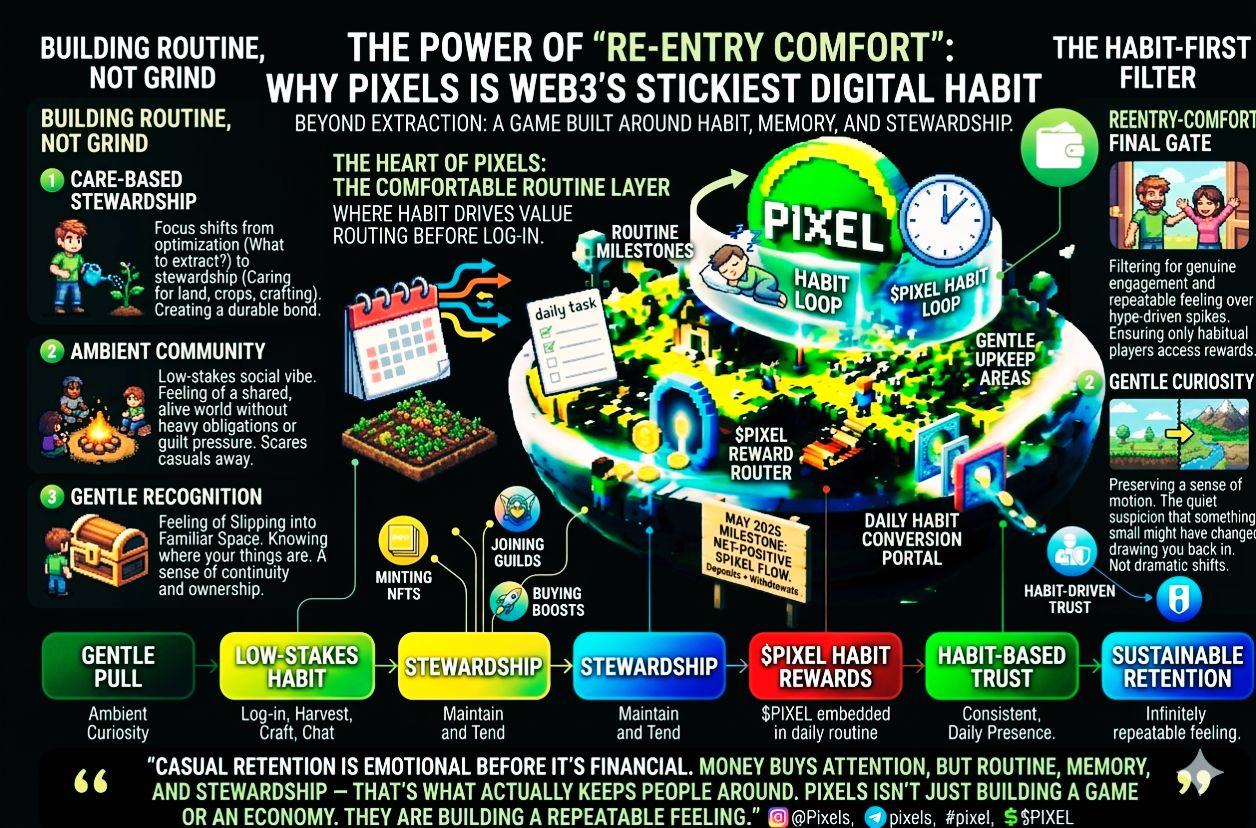
Let's be real—casual players don't want every gaming session to feel like an exam. They want a world that’s easy to drop into, one that doesn't punish them for having a real life outside the screen. Pixels nails this rhythm. You log in, harvest a few things, craft, chat a bit, and log out. The session doesn't have to be epic to be satisfying. In fact, because the loop is so low-stakes and natural, it's incredibly easy to repeat.
It creates what I like to call re-entry comfort. People don’t stick around for adrenaline; they stay for recognition. Once you spend enough time in Pixels, it stops being a spreadsheet of mechanics and just becomes a familiar space. You know where your stuff is. You remember what needs tending to. It’s exactly like going to your favorite neighborhood café—every visit isn't mind-blowing, but it fits perfectly into your daily routine. Friction drops to zero, leaving a mild but durable emotional pull.Here’s where I get a bit personal: I truly believe games built around care outlast games built entirely around extraction.
When you're just grinding to optimize output, your relationship with the game is cold and transactional. But Pixels leans into upkeep—checking on crops, organizing, maintaining land. It shifts the mindset from grinding ("What can I extract?") to stewardship ("What happens to my stuff if I don't show up?").
That subtle shift breeds a quiet, durable bond. Coming back stops being a rational calculation and becomes an emotional habit. The game doesn't need to scream for your attention; it just leaves enough unfinished business in the world that logging back in feels natural.
A lot of Web3 commentators get way too hung up on the $PIXEL token in isolation. Yes, the token matters—it shapes the econo my and behavior. But if a token is just a speculative object, player loyalty is fragile and entirely dependent on price action.
What Pixels does right is embed the token into the daily lived experience of the game. It touches progression, staking, and social layers. You use it, plan around it, and integrate it into your routine. It stops being something you just watch on a chart and becomes something you actually interact with. It doesn't make the economy invincible, but it absolutely makes it more human.
The social layer in Pixels is brilliant precisely because it doesn't feel heavy. A lot of games think "community" means mandatory coordination, heavy guild obligations, and constant pressure. That just scares casuals away. In Pixels, the social vibe is ambient. You know the world is shared and alive, but the emotional tax of hanging out is extremely low. It gently surrounds you rather than trapping you.
Beyond that, the world actually feels alive. Games usually lose players not out of disappointment, but because the world feels frozen. Pixels preserves a sense of motion—whether through new land utility or Ronin ecosystem updates. There’s always a quiet suspicion that something might have changed since you last logged in. That gentle curiosity is a massive retention hack.
Honestly, Pixels gets better the less you treat it as a crypto trade and the more you treat it as a lightweight digital habit.
It’s not flawless. But it understands a secret most of Web3 is entirely blind to: casual retention is emotional before it's financial. Money buys attention. Structure drives behavior. But routine, memory, and the quiet discomfort of leaving something unattended—that’s what actually keeps people around. Pixels isn't just building a game or an economy. They are building a repeatable feeling.
And in the long run, that is infinitely harder to clone than a tokenomics whitepaper.