
There are evenings when I no longer feel like looking at the price board, yet I still open Binance AI Pro because I want to see where this tool is actually leading me inside the trading structure. The more closely I look, the more I feel the question worth paying for is not where the market is about to go, but how many pairs this tool truly reaches and which costs are being hidden inside its sense of convenience.
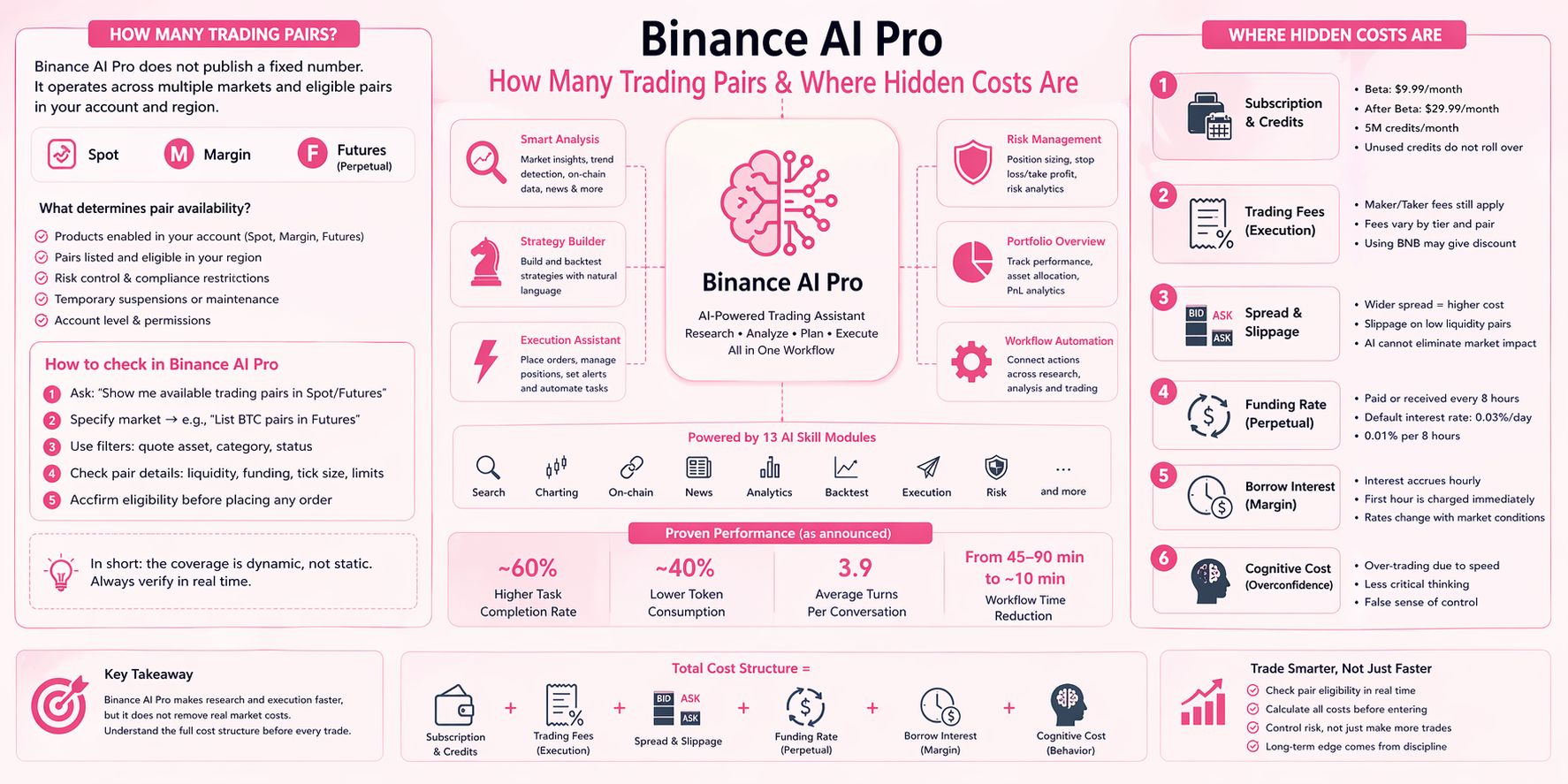
When people ask how many trading pairs Binance AI Pro supports, they usually expect a neat number so they can feel reassured. But what matters here is not a fixed table to count from, but an operating range that moves across Spot, Margin, and Futures on the eligible pairs available in a user’s account and region. Perhaps that is why anyone trying to pin it down to an absolute number often misses the real nature of the issue.
I think Binance AI Pro is worth paying attention to because it does not simply answer questions, it tries to pull many scattered actions into one processing flow. Recent public material said the system uses 13 skill modules, improves task completion by nearly 60 percent, and reduces token consumption by around 40 percent. That does not make it more magical than the market, but it does show that it is attacking exactly the most draining part, which is time, attention span, and user endurance.
But that is also where the hidden cost of Binance AI Pro starts to show itself. Honestly, many people confuse smoother execution with lower cost. The extra algo fee may have been removed on some eligible products, but execution fees are still there, funding is still there, borrowing interest is still there. Ironically, the less friction the interface shows, the easier it becomes for people to forget economic friction, and that is exactly where an account gets worn down most steadily.
The first cost layer in Binance AI Pro does not sit in some secret line of text, but in spread and slippage. A more concise order command does not make liquidity deeper. A clearer suggestion does not make a thin pair less dangerous. When the tool pulls you from observation into action faster, it also pulls you closer to the price of your own impatience, especially at moments when the market moves faster than reason.
The second cost layer in Binance AI Pro comes from holding time. In perpetual contracts, funding is a recurring rhythm of additions and deductions. In leveraged trading, borrowing interest compounds by the hour and eats into capital in a very quiet way. No one would have expected that small repeated charges are what ruin more decisions than major shocks, because people usually remember one hard hit, yet ignore ten small losses that are just mild enough not to trigger alarm.
The point that makes me most cautious with Binance AI Pro is cognitive cost. It makes the whole process look so neat that users can easily mistake smoothness for decision quality. A workflow compressed into a shorter time is clearly progress, but if that saved time is only exchanged for more trades, less self criticism, and a stronger illusion of control, then the most expensive cost is no longer on the fee schedule, but in the habit of using the tool in a distorted way.
After enough years of watching accounts die not from one major mistake but from being slowly worn down by small deductions, I no longer look at Binance AI Pro as a utility for faster hands. I look at it as a mirror that reveals how users face real costs, from subscription, non rolling credits, execution fees, funding, borrowing interest, all the way to slippage and the illusion of control. The remaining question is not whether Binance AI Pro is powerful, but whether users are clear headed enough to recognize whether they are paying for real efficiency or just for the feeling that everything has been arranged neatly.