
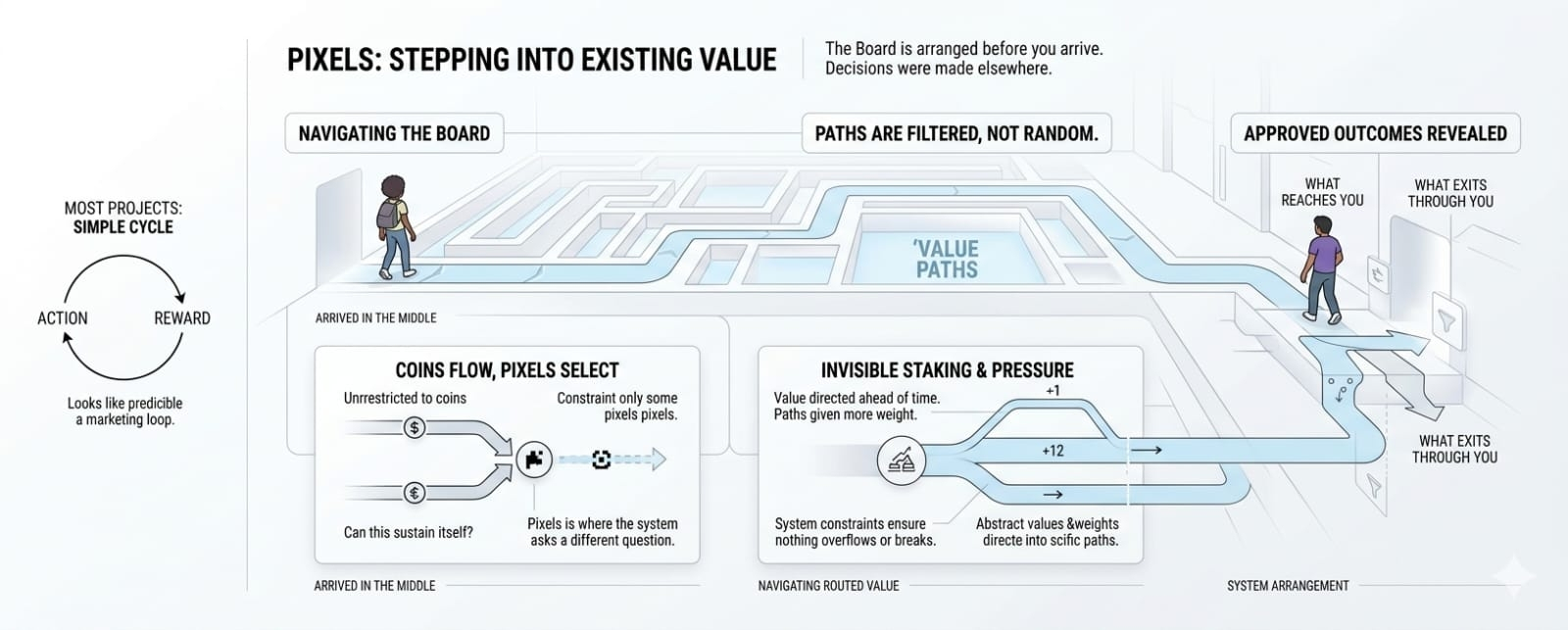
Most projects in this space tend to follow the same script. They present themselves as clean loops where your actions clearly lead to outcomes do something, get rewarded, move forward. It’s simple, almost too simple, and usually a bit overexplained in a way that feels more like marketing than reality. But Pixels doesn’t sit comfortably inside that pattern. The longer you spend in it, the more that familiar structure starts to feel… misaligned.
At first, nothing stands out. You log in, open the board, see tasks, complete them, collect rewards. It all feels normal, expected. But after a while, something subtle begins to shift. The task board doesn’t feel like it’s responding to you. It doesn’t feel like it’s forming in real time based on your actions. Instead, it feels like it’s already there—arranged, shaped, settled before you even arrive.
And that’s where the doubt begins. Because if the board is already structured before you interact with it, then when exactly were those decisions made? Was it when you logged in? Earlier? Somewhere completely outside your awareness? The loop you thought you understood action leading to response starts to lose its clarity. It begins to feel less like cause and effect, and more like alignment. Like the outcomes were already there, and you’re just stepping into them.
You start noticing that not all task paths feel the same. Some feel heavier, almost supported, like there’s something behind them. Others feel thin not empty, but lacking substance, like they exist without the ability to really carry anything forward. That difference doesn’t feel random. It feels intentional, like those paths have already been filtered before they ever reach you.
Coins don’t behave this way. They’re always there, always flowing, always available. They don’t feel restricted or shaped. But Pixels is where that changes. The moment Pixels gets involved, the system starts to feel selective. Not everything survives at that level. It’s as if the system begins asking a different question not “can this be done,” but “can this sustain itself if it is done.”
That’s where things like staking quietly come into the picture. Not in an obvious way, but as something that seems to have already influenced what you’re seeing. It feels like value has been directed somewhere ahead of time, like certain paths were already given more weight before you even opened the board. So when you’re choosing tasks, it doesn’t feel like you’re choosing freely. It feels like you’re stepping into where value has already been placed.
Behind all of that, there’s a kind of pressure you can’t see directly but can definitely feel. Nothing overflows. Nothing breaks. Nothing gives more than it should. Whatever appears on that board already feels like it has passed through some kind of constraint something that ensures it won’t exceed what the system can handle. The board stops feeling like a place where opportunities are created, and starts feeling like a place where approved outcomes are revealed.
Then there’s the layer you only notice after the fact. You complete something, you see the reward, but what actually comes out of it doesn’t always feel identical to what you expected. It’s like there’s another filter sitting at the end, shaping what actually leaves the system through you. What reaches you and what exits through you don’t always feel the same, and that difference lingers in a way that’s hard to ignore.
At some point, effort itself starts to feel different. You’re still doing things, still playing, still making decisions but it doesn’t always feel like those decisions are creating new possibilities. It feels more like you’re moving through a space that was already narrowed before you got there. Some sessions feel full, almost alive, like there’s real backing behind what you’re doing. Others feel thin, like whatever you’re interacting with was never meant to produce anything meaningful in the first place.
And the strange part is, nothing obvious changes on your end. Same time, same actions, same approach different result. So the question shifts. Did you actually do something differently, or did you just end up somewhere else inside the system this time? Did you move, or did the system move around you?
There’s also this quiet realization that not everything you do is meant to turn into value. Some of it might just exist to keep the system running, to maintain activity, to fill space. Not because you failed, but because that path was never designed to carry anything out in the first place. That idea sticks, because it changes how you interpret everything. What you’re seeing isn’t neutral it’s already been filtered.
From the inside, it still feels like you’re earning. You complete something, you receive something, and that connection feels real. But that feeling doesn’t necessarily prove that you created the outcome. It might just mean you were there when it became visible. And that’s a very different kind of role.
So you end up in this strange middle ground. You’re clearly participating, clearly doing something, but it’s hard to say where your influence actually begins. It doesn’t feel like you’re shaping the system from scratch. It feels like you’re navigating through something that was already structured where value has already been routed, constrained, and allowed to exist.
And when you open Pixels again the next day, and the board looks a little different, it’s tempting to call that a new opportunity. But it might not be new at all. It might just be another version of something that was already decided before you got there another arrangement of value that you’re stepping into slightly too late to fully understand where it began.
That’s the part that doesn’t resolve easily. You’re still playing, still choosing, still moving but it never quite feels like you’re at the start of anything.
It feels like you arrived somewhere in the middle.
