
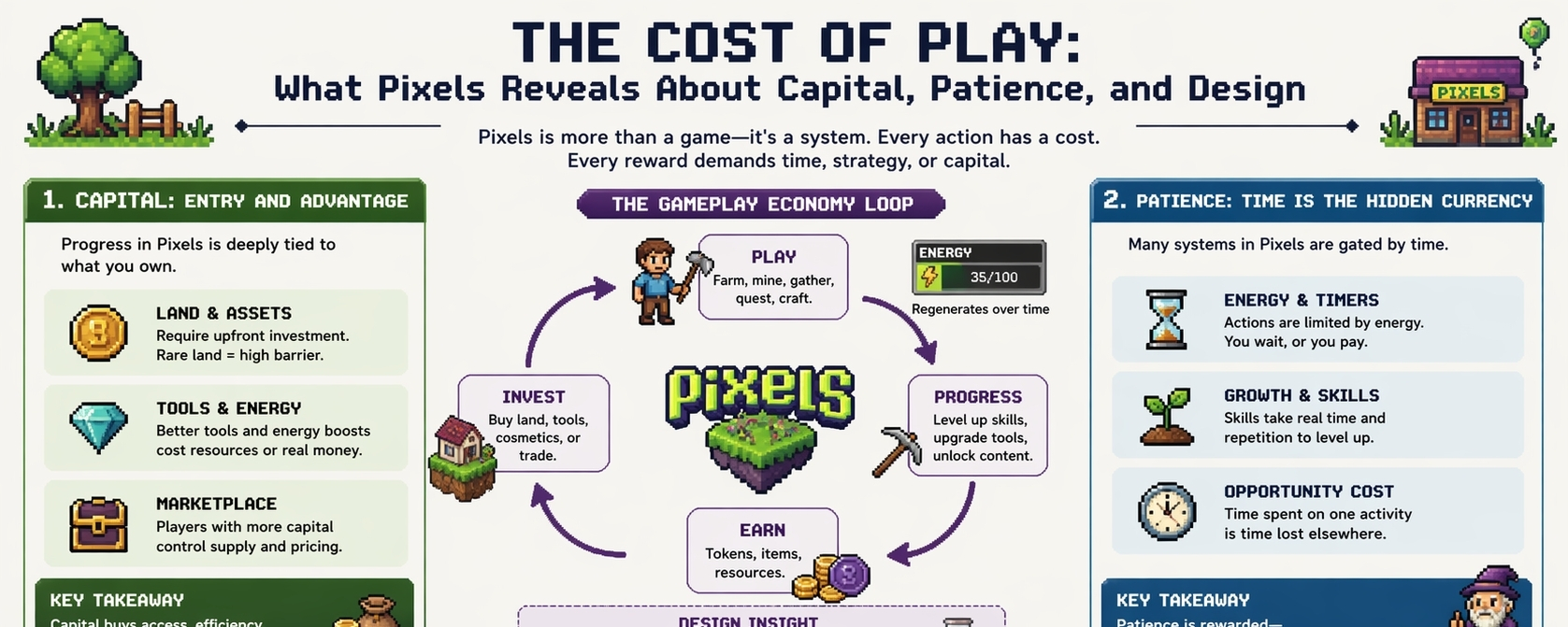
Pixels (PIXEL) doesn’t try to impress at first glance. It moves slowly, almost deliberately, like a system that prefers observation over attention. I’ve spent time watching how value flows through it, not just how players interact with it, and what stands out isn’t the farming or the exploration. It’s the structure beneath those actions the quiet attempt to reshape how time, capital, and incentives meet inside a game.
Most systems in DeFi struggle with the same problem. Capital arrives quickly, but it leaves even faster. Users chase yields, not systems. They enter when numbers look attractive and exit the moment pressure builds. The result is predictable: short bursts of growth followed by long periods of decay. Pixels seems aware of this pattern, and instead of fighting it directly, it tries to slow it down.
I notice how it leans into time as a stabilizer. Progress isn’t instant. Output depends on presence, not just deposits. This changes the relationship between the user and the system. It reduces the dominance of pure capital efficiency, which has quietly broken many protocols. In most DeFi environments, the largest players extract the most value with the least friction. Here, time introduces friction. It forces capital to wait, to participate, to behave differently.
But this approach comes with its own tension. Slower systems test patience, and patience is expensive. Many participants still carry habits from faster markets. They want liquidity, flexibility, quick exits. Pixels doesn’t fully remove that desire, it just makes it harder to act on it. That gap between expectation and design is where stress begins to build.
I think about wasted capital, one of the least discussed issues in this space. In many protocols, capital sits idle between cycles, waiting for the next opportunity. In Pixels, capital isn’t entirely idle, but it’s also not fully optimized. It’s tied to actions that require time and attention. That sounds efficient in theory, but in practice it creates a different kind of inefficiency. If a user steps away, the system doesn’t fully compensate for that absence. This introduces a quiet cost that doesn’t show up in simple metrics.
Then there’s the problem of forced selling, which appears in more subtle ways here. In traditional DeFi, users often sell because of liquidation pressure or yield decay. In Pixels, the pressure is softer but still present. When time investment doesn’t match expected returns, or when external market conditions shift, users begin to question their position. The decision to stay or leave becomes psychological, not just financial. And psychological pressure often leads to poor timing.
What I find interesting is how the system tries to reward consistency instead of aggression. Many protocols unintentionally reward short-term behavior. They create spikes in activity that look like growth but are actually signs of instability. Pixels moves in the opposite direction. It encourages repeated actions, routine engagement, and gradual accumulation. This reduces volatility inside the system, but it doesn’t eliminate risk. It just changes its shape.
Hidden risks still exist, and they tend to grow quietly. One of them is dependency on sustained user attention. A system built around time participation assumes that users will continue to show up. But attention is fragile. It shifts quickly, especially in an environment where new opportunities appear every week. If attention declines, the system doesn’t collapse immediately. It just slows down. And that kind of slowdown can be difficult to detect until it becomes structural.
Governance is another area where I see familiar patterns emerging. Many projects begin with the idea of community control, but over time, decision-making becomes concentrated or disengaged. Pixels hasn’t fully escaped this dynamic. Participation in governance often follows the same pattern as participation in the game itself — a small group remains active while others drift away. This creates a gap between design intentions and actual outcomes.
I’ve also learned to be cautious with growth plans that look clean on paper. Expansion, new features, ecosystem integrations — they all sound logical. But markets don’t reward logic alone. They respond to behavior. If new features don’t align with how users actually act, they don’t create lasting value. Pixels seems aware of this risk, which is why its growth feels measured rather than aggressive. Still, measured growth doesn’t guarantee resilience. It only reduces the chance of sudden failure.
What keeps me interested is the way Pixels treats value as something that should be earned over time, not extracted quickly. This isn’t a new idea, but it’s rarely implemented with consistency. Most systems eventually drift toward short-term incentives because they attract more users. Pixels resists that drift, at least for now. It builds an environment where value moves more slowly, and that changes how users behave within it.
I don’t see it as a perfect system. It still carries the weight of the broader market. Token prices, external sentiment, liquidity conditions — all of these factors influence outcomes in ways the system can’t fully control. But it does attempt something that many others avoid. It tries to align participation with time, not just money.
That alignment creates a different kind of experience. It filters out certain behaviors while encouraging others. It makes speculation less dominant, though not irrelevant. And it introduces a form of discipline that most users aren’t used to.
In the end, what matters isn’t whether Pixels grows quickly or attracts attention in the short term. What matters is whether it can sustain a system where value doesn’t depend entirely on constant inflows of new capital. That’s a difficult problem, and most projects fail to solve it.
Pixels doesn’t claim to have solved it either. It just approaches it from a different angle. It slows things down, adds friction, and shifts focus from immediate returns to gradual progression. That might not appeal to everyone, and it doesn’t need to.
I’ve seen enough cycles to know that systems built on speed often burn out. Systems built on patience tend to last longer, but only if they can maintain engagement without forcing it. Pixels sits somewhere in between, trying to balance these forces without leaning too far in either direction.
That balance is fragile. It always is. But it’s also where the most interesting experiments happen.
And that’s why it matters. Not because it promises growth, but because it questions the assumptions that usually drive it
