
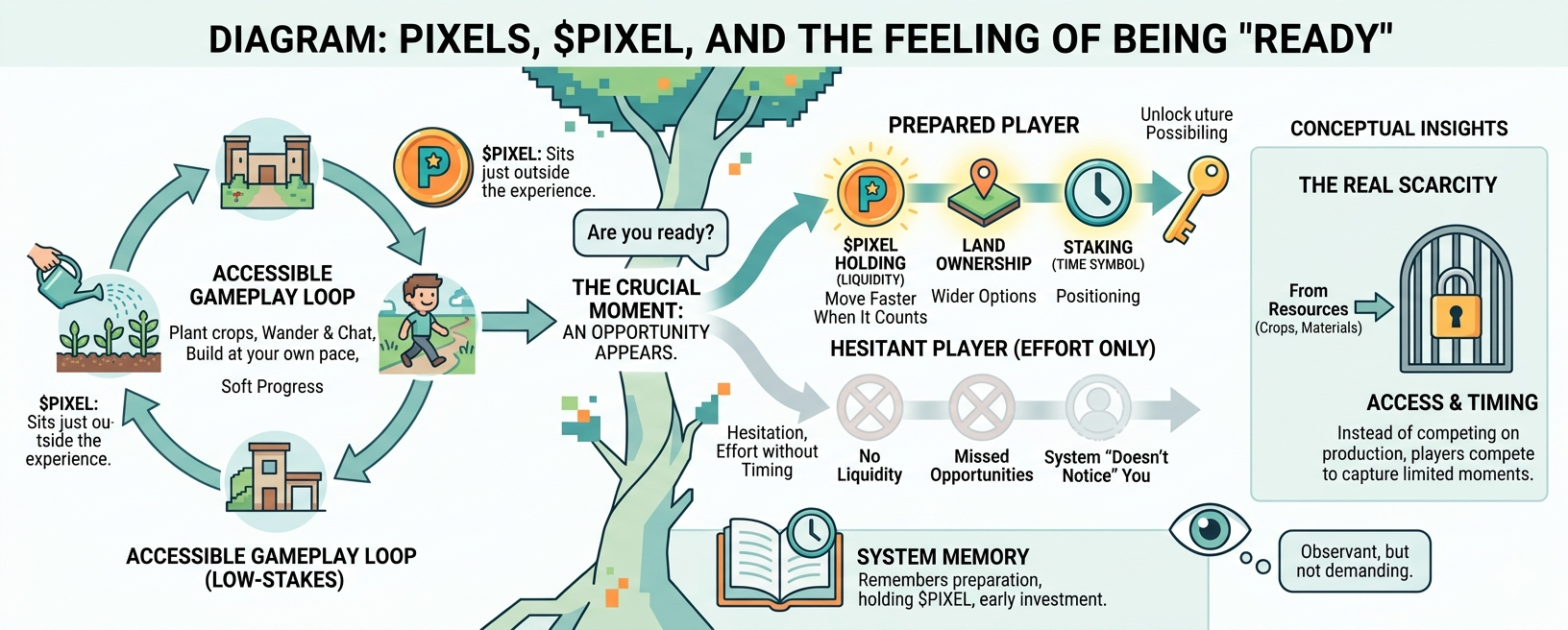

There’s something quietly deceptive about Pixels. On the surface, it feels simple in a good way—plant your crops, wander around, chat with people, build things at your own pace. It doesn’t rush you. It doesn’t constantly ask for money or tokens. You can spend hours just existing in the world without ever thinking about the economy behind it.
And that’s exactly why the economy is interesting.
Because $PIXEL doesn’t sit in the middle of your experience—it sits just outside it.
Most of the time, you’re in a comfortable loop. You’re farming, collecting, crafting—doing things that feel productive but low-stakes. Nothing interrupts you. There’s no constant reminder that this is a Web3 game. Progress feels soft, almost like it’s floating rather than locking into place.
But every now and then, you hit a moment where the game subtly changes its tone.
It might be an upgrade you want, a piece of land you’re thinking about, or a faster way to do something you’ve already been doing for hours. Suddenly, the question isn’t “what have you done?” but “are you ready?”
That’s where $PIXEL comes in.
Not as a reward for what you just did—but as a kind of key for what you could do next.
It’s not about effort—it’s about timing
What stands out over time is that Pixels doesn’t always reward the person who worked the hardest. It tends to favor the person who was prepared when something mattered.
Two players might spend the same amount of time farming. One of them, though, happens to be holding some $PIXEL, or already owns land, or has been staking for a while. When a valuable opportunity shows up—something limited, something that actually changes their position—that player can act immediately.
The other player hesitates. Not because they didn’t put in effort, but because they weren’t positioned for that specific moment.
It’s a small difference, but it adds up.
If you’ve ever watched financial markets, the pattern feels familiar. The people who benefit most aren’t always the ones working hardest—they’re the ones who already have liquidity, who are already in place when something shifts. Pixels doesn’t copy that aggressively, but you can feel a softer version of it forming.
You’re not just playing. You’re slowly learning to stay ready.
Where scarcity really lives
At first, it seems like the game is about resources—crops, materials, land. But over time, those don’t feel like the main constraint.
The real scarcity starts to feel more abstract.
It’s about access. About being present at the right moment with the ability to act. About whether the system “notices” you when something valuable passes through.
Most of what you do in Pixels stays in that easy, flowing loop. But only certain moments get elevated—turned into something more permanent, more meaningful. And those moments are limited.
So instead of competing over who can produce the most, players start (often without realizing it) competing over who can capture those moments.
That’s a different kind of pressure. Quieter, but more persistent.
Fair, but not equal
To its credit, Pixels doesn’t lock people out. You can join, play, and enjoy the game without ever touching $PIXEL. That matters. It keeps the world open and approachable.
But there’s also a gentle layering of advantage.
If you already have $PIXEL, you move faster when it counts.
If you own land, your options widen.
If you’re staking or connected to the right systems, opportunities feel closer, more frequent, easier to act on.
None of this is forced. It’s not aggressive. But it’s there.
And over time, you start to notice that some players don’t just progress—they position. They’re not reacting to the game; they’re slightly ahead of it.
A game that doesn’t rush—but does remember
What makes this system feel different is that it doesn’t constantly demand your attention. It lets you relax. You can ignore the deeper layers for a long time and still feel like you’re playing properly.
But the game, in a way, remembers.
It remembers who prepared. Who held onto $PIXEL. Who invested early. Who stayed active in the right ways.
And when those small, important moments appear, it quietly rewards that memory.
Still unfolding
It’s probably too early to say exactly where this leads.
If $PIXEL continues to sit at the edges—only appearing when something genuinely meaningful is happening—then the balance might hold. The game can stay calm and social on the surface, while still having a deeper economic layer for those who want to engage with it.
But if those “important moments” become too frequent, or too necessary, the feeling could shift. What currently feels like optional readiness might start to feel like constant obligation.
For now, though, the system feels… observant.
It watches what players do. It lets most of it pass. And then, every so often, it offers a moment that asks a simple question:
Were you ready for this?