
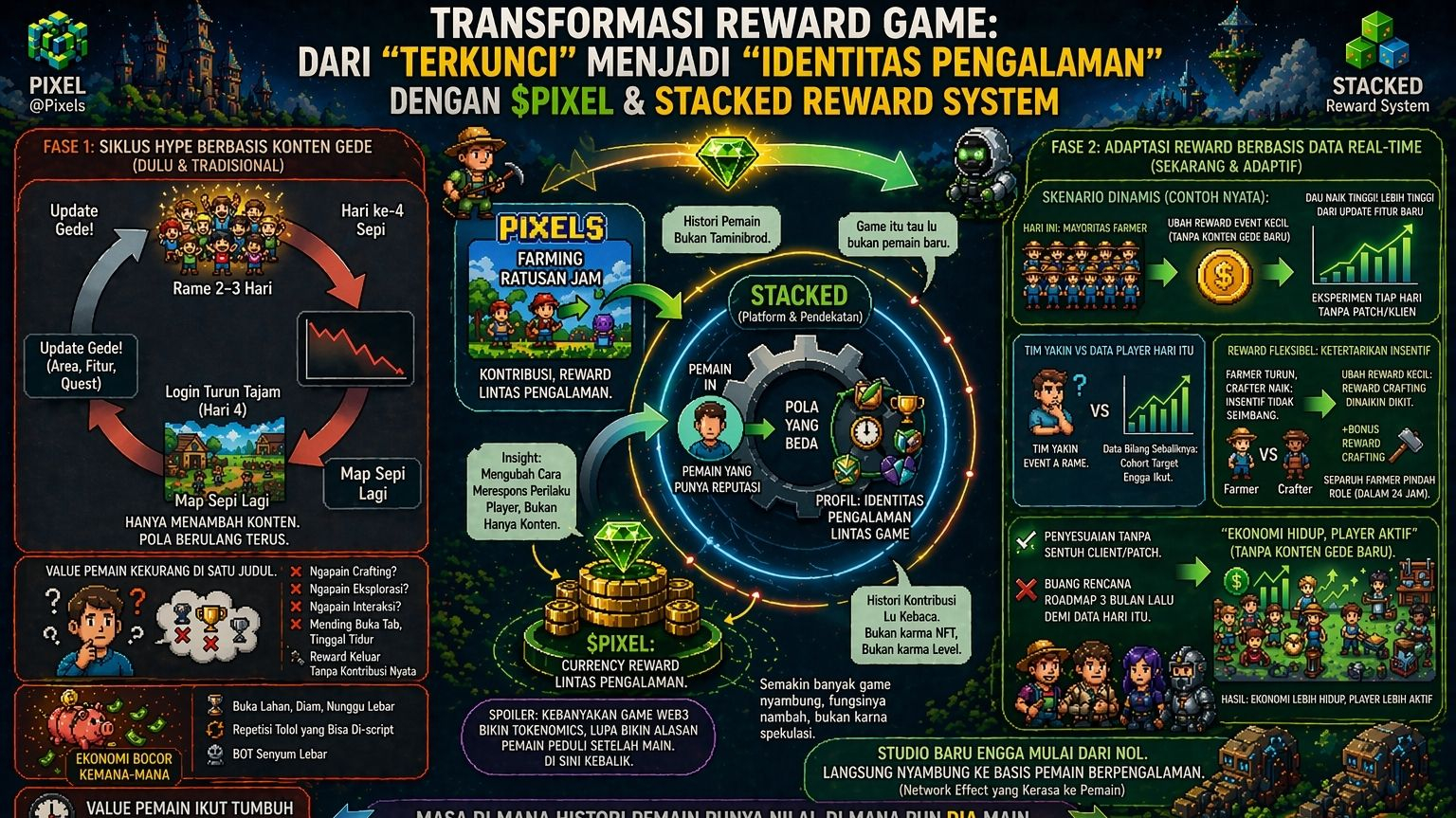
I used to think that rewards in games were the simplest thing: give prizes, players are happy, and that’s it. But in Pixels, that assumption started to crumble slowly.
We spread rewards across various aspects. At first, it seemed successful—day one was bustling, day two still had some activity, but by day three, the map started to quiet down again. At that point, an uncomfortable question arose: are these rewards really making an impact, or just a temporary hype?
That’s when the Stacked approach began to change how we analyze rewards. The focus shifted from 'how much is given' to 'what changes afterward.'
Each campaign now leaves a clear trail. Who received rewards, when they received them, and the reasons for their selection. It's no longer random distribution that makes it hard to track the effects. So if something fails, we can pinpoint the source of the problem rather than just making assumptions.
Then we started to analyze player behavior more deeply. Some would log in just once a day before the reward, but after the reward, they started coming in frequently, even up to three times a day. However, there were also players who showed no change at all. From this, we began to see which rewards truly drove behavior and which ones just passed by without impact.
ROI has also become more decipherable. Some rewards successfully 'activated' one type of player but completely failed with another type. Previously, everything seemed the same because the data was mixed. Now, the differences are crystal clear.
There was a case of crafting rewards. The expectation was clear: to boost crafting activity. But what actually surged was the trading of crafted items, not the crafting process itself. It looked successful on paper, but in terms of design, it strayed from the original goal.
The most crucial change is how we view the cohort. Effective rewards for new players might not be relevant for whales, and vice versa. It used to be a one-size-fits-all approach, but that's no longer feasible.
From that, one thing became clear: rewards are not just tools for generating buzz. If their impact can't be measured, that's not a strategy—it's just a reward distribution.
And in a lively game like Pixels, that could be a costly mistake.
The question remains the same: does this reward actually change something, or does it just create a fleeting buzz?
And at that time... the answer wasn't necessarily there.