
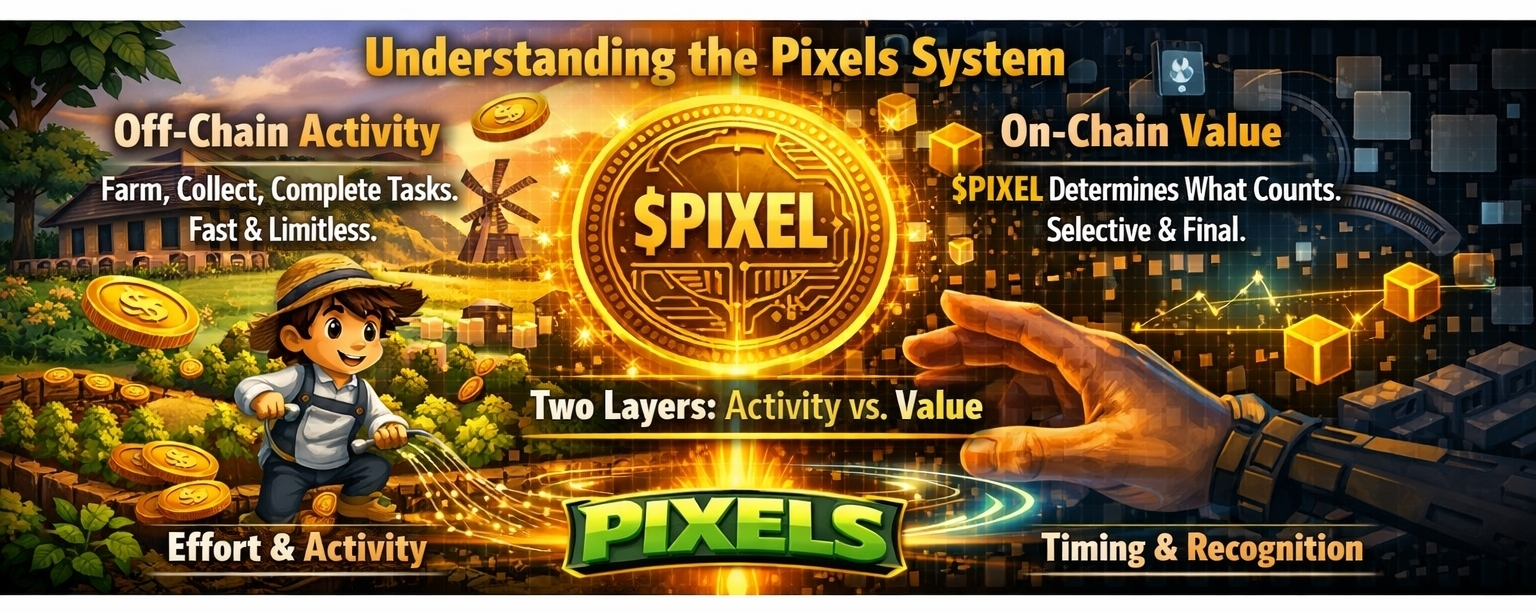
Everything moves smoothly. Tasks refresh quickly, resources cycle endlessly, and the loop feels familiar. You plant, you wait, you collect, and then you do it again. It feels like a contained system where progress is directly tied to effort.
At least, that’s how it appears at the beginning.
But the longer you stay inside Pixels, the harder it becomes to ignore a subtle shift in how things behave. Not broken. Not unfair. Just… slightly disconnected.
Activity is constant.
Coins move endlessly. Tasks regenerate. The system never really slows down. It feels like everything you do is contributing to something.
But then there are moments where that feeling changes.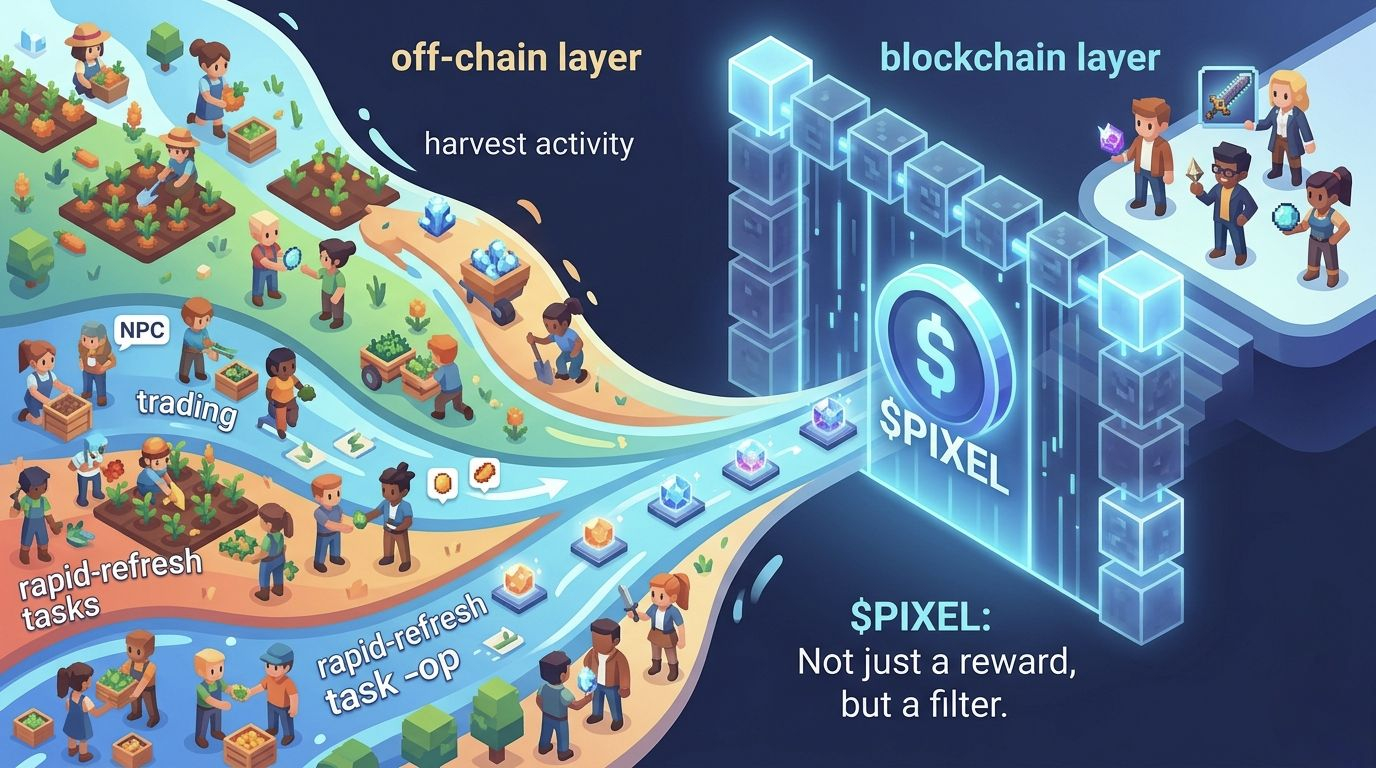
Moments where activity stops being background movement and turns into something that actually matters.
And those moments don’t feel continuous.
They feel selective.
This is where $PIXEL starts behaving differently from everything else in the system.
Most of what happens inside Pixels exists off-chain. It’s fast, fluid, and almost frictionless. You can play for hours without ever needing to think about the token itself.
But the moment something needs to finalize, an upgrade, an asset, a meaningful conversion, the system tightens.
It stops being about activity.
It becomes about access.
If you already have $PIXEL available, you move without hesitation.
If you don’t, the moment passes.
And those moments are where value actually forms.
That’s the part that doesn’t feel obvious at first.
Because the system still looks open. Anyone can play, anyone can participate, anyone can generate activity. And that’s true, but not all activity carries the same weight.
Some actions stay inside the loop.
Others get pulled out of it and turned into something final.
PIXEL seems to sit right at that boundary.
Not as a reward, but as a filter.
It doesn’t decide what you do.
It decides what counts.
And once you start looking at it that way, the structure underneath Pixels begins to feel less like a game loop and more like a layered system.
The off-chain layer generates activity.
The blockchain layer selects which parts of that activity become value.
That separation is what keeps the system scalable, but it also creates a difference between being active and being positioned.
Because over time, players don’t just optimize what they do.
They start optimizing when they can convert.
Less wandering.
More timing.
Less experimentation.
More alignment.
This is where the system becomes harder to read.
From the outside, everything still looks alive. Player counts can grow, activity can increase, and the world can feel full.
But the points where value actually forms remain selective.
Maybe even more selective over time.
And that changes how you think about progress.
Because it’s no longer just about how much you do.
It’s about whether what you do ever reaches the layer where it becomes visible.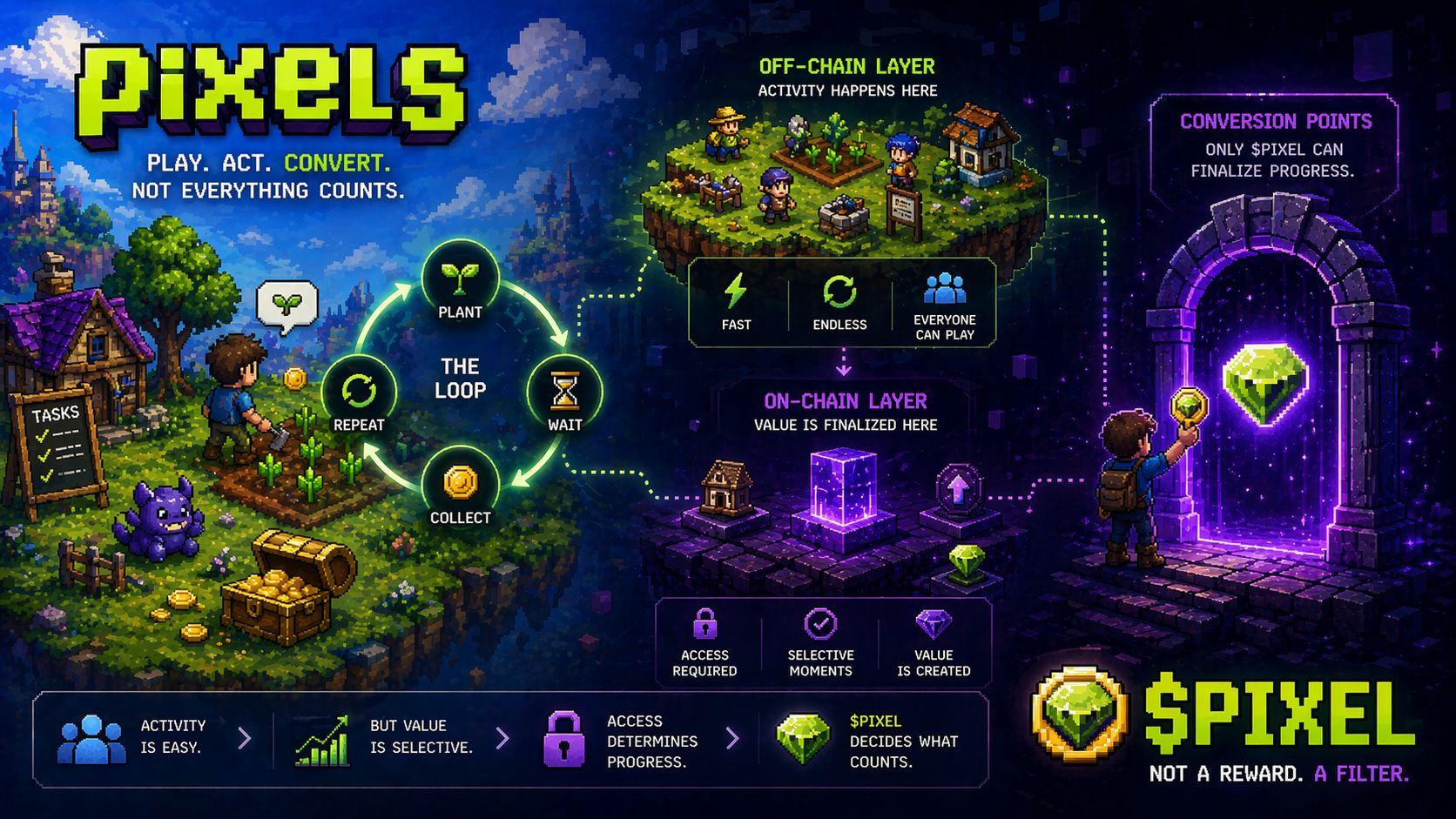
Pixels doesn’t remove effort.
It reframes it.
Not as something that automatically creates value…
but as something that waits to be recognized by the system.
And that recognition doesn’t happen everywhere.
It happens at specific points.
Points that feel spaced, controlled, and sometimes out of reach.
Which leads to a different kind of question.
If most activity is just circulating inside the system…
then what exactly determines which parts of it get to matter.
And more importantly…
when that decision is already made before you arrive…
what part of the process actually belongs to you. @Pixels $PIXEL #pixel
