
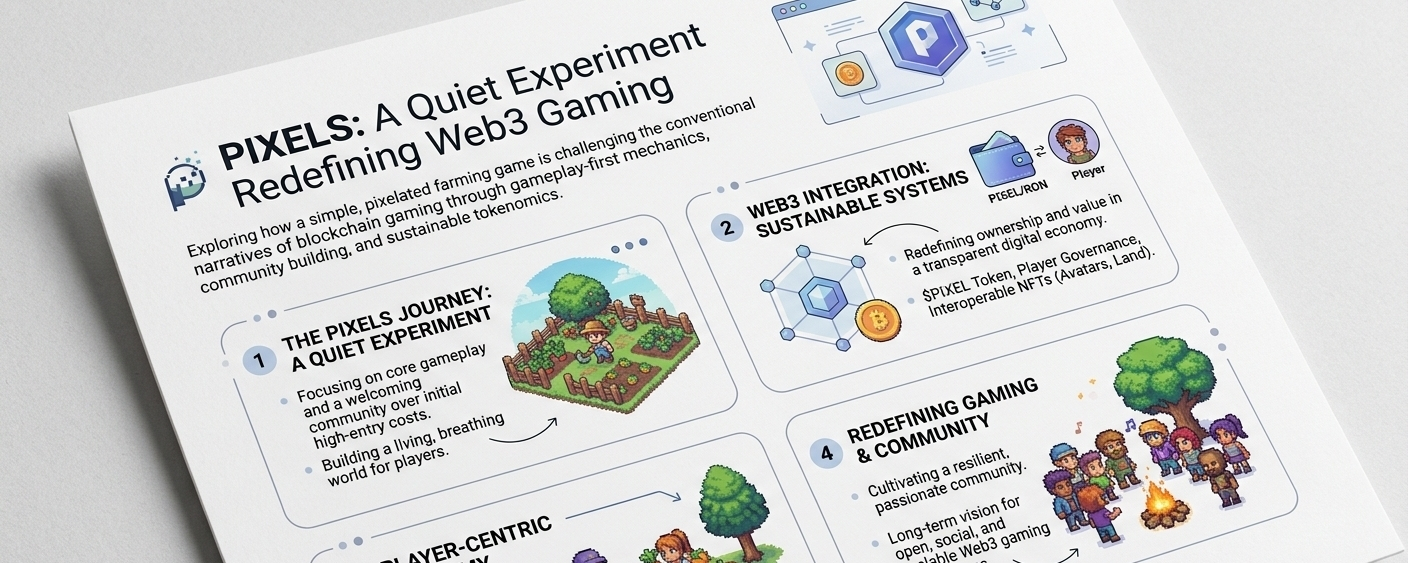
At a glance, Pixels feels familiar. It looks like the kind of farming game you’ve seen before plant crops, gather resources, upgrade your land. Easy to pick up, easy to understand.
But that simplicity is deceptive.
Behind the relaxed gameplay is a system that’s constantly evolving one that’s less about farming itself and more about how players behave inside a digital economy.
Where It Started and What Broke
In its early days, Pixels followed a model common across Web3 games: reward players with tokens for their time and activity. It worked… until it didn’t.
The original in-game currency (BERRY) quickly ran into inflation issues. Players weren’t really “playing” they were optimizing for extraction:
Farm as efficiently as possible
Claim rewards
Sell immediately
That loop created pressure on the entire system. More supply, less demand, declining value. And once rewards start losing meaning, engagement follows.
This wasn’t unique to Pixels. It was a pattern seen across the space. But Pixels chose to respond instead of ignoring it.
The Reset: From Output to Behavior
The introduction of the $PIXEL token wasn’t just a replacement it was a redesign of incentives.
Instead of rewarding players purely for what they produce, the system started focusing on how they participate.
That shift matters.
Now, value comes from:
Staying active in the ecosystem
Reinvesting resources
Engaging with different game loops
It’s no longer about how fast you can extract it’s about whether you remain part of the system.
Missions That Do More Than Reward
Missions in Pixels might look basic, but they’ve become one of the game’s most interesting mechanics.
Two players can complete the exact same task and walk away with completely different paths:
One continues building and engaging
The other exits after claiming rewards
That difference is where Pixels is evolving. Missions are no longer just tasks they’re part of a system that subtly shapes decisions.
Over time, the game leans toward encouraging players who contribute to its economy rather than those who simply pass through it.
Ownership That Actually Means Something
Land NFTs in Pixels aren’t just collectibles they change how you play.
Owning land can affect:
Resource generation
Production efficiency
Social interaction
It adds a layer of permanence. Your decisions start to matter more because you’re not just renting time in the game you have a stake in it.
And because these assets exist onchain, they carry a form of identity. Your setup, your strategy, your progression it all becomes part of your presence in the ecosystem.
Scaling Through the Right Ecosystem
A major boost for Pixels came when it moved to the Ronin network.
This shift brought practical advantages:
Faster transactions
Lower costs
Access to an existing Web3 gaming audience
But more importantly, it showed that success in Web3 gaming isn’t just about building a good product it’s about choosing the right environment to grow in.
Simple on the Surface, Complex Underneath
Pixels does something clever: it lets different types of players experience the game in different ways.
Casual players see a relaxing farming sim
Competitive players see an economy to optimize
Analysts see a live system of incentives and behavior
Not everyone needs to understand the deeper layers but they’re always there, shaping the experience.
The Challenges Aren’t Gone
Even with improvements, Pixels still faces real hurdles:
Keeping its economy stable over time
Retaining players once initial excitement fades
Balancing real gameplay with financial incentives
These aren’t easy problems and no Web3 game has fully solved them yet.
Why Pixels Is Still Worth Watching
What makes Pixels stand out isn’t perfection it’s adaptability.
It didn’t stick to a broken model. It adjusted, reworked its systems, and kept building. That kind of iteration is rare in a space where many projects either stall or disappear.
Pixels is still experimenting. Still refining. Still learning from its players.
Closing Thought
Pixels may look like a simple farming game, but it’s really testing something bigger:
Can a game build an economy where players don’t just earn but actually belong?
That question hasn’t been fully answered yet. But Pixels is one of the few projects actively trying to figure it out.