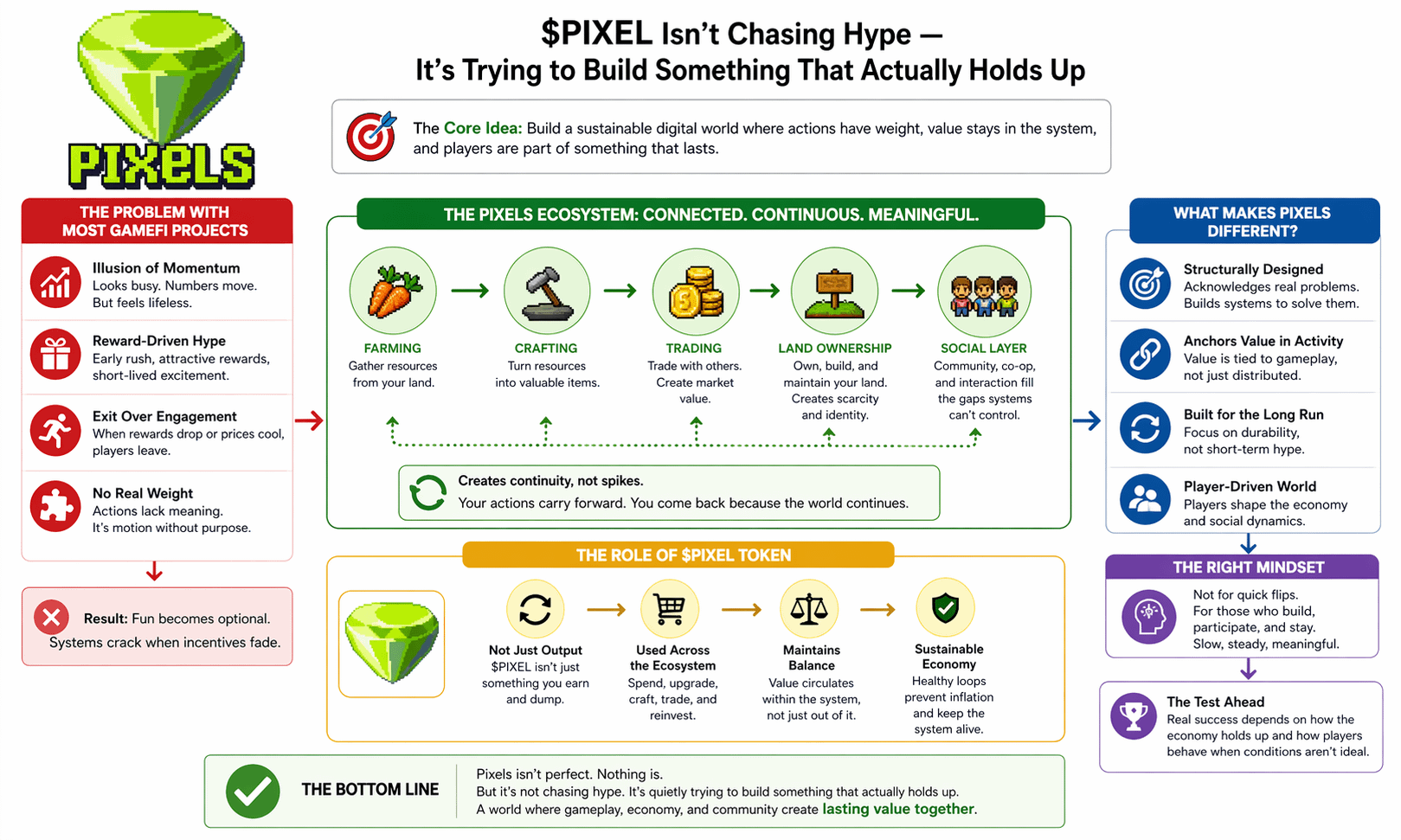
I keep circling back to this one uncomfortable question: why do so many digital worlds look busy, but feel completely lifeless once you spend time in them? On the surface, everything checks out players are active, tokens are moving, numbers are ticking up and down. It gives the illusion of momentum. But if you stay long enough, you start noticing something missing. There’s no real weight behind the actions. Nothing feels like it has to happen. It’s all motion without meaning.
And honestly, this isn’t new. It’s a pattern that’s played out over and over again. A GameFi project launches, early adopters rush in, rewards are attractive, and for a short window, everything feels like it’s working. But that phase never really lasts. The moment rewards start shrinking or token prices cool off, the shift is immediate. People stop engaging and start calculating. Decisions become less about playing and more about timing exits. What was framed as a game slowly reveals itself as a strategy sheet with a UI.
The core problem isn’t hard to understand it’s just difficult to design around. These systems are constantly trying to balance two competing forces: being genuinely enjoyable and being financially rewarding. The issue is, once financial incentives take the lead, everything else starts to orbit around them. Fun becomes optional. And if the experience can’t stand on its own without rewards propping it up, then the entire structure becomes fragile. Sooner or later, it cracks.
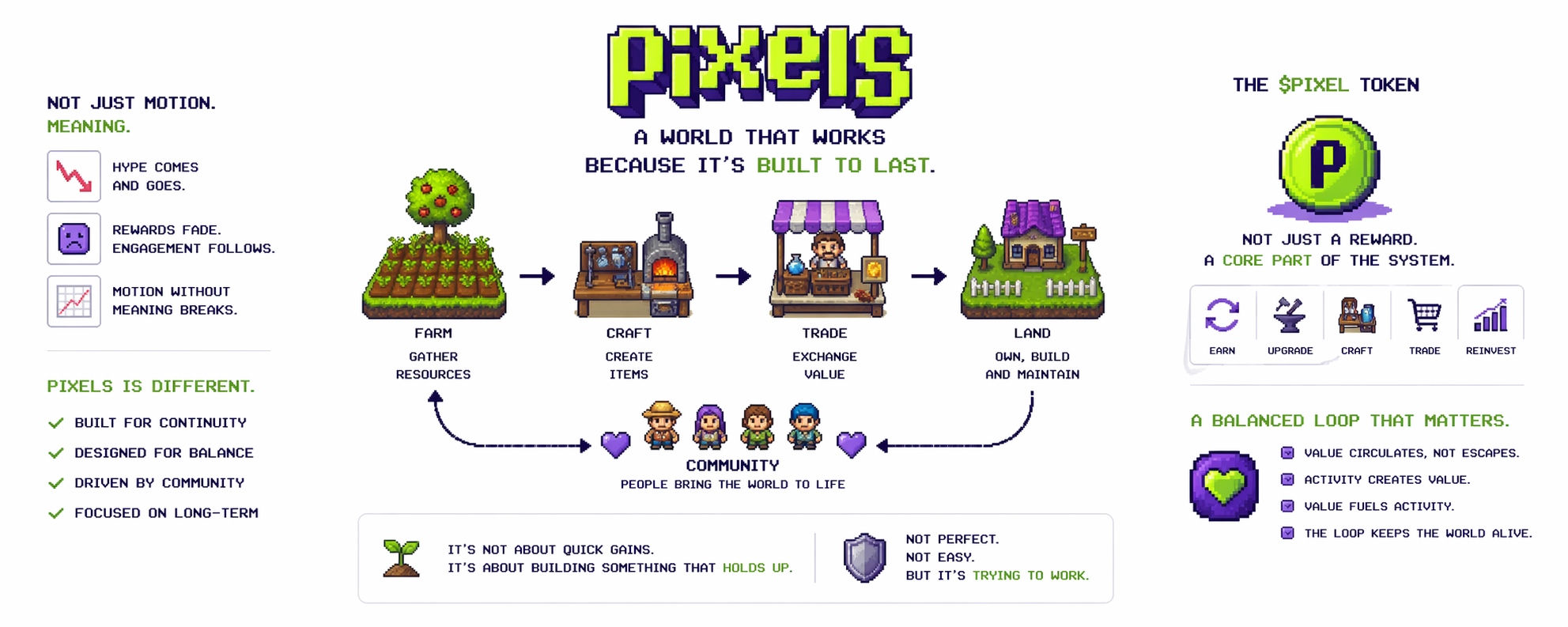
That’s where Pixels starts to feel… different. Not in an obvious, flashy way but in a quieter, more structural sense. It doesn’t come across like it’s trying to prove anything upfront. It just functions. At a glance, it’s simple farming, crafting, trading, social interaction. Nothing groundbreaking individually. But the way these pieces connect is where it gets interesting. Farming feeds into crafting. Crafting supports trade. Land introduces constraints and ownership. And social behavior fills the gaps that systems can’t fully control.
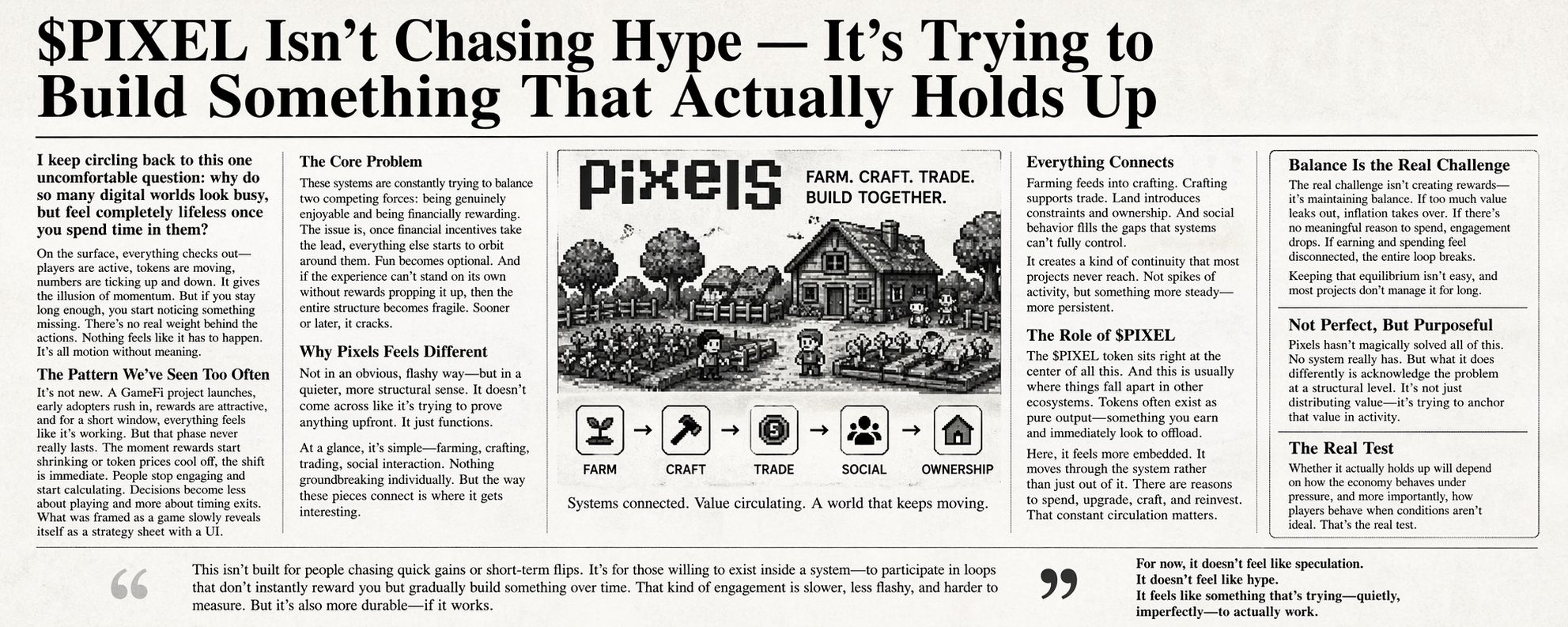
It creates a kind of continuity that most projects never reach. Not spikes of activity, but something more steady more persistent.
What I find particularly important is how the game subtly pushes you toward coming back. Not through aggressive rewards or urgency, but through continuity. Your previous actions don’t just disappear into the background they carry forward. Land isn’t just something you hold; it’s something you maintain. Resources aren’t just extracted and forgotten; they’re part of cycles you re-enter again and again. It’s a small shift in design, but it changes how you relate to the system over time.
Then there’s the role of the $PIXEL token, which sits right at the center of all this. And this is usually where things fall apart in other ecosystems. Tokens often exist as pure output something you earn and immediately look to offload. But here, it feels more embedded. It moves through the system rather than just out of it. There are reasons to spend, upgrade, craft, and reinvest. That constant circulation matters.
Because the real challenge isn’t creating rewards it’s maintaining balance. If too much value leaks out, inflation takes over. If there’s no meaningful reason to spend, engagement drops. If earning and spending feel disconnected, the entire loop breaks. Keeping that equilibrium isn’t easy, and most projects don’t manage it for long.
To be clear, Pixels hasn’t magically solved all of this. No system really has. But what it does differently is acknowledge the problem at a structural level. It’s not just distributing value it’s trying to anchor that value in activity. That doesn’t guarantee success, but it’s a far more realistic starting point than most.
And that’s probably the key takeaway. This isn’t built for people chasing quick gains or short term flips. It’s for those willing to exist inside a system to participate in loops that don’t instantly reward you but gradually build something over time. That kind of engagement is slower, less flashy, and harder to measure. But it’s also more durable if it works.
Whether it actually holds up will depend on how the economy behaves under pressure, and more importantly, how players behave when conditions aren’t ideal. That’s the real test.
But for now, it doesn’t feel like speculation. It doesn’t feel like hype.
It feels like something that’s trying quietly, imperfectly to actually work.