

The first few times I opened the Task Board in Pixels, I did not question it.
It felt simple. Open the board. See tasks. Pick one. Do it. Get something back. That is the kind of loop games train you to trust. It gives you a clean feeling of cause and effect. I act. The system responds. The reward appears. But the more I sat with Pixels, the less that sequence felt real to me. The board never feels raw. It feels arranged. Like I am not triggering it, only arriving inside it after something important has already happened.
That is the thought I cannot really shake.
Because once the board stops feeling reactive, it starts feeling staged. Some chains feel deep. Some feel thin. Some seem to carry real weight. Others feel like placeholders. And none of that looks random. It feels like the board is not building itself around what I just did. It feels like it is presenting a version of the system that was already shaped before I got there.
That changes the whole emotional logic of the game.
A choice screen is supposed to feel open. It is supposed to feel like I am standing in front of possibilities that become meaningful because I choose them. But Pixels does not fully feel like that to me anymore. It feels like I am stepping into opportunities that already survived some earlier layer of filtering. Not live possibilities. More like pre-approved ones.
And that is where the game starts feeling stranger.
Because Coins do not behave like that. Coins feel loose. Always moving. Always available. They let the loop run. But the moment $PIXEL gets attached, the whole board starts feeling selective. Like now the system is no longer asking what I want to do. It is asking what it can afford to let exist. That is a very different kind of environment.
The more I think about it, the less I see the Task Board as the place where decisions happen.
I think it may be the place where decisions show up.
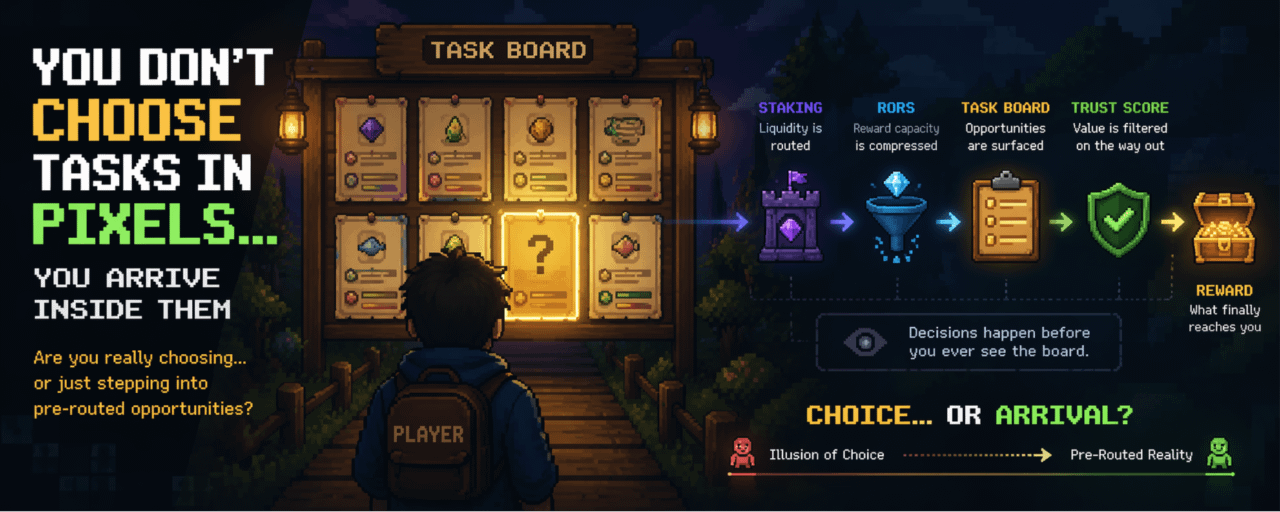
That is a big difference. Because if staking has already pointed liquidity somewhere, and if RORS has already compressed what can actually sustain payout, then by the time I open the board I may not really be choosing in the usual sense. I may just be moving inside a space that was already narrowed before I arrived.
That is the tension I keep coming back to.
Player choice sounds open.
Pre-routed opportunity sounds controlled.
And Pixels is starting to feel much closer to the second one.
What makes it even harder to ignore is that the path does not seem to stop at the board. The board surfaces something. Then another layer may still decide how cleanly that value exits. So now it is not just one filtered moment. It is a sequence. Staking routes it. RORS compresses it. The board reveals it. Trust Score may filter what survives after. When I look at it that way, the game stops feeling like a live conversation between me and the system. It starts feeling like I am entering the visible end of a process that was already moving before I got there.
And that is where effort starts feeling less stable too.
Because if the real shape of opportunity is already set upstream, then effort may not be creating value so much as aligning with where value already exists. That would explain why some sessions feel rich and alive while others feel thin, even when the time spent looks almost identical. Same loops. Same player. Different board. That is not an easy thing to explain if the system is purely reactive. It makes a lot more sense if what I am seeing is already filtered reality.
That idea bothers me more than I expected.
Because once I start thinking this way, progress stops feeling as clean as it used to. Maybe I am not getting better at tasks. Maybe I am just getting better at ending up near the parts of the system where tasks actually matter. Maybe what feels like agency is sometimes just arrival at the right place after the important routing decisions were already made.
And the uncomfortable part is that from inside the loop, it still feels earned.
That is why this is hard to talk about.
Because the feeling of earning does not prove that the opportunity was open. It only proves I was there when it surfaced. And that is not the same thing. A reward can feel personal even when most of what shaped it happened somewhere upstream, out of sight, before I ever touched the board.
So yeah, I still open the Task Board and play.
I still make choices. I still run loops. I still move through the game.
But the more I sit with Pixels, the less I think I am choosing tasks in the way I first believed.
The real question for me now is whether I am actually shaping outcomes...
or just stepping into arrangements where value was already routed, compressed, and allowed to appear before I arrived.