

I keep coming back to Pixels in a way that feels less like playing a game and more like revisiting a habit I don’t fully understand yet. Not because it’s pulling me in with intense mechanics or high-stakes competition, but almost the opposite — because it doesn’t. It just sits there, running quietly, like something that doesn’t really need me but still lets me feel involved.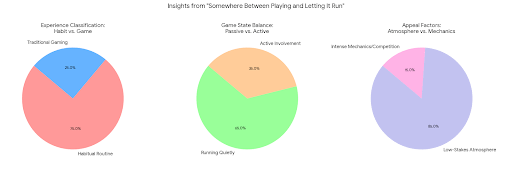
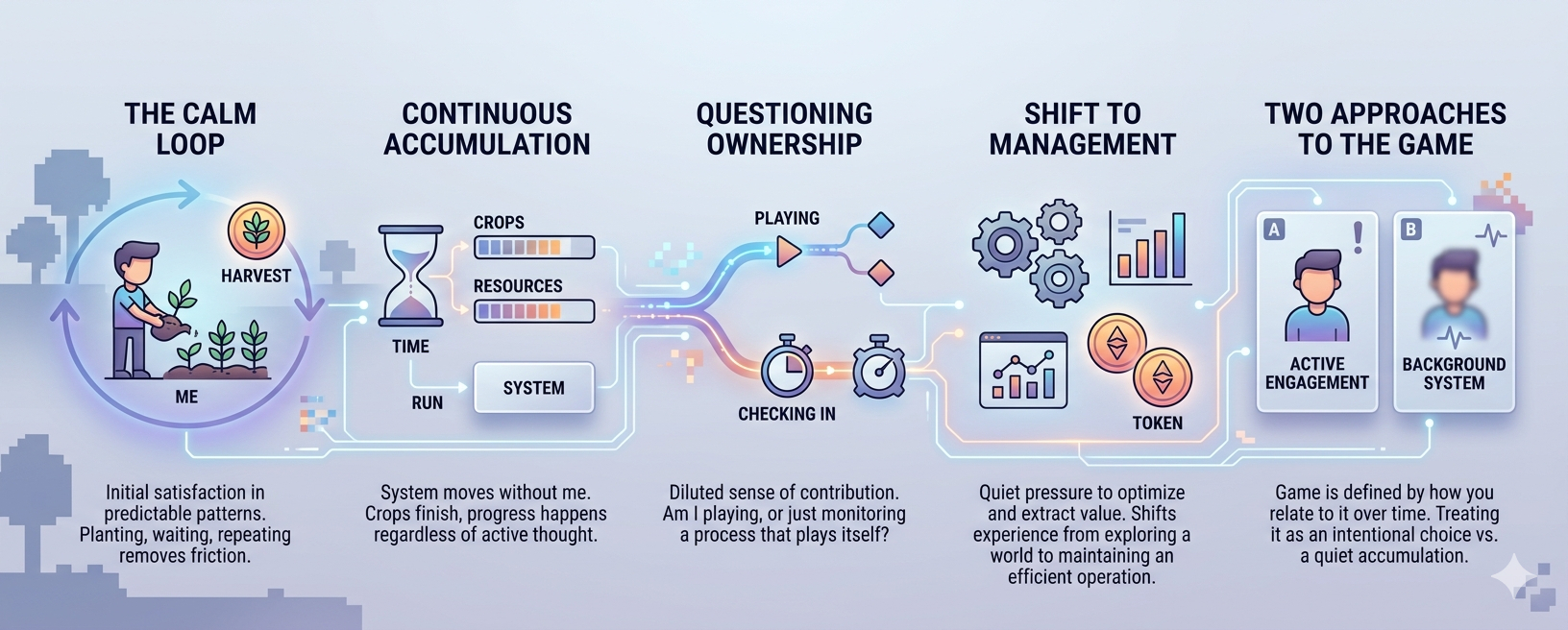
At first, it’s easy to get caught in the surface layer. You plant crops, you wait, you harvest, you repeat. There’s something oddly calming about that loop, almost like the game is designed to remove friction entirely. No resistance, no real setbacks, just a smooth progression where everything behaves exactly how you expect it to. And for a while, that predictability feels satisfying. It creates this illusion of control, like you’re building something stable.
But the longer I stay with it, the more I start noticing what’s missing.
There’s no real tension. No moment where I feel like I might lose something meaningful. Even when I step away, the system keeps moving — crops finish, resources accumulate, time converts into progress whether I’m actively thinking about it or not. And that’s where it gets strange, because it makes me question what part of this is actually mine.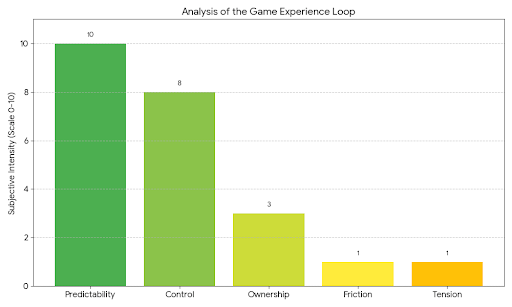
I used to think ownership in games like this meant something clear. You put in time, you make decisions, and what you build reflects that. But here, it feels diluted. If everything continues without me, then what exactly am I contributing? Am I playing the game, or just checking in on something that plays itself?
The Web3 layer adds another dimension to that question. On paper, it suggests deeper ownership — assets, tokens, economies that extend beyond the game. And yeah, that sounds compelling in theory. But in practice, I’m not sure if that changes the feeling as much as it claims to. If the core loop itself doesn’t demand much from me, then attaching value to it doesn’t automatically make it meaningful. It just makes it… trackable.
There’s also this quiet pressure underneath everything. Not aggressive, not obvious, but it’s there. The idea that if you optimize your time, if you engage just enough, if you understand the system well enough, you can extract something from it. Not necessarily fun, but value. And I find myself wondering whether that shifts the experience from playing to managing — like I’m not exploring a world, but maintaining a small, efficient operation inside it.
And yet, despite all that, I don’t completely dismiss it.
There’s something about the simplicity that still works. The open-world design, even in its calmness, gives space to just exist without urgency. It doesn’t overwhelm. It doesn’t demand constant attention. In a way, that’s rare. Most games push you hard — objectives, competition, progression systems layered on top of each other. Pixels strips that down to almost nothing, and that absence is noticeable.
But maybe that’s also the trade-off.
Because when a system becomes too smooth, too effortless, it starts to feel less like an experience and more like a process. And processes are efficient, but they’re not always memorable. I don’t really recall specific moments from playing Pixels. I recall patterns. Loops. Systems working as intended. And that’s a different kind of memory — less emotional, more mechanical.
Sometimes I think the game is less about what you do inside it and more about how you relate to it over time. Whether you treat it like a background system that quietly accumulates, or something you actively engage with. And maybe that’s the real question it leaves me with.