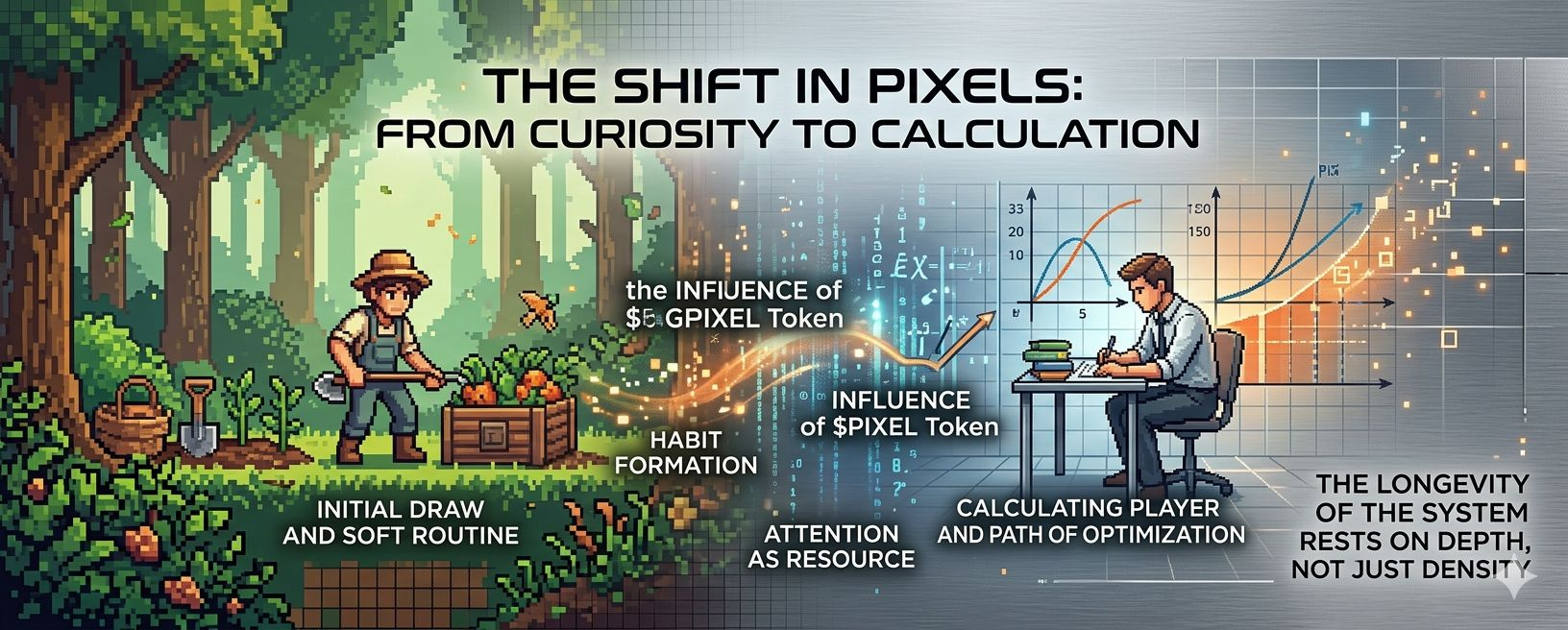
I’m watching how people move through Pixels lately, not in a rush, not with the excitement that usually surrounds new systems, but with a kind of quiet calculation. I’m waiting to see if their behavior settles into something consistent or if it keeps shifting with every small update. I’ve seen enough of these environments to know that what looks alive at first can slowly turn mechanical over time. So I’m looking closely, not at the surface features, but at the way attention flows through the world and how long it actually stays there.
At a glance, Pixels still carries that soft pull of an open-world routine. Farming, crafting, small loops of productivity—it all feels familiar in a way that lowers the barrier to entry. But familiarity can be deceptive. The real question isn’t whether the systems work, it’s whether they hold meaning after repetition sets in. Watching players move through their daily actions, there’s a pattern forming that feels less like exploration and more like optimization. Not in an aggressive way, but in a quiet, almost unconscious shift where decisions are guided less by curiosity and more by efficiency.
The presence of the token adds another layer that’s hard to ignore. $PIXEL isn’t just sitting in the background; it subtly shapes behavior. I notice how players adjust their time, their routes, even their patience based on expected outcomes rather than experience. This doesn’t necessarily break the game, but it changes the tone of it. What starts as a relaxed environment slowly leans toward a system of measured returns. And once that shift happens, it’s difficult to fully go back.
There’s also something interesting about how the world itself feels. It’s not empty, but it’s not deeply immersive either. It exists in that middle space where interaction is constant but not always meaningful. People are present, tasks are being completed, resources are moving—but the sense of attachment feels thin. I keep asking myself whether players are here because they want to be, or because the system gives them a reason to stay just a little longer each day.
The updates, especially the newer layers being added, suggest an attempt to deepen the experience. More systems, more mechanics, more ways to engage. On paper, that should create longevity. But I’m not fully convinced it works that way in practice. Sometimes adding more doesn’t create depth—it just redistributes attention. Players don’t necessarily engage more; they just spread themselves thinner across a wider set of actions.
What I find more revealing is how people talk about the game after spending time in it. Not the initial impressions, but the quieter reflections. There’s a recurring tone of cautious involvement. Not frustration, not excitement—something in between. As if players are still deciding what this environment really is to them. A game, a routine, an opportunity, or just a temporary stop.
That uncertainty might actually be the most honest signal. Because strong systems usually create a clear emotional response over time, whether positive or negative. Here, the response feels delayed, almost suspended. People keep showing up, but they don’t fully commit to how they feel about it.
From a design perspective, Pixels is doing something subtle. It’s not forcing engagement; it’s allowing habits to form naturally. And habits are powerful. But they’re also fragile. If the underlying experience doesn’t evolve in a way that feels meaningful, those habits can disappear as quietly as they formed.
So I keep watching. I’m not trying to reach a conclusion too quickly. There’s something here, but it’s still settling into its final shape. The real test won’t be in how many players arrive, but in how many continue to return when the novelty fades and the systems become routine.
Right now, Pixels feels like it’s in that in-between state—not new enough to rely on curiosity, not deep enough yet to rely on attachment. And in that space, everything depends on how it grows from here.