
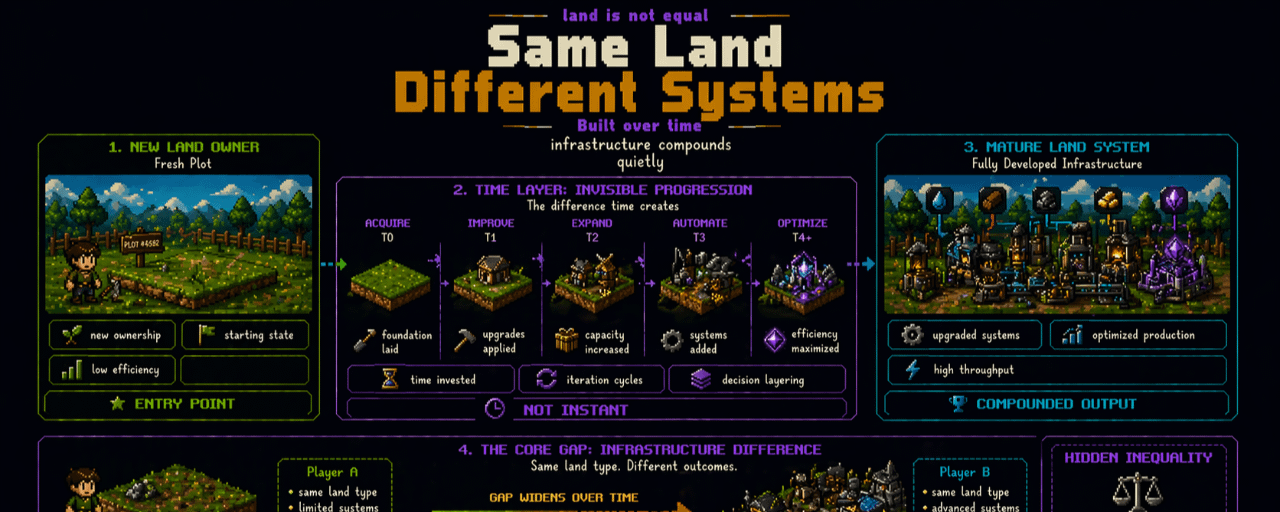
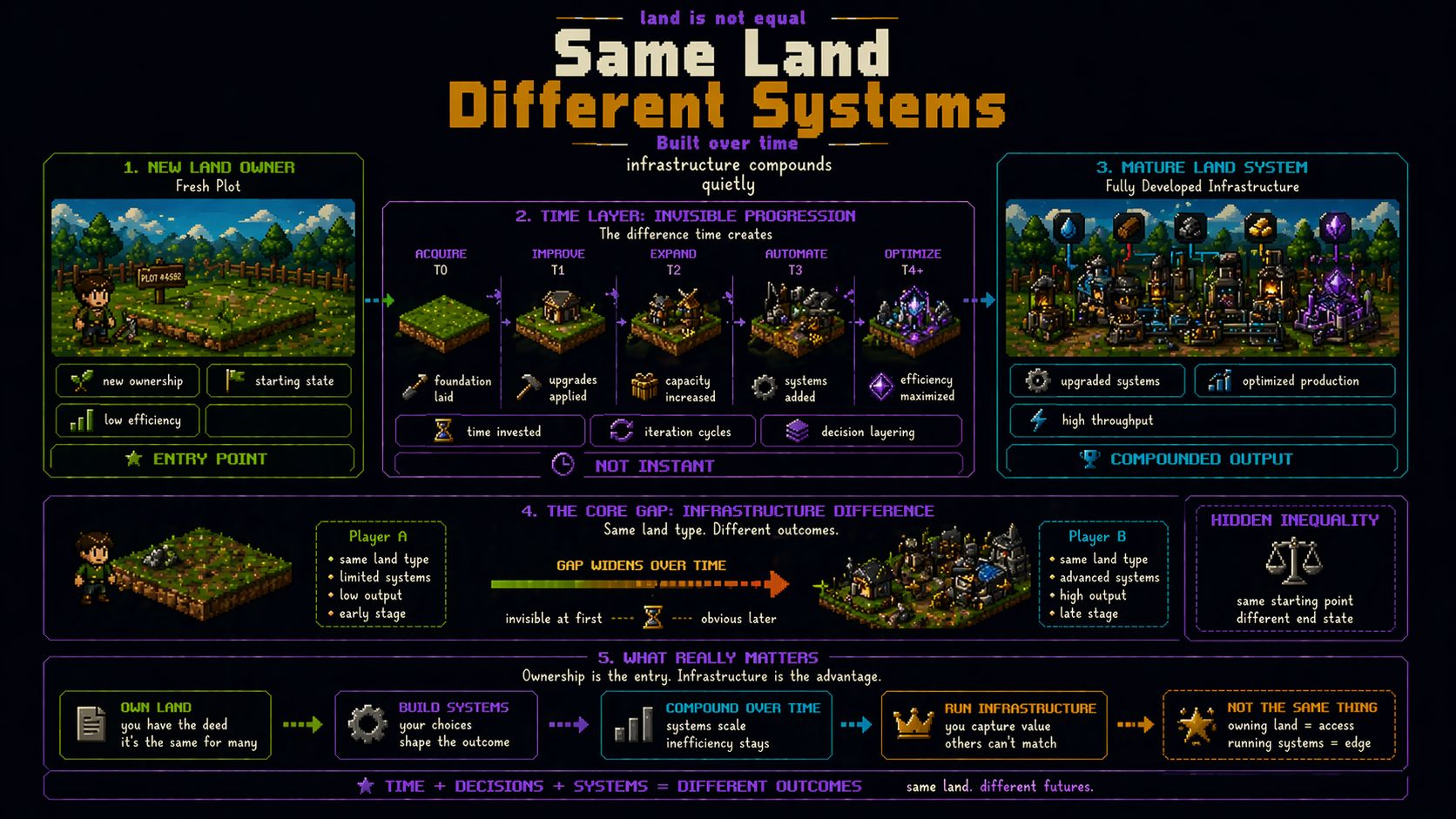
I didn’t expect land upgrades in Pixels to make me pause this much. At first it reads like any other progression system, you own land, you upgrade it, output improves. Pretty standard. But the more I sat with it, the more it felt like this isn’t just progression… it’s infrastructure quietly compounding over time.
Most discussions I see about land in Web3 games focus on entry price. Early players bought cheap, late players buy expensive. That’s the usual framing. But in Pixels, that almost feels like the least interesting part.
What actually matters is what early land owners did with time.
Because owning land here isn’t passive. You don’t just hold it and wait. You build on it. You upgrade, activate industries, reconfigure production, maybe even automate parts of it over time. And if someone has been doing that consistently since 2022, they’re not just holding an asset anymore. They’ve built a production system.
That’s the part I didn’t fully register at first.
Two players can both own land in 2026, but they’re not standing in the same place. One might have a fresh plot. The other might be running something that’s been optimized, adjusted, and scaled over multiple cycles. And that gap isn’t something you close just by spending more. It’s time, decisions, and iteration stacked together.
Then you zoom out a bit and the numbers start to feel different.
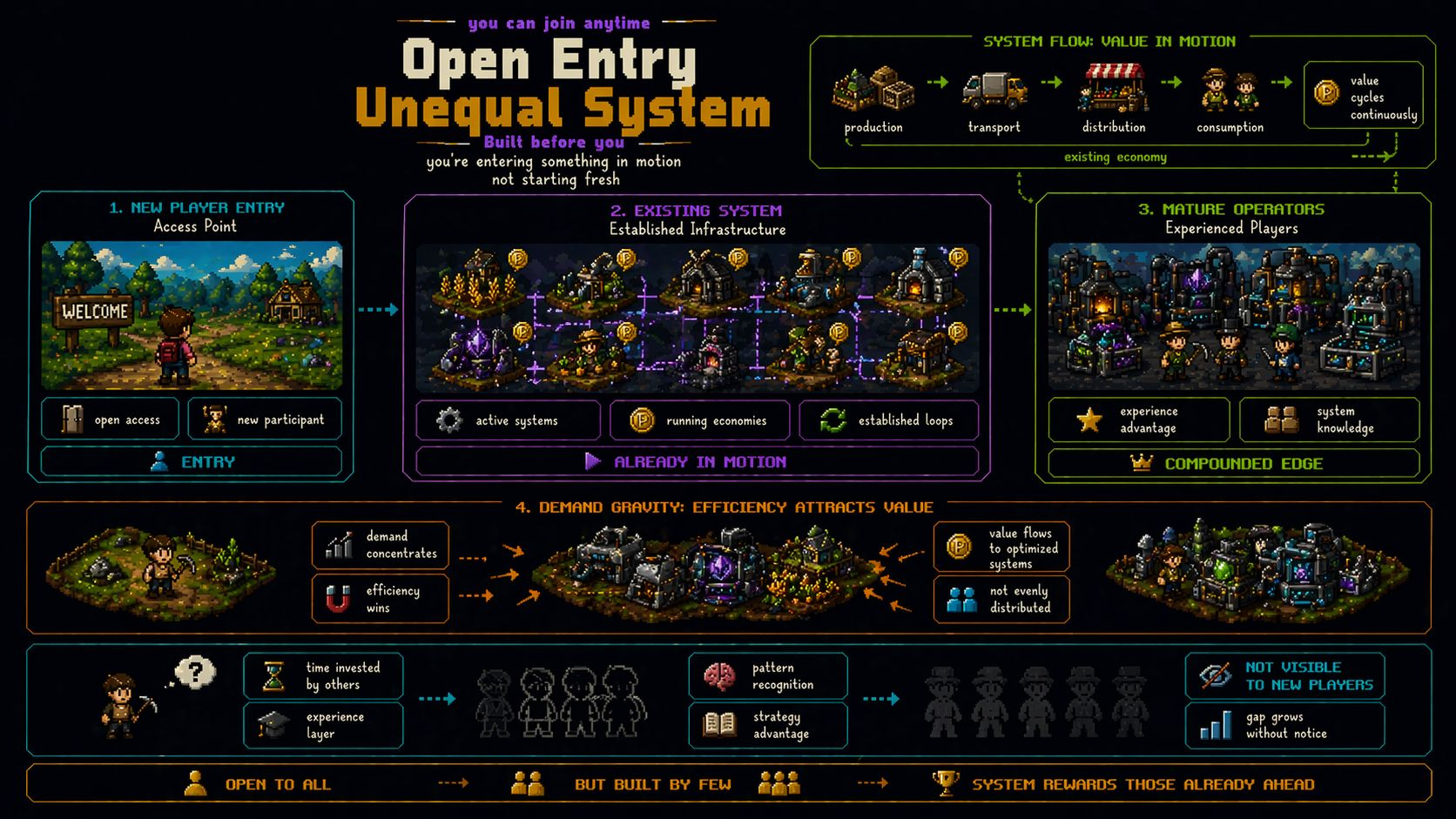
There are around 5,000 land plots. Fixed. Meanwhile, the player base has grown massively. So every new player entering without land is, in some way, interacting with that limited layer. Renting, supplying, consuming, feeding into systems that are anchored by those plots.
But demand doesn’t spread evenly.
It gravitates toward the most efficient setups. The plots that are already upgraded, already optimized, already producing at higher throughput. So the advantage isn’t just owning land. It’s owning mature land.
And automation adds another layer to that.
It’s not something you just unlock instantly. It’s something you build toward. So when someone is running an automated plot today, what you’re really looking at is the result of years of incremental upgrades. A new owner doesn’t buy that state. They buy the starting point toward it.
That difference feels subtle at first, but it’s not.
Because in a system with fixed supply and growing demand, productive capacity becomes the real currency. And productive capacity here is heavily shaped by time.
There’s also something less visible, but I think it matters just as much.
Players who’ve been through multiple phases of the game, different economic shifts, changes in resource flow… they’ve seen patterns newer players haven’t. They know what tends to happen when updates roll out, how demand shifts, what gets scarce before it’s obvious. That kind of knowledge feeds back into how they run their land.
So even beyond upgrades, there’s an experience layer that compounds too.
At the same time, I don’t think Pixels completely locks new players out. The free-to-play layer, Specks, shared land, all of that gives real access. You can participate, earn, learn the system without owning land.
But participating and understanding aren’t the same thing.
And I guess that’s what I keep coming back to. When new players enter now, they’re not stepping into a fresh economy. They’re stepping into one that’s already been shaped by years of invisible infrastructure, upgraded plots, optimized systems, and players who’ve been refining their approach long before the recent growth.
So yeah, the system is accessible.
But it’s not flat.
And maybe understanding that difference is what actually changes how you play.