
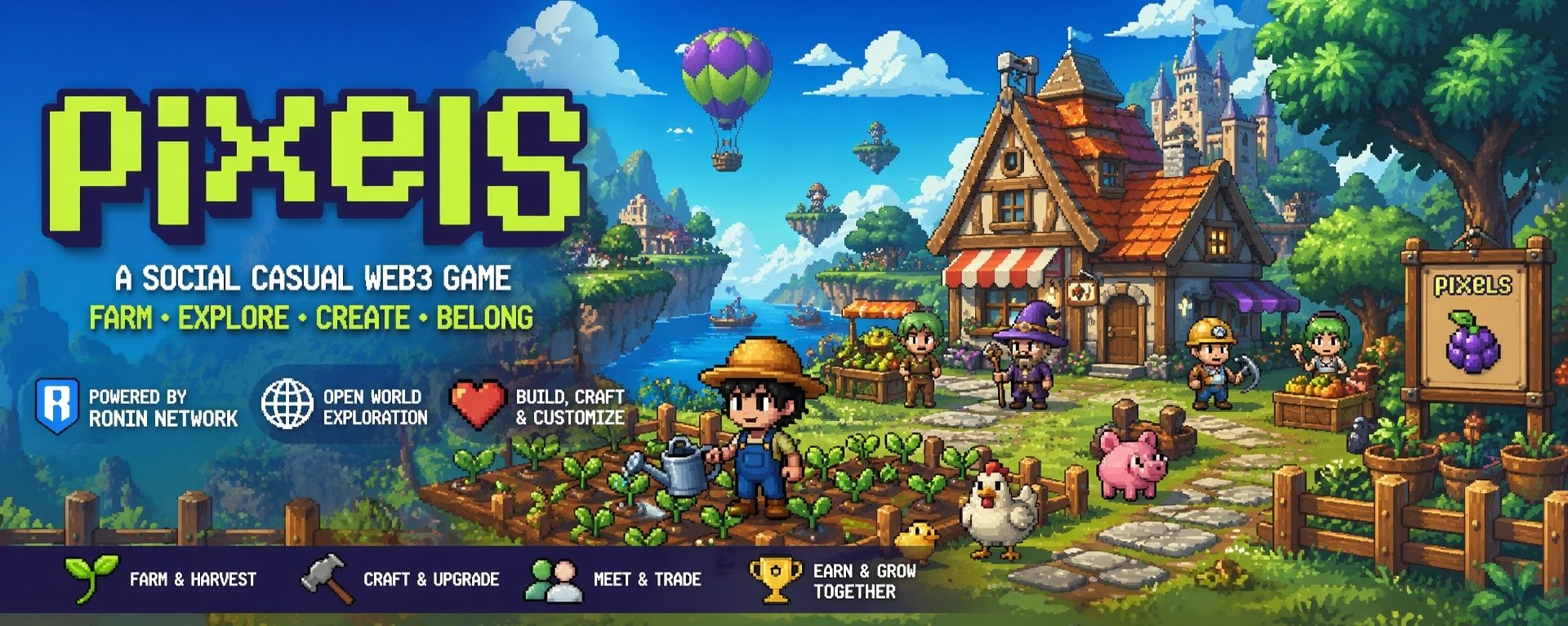
Pixels feels different from a lot of Web3 games, and not because it tries to look different. It just has a softer kind of pull. Most projects in this space come in loud. They lead with hype, token talk, big promises, and that usual pressure to believe you are looking at the future before anything has really been proven. Pixels never felt like that. It built its identity around a world that people could actually settle into. Farming, exploring, creating, meeting others, building routines. Small things, but small things done right can keep people around much longer than noise.
At its core, Pixels is a social casual game, and that matters more than it sounds. A lot of crypto games make the mistake of treating gameplay like a wrapper around rewards. Pixels went the other way. It tried to make the world itself the reason you stay. The farming loop, the land management, the gathering, the crafting, the movement through the map, the feeling that your time inside the game builds into something personal. That is what gives the project its real shape. It does not feel like a system asking you to extract value from it as fast as possible. It feels more like a place that wants you to return tomorrow.
That is probably why Pixels got attention in the first place. Not just because it was on Ronin. Not just because it had a token. It had a rhythm. People could understand it quickly, but there was enough depth in the loop to keep them moving. You plant, harvest, collect, improve, expand, and before long the game starts creating its own routine in your day. That is harder to build than people think. It is easy to launch something with excitement around it. It is much harder to build something that quietly becomes part of a player’s habit.
What makes the project interesting is that it never tried to be a hardcore experience pretending to be casual. It embraced the lighter side of gaming without making it empty. That balance matters. Pixels has always been easier to approach than a lot of blockchain games because it does not throw complexity at the player from the first minute. It lets the world do the work. You enter, you move, you interact, and the game slowly opens itself. That kind of design creates a different relationship between player and project. It feels less like joining a campaign and more like stepping into a living space.
The social part matters too. Pixels is not just about farming alone in silence. The world feels built around shared presence. People move through the same spaces, build alongside each other, trade attention, trade time, and shape the atmosphere of the game together. That gives the project a human layer that many Web3 games never really find. A lot of them talk about community, but what they really mean is audience. Pixels feels closer to actual community because the social side is part of the experience itself, not just something happening outside the game on posts and timelines.
The project also deserves credit for picking a direction that fits its audience. Running on Ronin gave Pixels a stronger gaming identity from the start. It placed the game inside an ecosystem where users were already more open to interactive, game-based experiences. That helped the project feel more natural. In a different environment, the same game might have felt forced. On Ronin, it made sense. The network and the game supported each other, and that gave Pixels room to grow into its own style instead of constantly needing to explain why it existed.
What I find strongest about Pixels is that it understands that not every successful game needs to feel intense. Some games win because they create comfort. They create routine. They make progress feel steady instead of dramatic. Pixels leans into that. It is not built around constant pressure. It is built around repetition that feels rewarding rather than exhausting. That sounds simple, but there is real design discipline behind it. A game that people casually return to again and again can end up being much stronger than a game that creates one huge moment and then loses everyone after the excitement fades.
There is also a real sense of personality in the project. The pixel-art style, the farming identity, the open world structure, all of it comes together in a way that feels warm instead of cold. That may be one of the biggest reasons Pixels stands out in Web3. So many projects in this space feel mechanical. Their worlds exist only to support a system. Pixels feels more like the system was built to support the world. That shift changes everything. It makes the experience easier to connect with. It makes the project feel less transactional and more lived-in.
Of course, no project like this survives on charm alone. Pixels had to become more than a nice-looking world. It had to prove that the game could keep people engaged beyond the first wave of curiosity. That is where the project became more serious. It had to keep improving the experience, refining how progression feels, and making sure the world does not lose its energy once players understand the basics. That challenge never really ends for a live game. A world like this has to keep earning attention. It has to stay alive enough that returning still feels worth it.
And that is really where Pixels feels most real to me. It is not trying to be everything. It is not pretending to be some perfect answer to the future of gaming. It knows what it is. A social, casual, open-world Web3 game built around farming, exploration, and creation. That clarity helps. The project does not need to wear ten different identities to stay relevant. Its strength comes from staying close to its own nature and making that world deeper over time.
In the end, Pixels works because it understands something a lot of projects forget. People do not only come back for rewards. They come back for feeling. For familiarity. For progress they can see. For a world that feels calm enough to enjoy and alive enough to matter. Pixels built itself around that kind of return. That is what gives the project its staying power. Not noise. Not pressure. Just a world that keeps inviting people back in.