
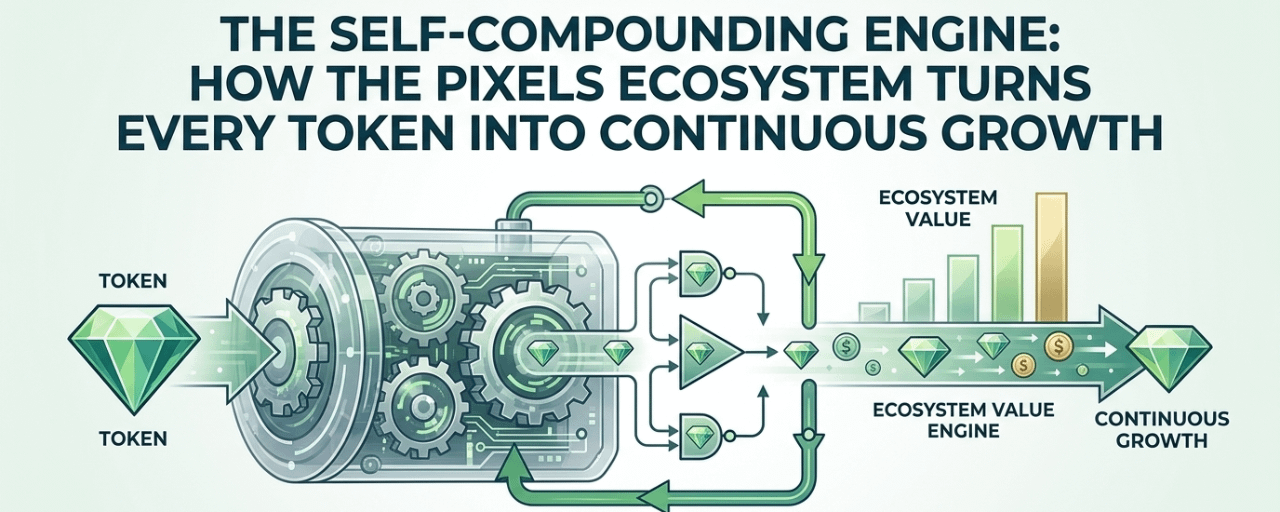
In most digital economies, value flows in a straight line. Money comes in through ads or purchases, gets spent on acquisition, and much of it disappears into external platforms with little trace of what actually worked. The Pixels ecosystem is built differently. It is designed as a circular economic flywheel where value does not exit the system it continuously recycles, learns, and strengthens itself.
At the center of this system is PIXEL, along with its staked form vPIXEL. Instead of treating tokens as static assets or simple rewards, Pixels turns them into active participants in a living feedback loop that connects staking, user acquisition, revenue generation, data intelligence, and future growth.
The result is an ecosystem that does not just scale linearly. It compounds.
A Circular Economy by Design, Not by Accident
The Pixels economy is intentionally structured as a closed-loop system. Every unit of PIXEL that enters the ecosystem is not meant to sit idle or exit quickly. Instead, it moves through a continuous cycle that strengthens the next cycle.
At a high level, the loop looks like this:
PIXEL staking → User acquisition credits → Player engagement and spend → Revenue sharing → Staker rewards → Behavioral data generation → Smarter targeting → New games → back to PIXEL staking
Each stage feeds the next, and importantly, improves it. The system is not just repeating a process; it is refining it every time.
The ultimate goal is to maintain a Return on Reward Spend above 1. In simple terms, this means that every unit of value used to incentivize users should generate more than one unit of value in return. Once that threshold is consistently exceeded, the system becomes self-sustaining and compounding.
Stage One: Staking Becomes Acquisition Power
In traditional ecosystems, staking is often a passive activity tied to network security or yield generation. In Pixels, staking has a direct and immediate economic function.
When users stake PIXEL or the 1:1 backed vPIXEL, they are not just locking value they are allocating it. That stake is directed to a specific game acting as a validator within the ecosystem. The size of a game’s staking pool determines its user acquisition budget.
This budget is converted into user acquisition credits, which are not spent on external ad platforms like social media networks. Instead, they are deployed directly inside games as rewards for players.
This shifts acquisition from external dependency to internal economic coordination. Games compete not through ad auctions, but through economic attractiveness funded by stakers who believe in their long-term performance.
Stage Two: Acquisition Credits Drive Real Engagement
Once a game receives user acquisition credits, it uses them to attract and retain players. But instead of traditional advertising impressions, these credits translate into in game incentives rewards for completing quests, returning daily, exploring features, or participating in events.
This creates a very different kind of user acquisition loop. Players are not interrupted by ads; they are rewarded for participation. The incentives are embedded directly into gameplay, making acquisition indistinguishable from experience.
As new players enter and existing players re engage, they begin spending within the game economy. This is where acquisition transforms into measurable economic activity.
Stage Three: Revenue Flows Back On Chain
Every purchase or transaction made by players flows back into the system as on chain revenue. Importantly, this revenue is recorded in the same smart contract framework that issued the acquisition credits in the first place.
This creates a transparent relationship between what was spent to acquire users and what those users generate in return.
Unlike traditional ecosystems where marketing efficiency is estimated through fragmented analytics tools, Pixels creates a unified financial and behavioral record. Every dollar equivalent spent has a visible outcome.
Stage Four: Staker Rewards Close the Loop
Revenue generated by player activity does not remain idle. It is redistributed back to stakers based on the game’s internal reward design.
Each game has autonomy in determining how rewards are structured, but market forces ensure that inefficient systems are quickly outcompeted. Games that generate stronger engagement and higher revenue can afford to reward stakers more effectively, attracting more staking capital in the next cycle.
This creates a competitive environment where economic design becomes as important as gameplay itself. Stronger games attract more staking power, which increases their acquisition capacity, which further strengthens their player base.
Stage Five: Data Becomes the Hidden Engine
Every interaction inside the ecosystem purchases, quest completions, trades, session duration, withdrawals is captured through the Pixels Events API.
Over time, this generates a deep first-party dataset that spans:
Player lifetime value curves
Retention and churn patterns
Fraud and exploitation signals
Engagement depth and frequency
Behavioral segmentation across multiple games
This is not just analytics data. It is structural intelligence that reflects how value moves through the entire ecosystem.
Because all games feed into the same data infrastructure, the system learns collectively rather than in isolation. One game’s insights improve the performance of others.
Stage Six: Smarter Targeting Improves Every Future Dollar
The data generated is not stored passively. It is actively used to retrain targeting and reward distribution models on a daily basis.
The system identifies which player segments respond best to incentives, which moments in the user journey produce the highest retention lift, and which reward structures maximize long-term engagement instead of short-term exploitation.
As a result, acquisition budgets are continuously reallocated toward higher-performing cohorts. Waste is reduced. Real players receive better incentives. Extractive behavior becomes less profitable.
This is where the flywheel starts to accelerate. Each cycle becomes more efficient than the last.
Stage Seven: More Games Expand the Entire System
One of the most powerful outcomes of this structure is that it lowers the barrier for new game studios to enter the ecosystem.
Because acquisition efficiency is visible and measurable on chain, new developers can understand potential return on acquisition before building their full product. They can model expected performance based on real data rather than speculation.
Each new game adds:
A new pool of players
New behavioral data streams
New staking opportunities
New economic interactions
Instead of fragmenting attention, the ecosystem expands it. Every new participant strengthens the entire network.
Why This Flywheel Works
The key innovation in the Pixels ecosystem is not any single component it is the way all components reinforce each other.
A traditional system treats spending, acquisition, and analytics as separate layers. Leakage is inevitable. Marketing budgets disappear into external platforms, and insights remain fragmented.
In contrast, the Pixels model ensures that value continuously recycles:
Staking becomes acquisition power
Acquisition becomes revenue
Revenue becomes rewards
Rewards become data
Data becomes optimization
Optimization increases the value of future staking
Nothing truly leaves the system. It is constantly reintroduced in a more refined form.
The Compounding Effect: Beyond Linear Growth
The most important outcome of this structure is compounding. The same unit of PIXEL can participate in the ecosystem multiple times:
First as staked capital
Then as acquisition funding
Then as part of revenue redistribution
Finally as data that improves future allocation
Each cycle increases the efficiency of the next. Over time, the Return on Reward Spend rises above 1 and stabilizes there, meaning the system generates more value than it consumes to sustain itself.
At that point, growth is no longer dependent on external inputs. It becomes internally reinforced.
Final Thought
The Pixels ecosystem is not just a token economy or a gaming platform. It is a self-reinforcing growth machine where capital, users, and intelligence continuously feed one another.
Instead of leaking value outward, it circulates it inward. Instead of guessing what works, it measures everything. And instead of resetting with every new user acquisition cycle, it builds on the last.
That is what makes it a flywheel rather than a treadmill and why, over time, every rotation makes the system stronger than the one before.
