A token dropped 95% from its peak, but its underlying system just transitioned from a game to an industry infrastructure—yet the market is still pricing it with old labels.
This isn't normal. Or maybe it's the kind of abnormal that deserves the most thought.
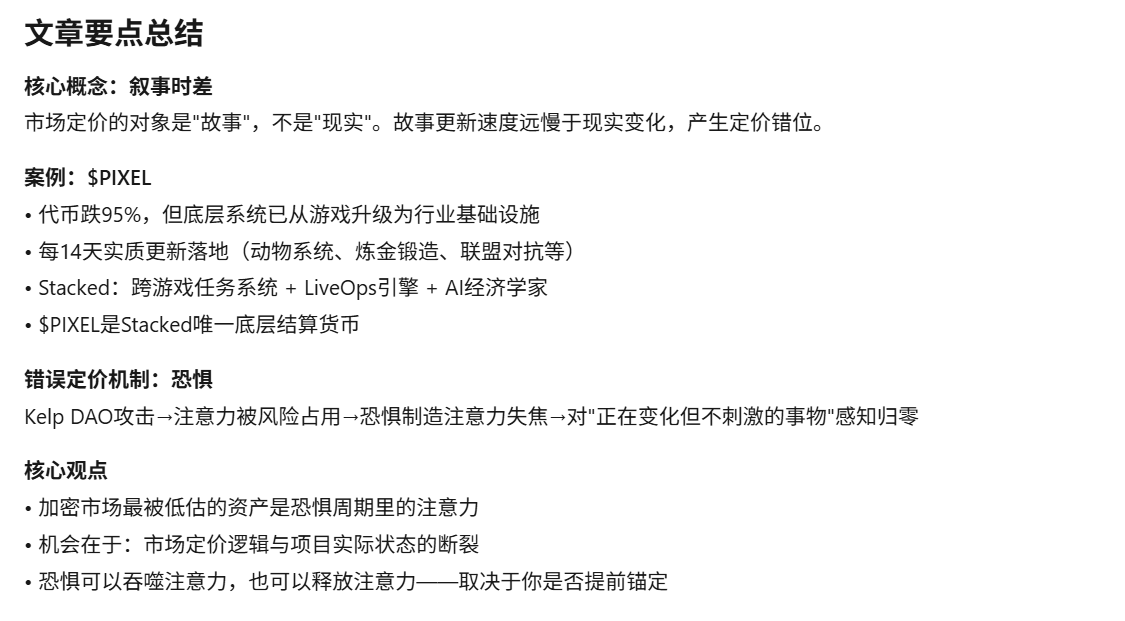
I call it narrative lag: the market never prices reality, it prices the story. And the pace of story updates is far slower than reality.
Asset: Pixels, $PIXEL.

By the end of 2023, moving to Ronin saw DAU skyrocket from a few thousand to over a hundred thousand, and by May 2024, we hit over a million in a single day, a record for Web3 gaming. Then the token crashed 95% from its peak, and the crowd dispersed—the story was 'over.'
I recently went back and took another look, and honestly, I was a bit surprised. It’s not just that they’re "still working on it"—the execution rhythm and direction have both changed. There’s a substantial update every 14 days, not just teasers but real playable content: a major overhaul of the animal system, complete with a full breeding and nurturing cycle; alchemy and forging have been introduced as a brand new industry, with over 150 recipes; the merchant ship system is now linked to fishing pools and sushi tables; the neon district has launched a permanent new live maze; and Chapter 3, "The Bounty Falls," introduces three major alliances battling it out, with players choosing sides to compete for the heartstone's health value, and PIXEL rewards distributed based on alliance rankings.
My first reaction after reading it wasn’t "so cool," but rather "why hasn’t anyone mentioned this?"
But what truly makes me feel the narrative lag isn’t these updates; it’s Stacked.
The Pixels team has compiled four years of hard knocks—how to handle bots, how to design reward distribution, and how to keep players engaged because they love the game rather than just for profit—into a foundational infrastructure for the whole industry. The player side is an app for completing tasks across games, stacking wins, and collecting rewards all in one place; the studio side features a LiveOps engine that helps developers decide who to reward, when to do it, and how; there’s even an AI game economist running behind the scenes, delivering data analysis and experimental suggestions in real-time.
$PIXEL is the only foundational settlement currency for this system.
So here’s the question: the demand scenario for a token has shifted from "in-game consumption" to "cross-game economic infrastructure settlement layer," why should the market still price it using the logic of "farm game tokens"? $BTC rose from 16,000 to 30,000 in 2023, and the story the market told had already shifted from "electronic cash" to "digital gold." The narrative upgraded, and the price re-anchored accordingly. The reality of PIXEL has flipped the script, but the price tag hasn’t been ripped off yet.
This mispricing isn’t coincidental; it has a manufacturing mechanism: fear.
Yesterday, Kelp DAO got attacked, losing $292 million. The group went silent in an instant, some were cursing, some were cutting losses. Once fear kicks in, everyone's attention gets forcibly directed to the same thing—risk. Your information processing bandwidth gets filled with fear, and those "changes happening but not stimulating" become invisible. It’s not that you don’t want to see; it’s that you literally have no bandwidth to see.
Fear doesn’t directly cause losses; it creates a lack of focus. A lack of focus is the breeding ground for mispricing.
This reminds me of $ETC . Always living in the shadow of ETH's narrative, the market has long priced it under the old label of "fork chain," even though its PoW mechanism and independence in specific contexts represent a completely different asset attribute. How many people have been hurt by the narrative lag, underestimating it, and how many were not present when it actually took off?
So the real question to ponder isn’t "What to do about Kelp DAO?" but rather—when fear has sucked your attention away, who is watching the non-glamorous but changing things for you?
Pixels and Stacked aren’t about making a certain price prediction. It’s more of a diagnostic: there’s a gap between market pricing logic and the actual state of the project, execution is ongoing, but the narrative hasn’t kept up, with fear standing in the way. That’s all I can see.
The most undervalued asset in the crypto market isn’t any particular token. It’s the attention during the fear cycle.
When the next Kelp DAO comes around, will your attention be taken away by fear, or will it be just released from fear—only you can decide that.