
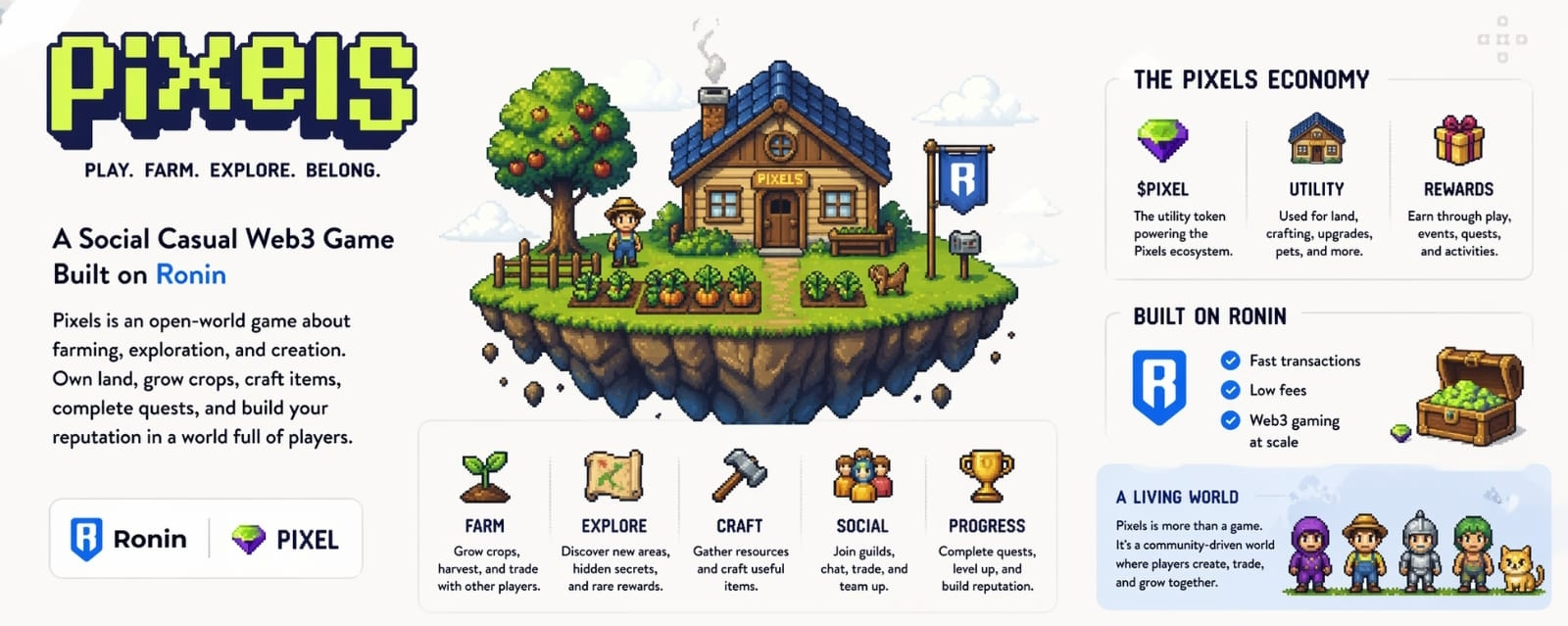

Pixels hits a nerve because most of us have been through the same mess already.
You see a Web3 game. You already know the script. Fake users. Empty worlds. Some token forced into every corner of the experience until the whole thing feels like unpaid labor with cute graphics on top. People call it a community when it’s really just a crowd waiting for an unlock. You bridge over, pay too much somewhere, click around for ten minutes, realize there’s nothing under the hood, then leave with another wallet full of junk and another tab you’ll never open again.
Pixels didn’t feel like that to me.
That’s the first thing that matters.
Not that it looked amazing. Not that it had some huge promise attached to it. Just that when I got into it, it felt like there was actual plumbing underneath the surface. The world moved. People were in it. The loop made sense. You farmed, gathered, crafted, wandered around, ran into other players, figured things out slowly. It wasn’t trying to hit you over the head with a grand vision in the first five minutes. Honestly, that alone made it feel more credible than half the sector.
Look, crypto has a habit of rewarding the wrong things. Loud launches. Big token narratives. Bots pretending to be users. Vanity metrics thrown around like they mean anything. So when something like Pixels starts getting traction, my first instinct is still suspicion. I’ve lived through too many cycles for it to be anything else. You learn to assume the numbers are dirty until proven otherwise. You learn to assume the gameplay is thin. You learn to assume the “economy” is just a fancy word for exit liquidity.
The thing is, Pixels actually felt inhabited.
That’s rare.
Not “community-driven.” Not “player-owned.” I mean inhabited. As in people were there because there was stuff to do. Small stuff, mostly. Routines. Tasks. Farming paths. Resource loops. Tiny optimizations. The kind of behavior that sounds boring if you describe it badly, but is exactly what gives a game a pulse. That’s what I noticed. Not excitement. Rhythm.
And rhythm is harder to fake than hype.
A lot of crypto games are economics first, world second. You can feel the token before you feel the place. Pixels flipped that, at least better than most. The world came first. The token and the market pressure were there, obviously, but they didn’t completely swallow the experience from the start. That matters because once a project teaches users to see everything as extraction, it’s over. The game becomes a spreadsheet. The players become mercenaries. Every update becomes a fight over yield.
Pixels flirted with that danger, sure. It lives in crypto. It can’t escape it. But it had enough actual game inside it to resist becoming pure farm sludge for a while.
That’s not a small thing.
Honestly, I think that’s why it stuck. Not because it was perfect. It wasn’t. These systems are hard to build. Keeping a live economy from turning into a landfill is hard. Balancing incentives without breaking the loop is hard. Building infrastructure that actually works while the market is crawling all over your back is hard. And you could feel Pixels dealing with that in real time. Updates. Adjustments. Rebalances. Changes to progression. Changes to rewards. The usual pain of trying to keep a crypto game alive without letting the token rot the center out of it.
That part felt real too.
Because real projects don’t glide. They patch things. They overcorrect. They annoy users. They fix one problem and create another. That’s what building looks like under stress. Pixels had that energy. Not polished. Not fake smoothness. More like a team constantly under the hood, trying to stop the engine from choking on its own success.
And then there’s the other trauma everyone in crypto gaming knows too well: friction. Endless friction. Bad wallets. Broken bridges. Awful onboarding. High gas. Networks that make every simple action feel like paperwork. Pixels benefited from not making the whole thing feel like a technical punishment. That is such an underrated part of why people stayed. If a product is casual, it has to actually be casual. That sounds obvious, but crypto usually ruins obvious things. Pixels being easy to enter and easy to understand gave it breathing room. It didn’t feel like you needed to complete an obstacle course just to start forming a habit.
Look, habit is the whole game.
Not ideology. Not tokenomics diagrams. Habit.
If someone logs in every day, the project is alive. If they don’t, all the branding in the world won’t save it.
Pixels understood that better than most of the projects around it. It built around repeat behavior. Do your loop. Improve something. Check something. Move around. Come back later. That’s mundane. It’s supposed to be. The mistake crypto keeps making is thinking everything needs to feel historic. Most sticky products don’t feel historic while you’re using them. They just quietly become part of your day.
That’s what Pixels started to become for a lot of people.
The market, of course, did what the market always does. Once it saw real users and recognizable momentum, it rushed in and wrapped the whole thing in price action. That always changes the atmosphere. A project can be building something real and still get dragged into the circus around it. Suddenly every conversation gets contaminated. Is the token undervalued. Is the user count sustainable. Are people actually playing or just farming. Is the whole thing overheated. Same movie. Different sprite art.
The thing is, Pixels was interesting even after you stripped that away.
That’s why I take it seriously.
If you remove the exchange noise and the usual cycle madness, what’s left is still a project that managed to build a world people actually settled into. Not forever. Maybe not even cleanly. But enough to matter. Enough that people remember the feel of it, not just the chart. That’s a big distinction in this space. Most projects are only remembered through numbers. Pixels got remembered through use.
And I don’t want to oversell that. It might still take time for something like this to fully prove itself. Maybe it never gets there in the clean way people want. Maybe the market pressure stays too heavy. Maybe the usual crypto mess eventually drags too much of the experience into financial theater. That risk never goes away. It’s always there, sitting in the room.
But when I think about Pixels, I don’t think first about the pitch. I think about the relief of seeing a Web3 game that didn’t immediately feel dead on arrival. I think about finally touching something in this category that had actual infrastructure underneath it. Something more than a token with scenery. Something that felt lived in. Messy, yes. Hard to maintain, obviously. But alive enough that you noticed the difference right away.
And after enough years in crypto, that difference is not nothing. It’s the first thing I look for now. The signs that there’s real plumbing under the surface. The signs that the mess is at least attached to something functioning. The signs that users are there because a place exists, not just because an incentive program does.
Pixels had that.
That’s why people stayed longer than expected. That’s why it felt bigger than a normal game token moment. And that’s why, even with all the usual caveats, I still look at it as one of the few projects in the category that actually made the whole thing feel less fake for a minute.