
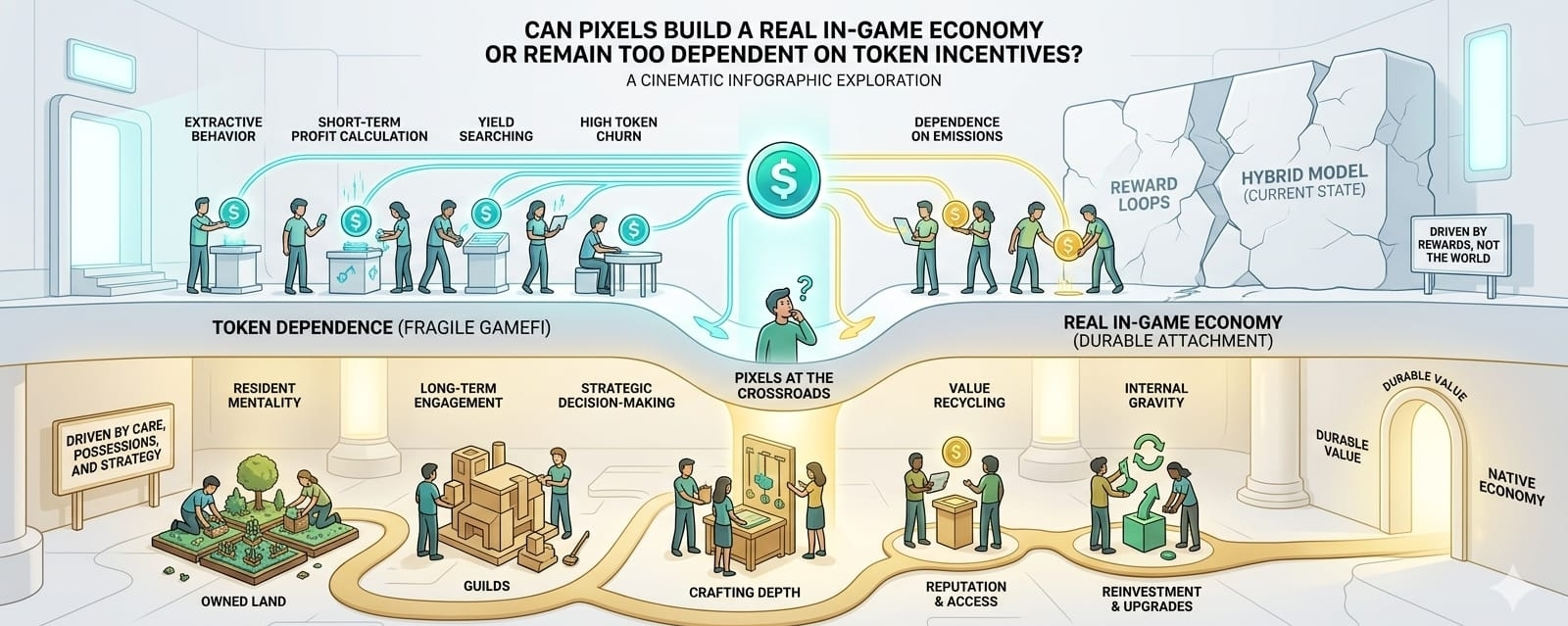
What keeps pulling me back to Pixels is not the token, and not even the game itself in the simple sense. It is the question sitting underneath it.
I keep wondering whether Pixels is actually becoming a real in-game economy, or whether it still depends too much on incentives to hold everything together.
To me, that is the most important question in Web3 gaming, and probably the one people avoid the most. It is much easier to talk about growth, wallets, activity, market cap, or new features. Those things are visible. They give people something clean to point at. But the real health of a game economy is usually harder to see. You feel it more than you measure it.
That is why I find Pixels so interesting.
On the surface, it is easy to understand why it worked. The game is approachable. It looks friendly. The loop is simple enough that almost anyone can grasp it quickly. You gather, farm, craft, build, trade, improve your land, join guilds, and keep moving. In a space where so many Web3 games felt like spreadsheets wearing costumes, Pixels felt more like an actual place. That mattered.
But I have learned to be careful with that first impression.
A game can feel alive without actually being economically alive. Those are not the same thing. I have seen plenty of projects with busy marketplaces, active users, and strong reward loops that looked healthy from the outside, only to realize later that most of the movement was being rented by incentives. Once the rewards weakened, the entire system started feeling hollow.
That is the lens I use when I look at Pixels.
The core issue, at least from where I stand, is whether players are participating because the world itself has value, or because the token still does too much of the emotional work. I do not think that is a small distinction. In fact, I think it is the whole story.
A real in-game economy begins when players stop interacting with the game like short-term extractors and start behaving more like residents. That shift changes everything. People stop asking only, “What can I earn?” and start asking better questions. What is worth upgrading? What is worth holding? What gives me a real advantage? What makes my place in this world stronger? What is worth paying for even if the reward is not immediate?
That is where I think Pixels is trying to go.
And to be honest, I respect that.

A lot of Web3 projects never even get that far. They keep leaning on emissions and calling it engagement. They confuse traffic with depth. Pixels at least seems to understand that if the economy is going to last, it has to give players reasons to spend, care, and stay that are not entirely dependent on incentives.
You can see traces of that in how the game has evolved. Land matters. Guilds matter. Reputation matters. Premium access matters. Crafting depth matters. These things may sound ordinary, but they are exactly the kind of systems that can slowly turn a reward loop into an economy. They create differences between players. They create pressure. They create reasons for trade, for strategy, for reinvestment.
And I think that word matters here: reinvestment.
For me, the difference between a weak GameFi economy and a stronger one usually comes down to whether players are mainly extracting value or cycling it back into the world. When people constantly want to pull value out, the game starts to feel temporary. When they begin to put value back in — by upgrading, acquiring, building, joining, holding, improving — the economy starts to gain weight.
Pixels feels like a project caught right in the middle of that transition.
That is why I cannot dismiss it, but I also cannot fully endorse the stronger claims people sometimes make about it. I do not think it is fair to call Pixels just another token farm anymore. That feels outdated. The project has clearly been trying to build more internal logic into its economy. It is not only relying on raw emissions to create activity. There is more structure now, more friction, more intentionality.
But I also do not think it has fully escaped token dependence.
That is the part I keep coming back to.
In Web3, tokens almost always become the loudest object in the room. Even when a team is trying to build a real world around them, the token keeps pulling attention back toward price, unlocks, rewards, profitability, and short-term behavior. That pressure is hard to overcome. It can distort player behavior, flatten the meaning of progression, and turn every design choice into a financial calculation.
Pixels is not immune to that. I do not think any Web3 game really is.
What makes Pixels different is that it seems more aware of the danger than most. It feels like a game that has already seen what over-reliance on incentives can do. And now it is trying to rebalance itself without losing the activity that got it here in the first place. That is a difficult thing to do. Maybe one of the hardest things to do in this sector.
Because the truth is, incentives are useful. They help bootstrap economies. They create momentum. They attract players early. They make people pay attention. The problem is not incentives themselves. The problem is when they become the only real reason the economy works.
That is where the line gets drawn for me.
If players are only active because rewards are attractive, then the economy is still fragile no matter how large it looks. But if players begin to care about ownership, convenience, efficiency, social position, access, and long-term progression in ways that feel natural inside the game, then something more durable starts to form.
That is what I am watching for with Pixels.
Not whether it can create activity. It already proved it can do that.
Not whether it can attract attention. It already did that too.
What I want to know is whether it can create attachment.
Can it make players feel rooted enough in the world that they spend because they want to strengthen their position, not just because they are calculating returns?
Can it make land feel meaningful beyond resale?
Can it make guilds feel valuable beyond coordinated farming?
Can it make progression feel personal enough that people invest in it even when rewards cool down?
Those questions matter more to me than almost any dashboard metric.
Because if the answer becomes yes, then Pixels has a chance to become one of the rare Web3 games with an economy that actually belongs to the game. Not just to the token wrapped around it.
And if the answer is no, then it will still struggle with the same weakness that has haunted this entire category for years: too much external incentive, not enough internal gravity.
My honest view is that Pixels is closer than many projects have ever been, but it is still in that awkward middle stage where the scaffolding is visible. You can see what it wants to become, and you can also still see what is holding it up.
That does not make it weak. In some ways, it makes it more credible.
I trust projects more when they look like they are wrestling with the real problem instead of pretending they already solved it. Pixels feels like that kind of project to me. Imperfect, still dependent in some ways, but moving toward a better model.
So when I ask whether Pixels can build a real in-game economy, I am not asking whether it can survive another burst of hype. I am asking whether it can create a world where value starts to feel native, not borrowed.
That is a much harder thing to build.
And honestly, that is why I still take it seriously.