I have been looking at @Pixels differently lately and honestly, it doesn’t feel like a typical game anymore.
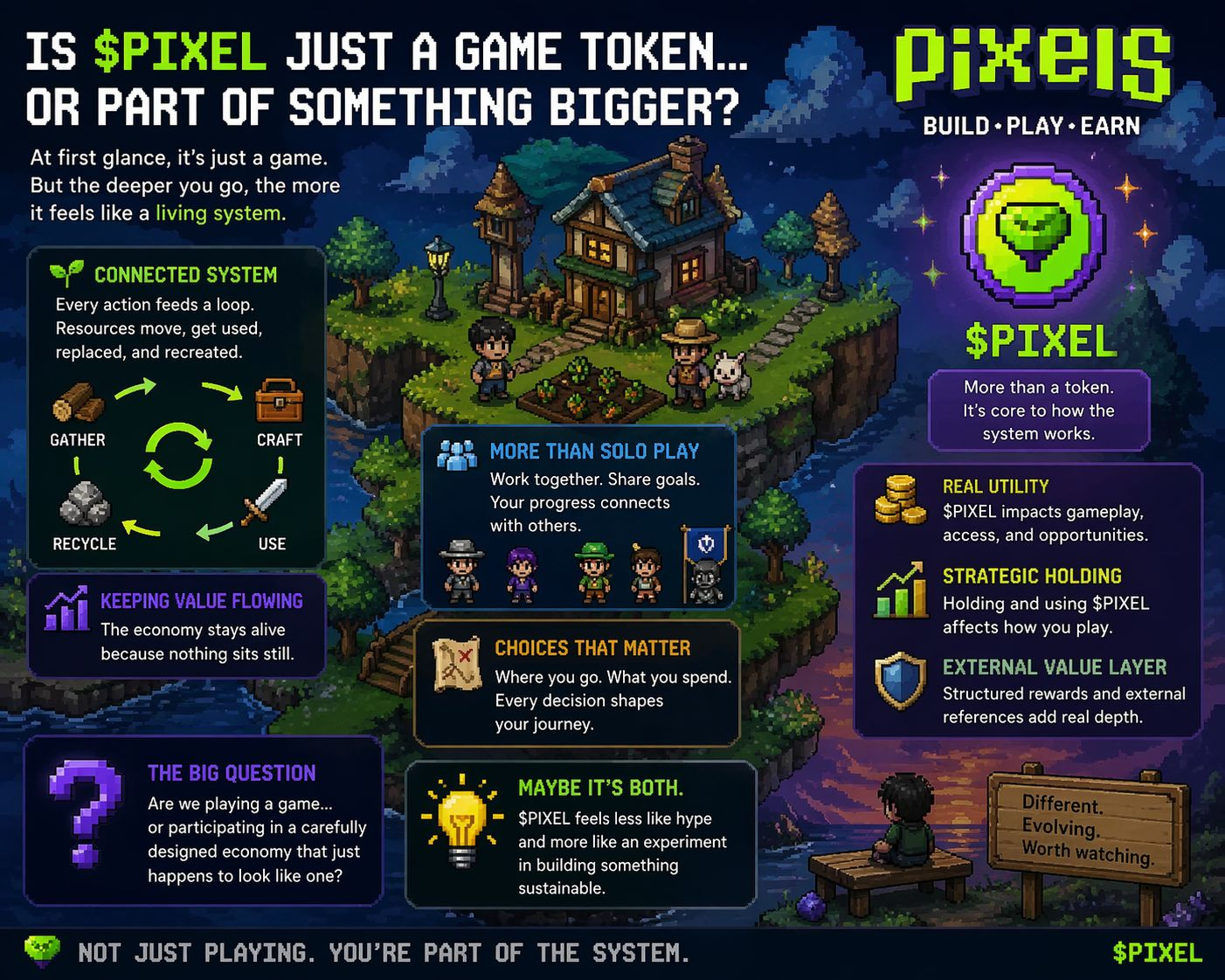
At the surface, it’s easy to understand, grow resources, craft items, earn rewards. But once you spend more time inside, it starts to feel less like gameplay and more like participation in a living system.
What stands out to me now is how everything seems connected. Progress isn’t just about grinding harder, it’s about making decisions, what to produce, when to use it, when to hold back. Every action feeds into a bigger loop.
And that loop matters.
Resources don’t just sit there anymore. They circulate. They get used, replaced, and recreated. That constant movement gives the environment a kind of rhythm that keeps things from going stale.
Then there is the shift away from solo play.
You are not just operating on your own anymore. There’s coordination, shared objectives, and a growing sense that individual progress ties into something collective. That alone changes how people approach the entire experience.
Even access to certain activities now feels intentional. You are making choices about where to spend your time and assets, not just clicking through repetitive tasks. It adds a layer of strategy that wasn’t obvious at first.
What really caught my attention though is how value is evolving.
$PIXEL isn’t just something you earn and move on from. It’s starting to play a deeper role, impacting how you interact with the system itself. Holding it, using it, allocating it… all of that feels more meaningful than before.
And when you combine that with structured rewards and external value references, it starts to blur the line between “game currency” and something more functional.
So now I keep coming back to one question:
Are we playing a game…
or participating in a carefully designed economy that just happens to look like one?
Maybe it’s both.
And maybe that’s the whole point.
$PIXEL feels less like a short-term hype cycle now and more like an experiment in building something sustainable.
Whether that balance holds over time is another story…
but it’s definitely not something I’m looking at casually anymore.