
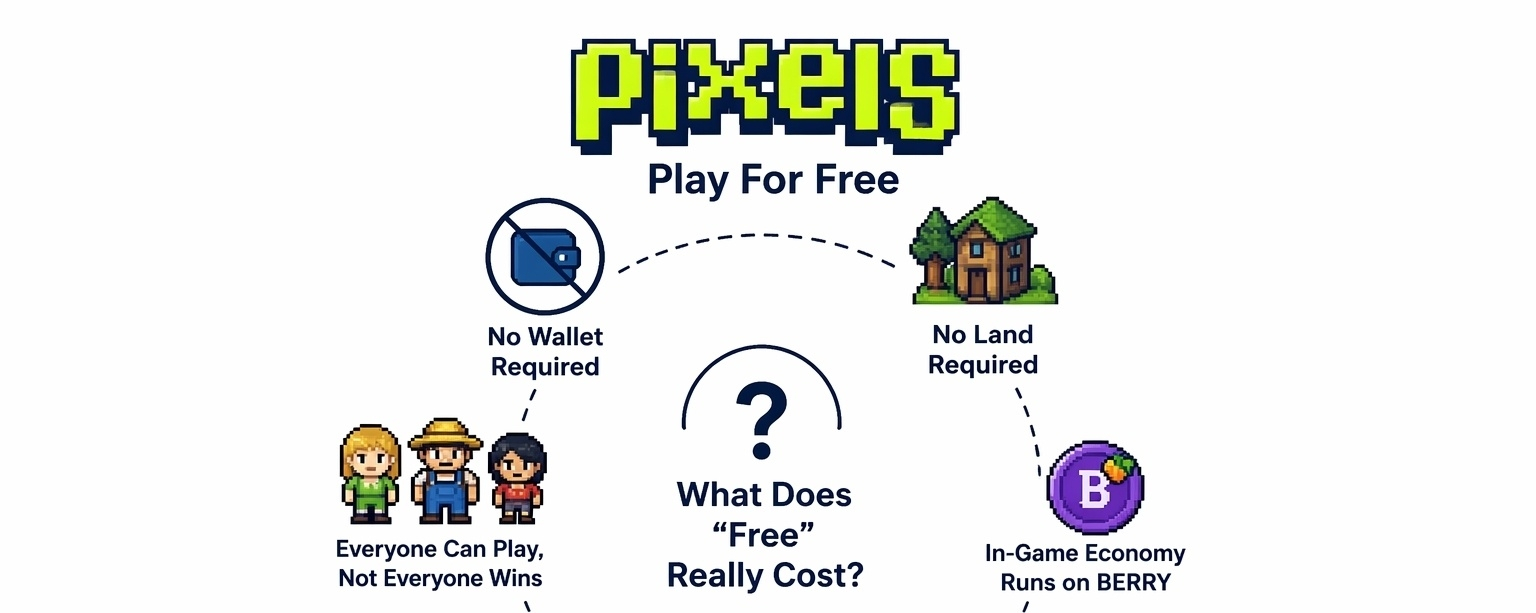
I don’t look at Pixels (PIXEL) as a “game” in the way most people casually do when they first encounter it.
I look at it more like a system that is still trying to figure out what it wants to become—an economy wearing the skin of a game, or a game slowly learning how to behave like an economy.
And I’ve seen enough cycles in this space to know something uncomfortable: most things don’t fail loudly. They just quietly stop evolving.
That’s why Pixels interests me—not because it is obviously dominant or groundbreaking in a headline sense, but because it sits in that strange middle state where meaning is still being negotiated.
Nothing is fully settled. Not the player behavior. Not the economic loop. Not even the identity of what participation really means.
And that kind of uncertainty is usually where real systems either crystallize—or dissolve.
I’ve learned to distrust first impressions in this space
When I first look at a Web3 game like Pixels, I don’t try to understand what it says it is.
I try to understand what it quietly demands from behavior.
Because most of the surface narrative in this space is just packaging. Farming, exploration, crafting—these are familiar mechanics. Comfortable ones. They don’t tell me anything new on their own.
What tells me something is repetition.
What do players come back to without being pushed?
What do they do when nothing exciting is happening?
What loops survive boredom?
Pixels, from what I observe, is built heavily around repetition disguised as simplicity. Farming cycles, resource management, daily interaction patterns—these are not dramatic systems. They are slow systems.
And slow systems are often misunderstood because they don’t produce instant emotional feedback.
But I’ve learned that what feels slow to a user is often exactly what allows an economy to stabilize underneath.
I don’t think people fully understand what “play” becomes here
There’s a narrative I keep seeing repeated in Web3 gaming circles: that players are either playing or earning.
But in reality, that separation doesn’t hold up inside systems like Pixels.
Because behavior doesn’t follow clean categories.
When I watch how people interact with these environments, I don’t see “players” in a traditional sense. I see behavioral patterns that shift depending on motivation, fatigue, curiosity, and expectation.
Sometimes they optimize. Sometimes they drift. Sometimes they just repeat because repetition feels stable.
And that’s where the real system lives—not in intention, but in rhythm.
Pixels isn’t just asking people to play.
It is quietly training them into cycles of interaction where value is produced indirectly through time spent, consistency, and participation density.
That doesn’t automatically make it sustainable. But it does make it structurally interesting.
Because time becomes an input, not just a byproduct.
And time is the most underestimated variable in digital economies.
I’ve seen enough cycles to recognize “quiet phases”
There’s a phase in almost every digital ecosystem where nothing looks particularly exciting from the outside.
No explosive growth. No obvious narrative dominance. No constant external attention.
Most people interpret that as weakness.
I’ve learned not to.
Because that phase is often where the system stops chasing attention and starts building internal consistency.
Pixels feels like it spends a lot of time in that kind of state—where movement exists, but it’s not performative. It’s not designed for spectacle.
And I’ve noticed something important over the years:
Attention-based systems grow fast and collapse fast. Behavior-based systems grow slowly and, if they survive, tend to last longer.
The problem is that the early stages of both look almost identical to most observers.
So people misread silence as failure.
But silence is often just absence of external validation—not absence of internal activity.
I think the real question is not “what is Pixels?”
It’s “what kind of behavior does Pixels normalize over time?”
Because at a structural level, that’s all these systems really are: behavior-shaping environments.
Pixels, with its farming loops, exploration mechanics, and creation systems, is essentially trying to anchor attention into repeated actions that feel light individually but accumulate meaning collectively.
That’s the subtle part most people miss.
No single action matters much.
But repetition changes everything.
And once repetition becomes habitual, the system no longer needs to push as hard externally.
It begins to sustain itself internally.
At least in theory.
I’m skeptical of narratives that reduce everything to hype or failure
I’ve seen too many projects in this space judged too early.
The market loves clear categories:
success or failure
growth or stagnation
adoption or abandonment
But systems like Pixels don’t fit neatly into those binaries while they are still forming.
What I see instead is something more ambiguous:
A system trying to stabilize behavior before it tries to scale attention.
And that order matters more than most people realize.
Because scaling attention before stabilizing behavior usually leads to collapse disguised as growth.
Pixels doesn’t feel like it is in that explosive phase. It feels more like it is still trying to anchor itself into predictable human routines.
And routines are harder to build than hype cycles.
But also more durable when they work.
I keep coming back to one uncomfortable idea: ownership here is not what people think it is
On paper, ownership in these systems is simple—you hold assets, you control them.
But in practice, I see something more conditional.