
When the dollar starts to lose strength overseas, Bitcoin tends to rally and climb. Looking at the cycles of that DXY (which measures the dollar's value against other strong currencies) alongside BTC's price, you can see this pattern repeating.
According to the folks at Mercado Bitcoin, when the DXY drops around 10%, Bitcoin usually pumps over 50% — and sometimes it rockets way beyond that. This happens because more cash flows into the market, people are more willing to take risks, and since Bitcoin is priced in dollars, it ends up reaping the benefits.
When interest rates abroad loosen or the market starts to let go of the dollar, there's more cash looking for better returns. That’s when Bitcoin kind of 'pulls' some of that money towards itself.
Between 2014 and 2020, this relationship was pretty strong. To give you an idea, about 70% of Bitcoin's variation moved in the opposite direction of the dollar.
And it's not just theory. In 2017, the dollar dropped about 10% and Bitcoin almost quadrupled in a few months. Then between 2020 and 2021, the dollar fell over 12% and Bitcoin shot up more than 500%.
Even in smaller timeframes, this shows up: dips of 5% in the dollar over a few months usually come with nice spikes in Bitcoin.
At the end of the day, here's how it works: a weaker dollar usually comes with more money circulating and lower interest rates. That's when investors step out of safer assets and chase after things that might yield more — like stocks, commodities, and crypto.
And Bitcoin has an important detail: you can't just increase its supply. So, when more people want to buy, the price goes up.
Here in Brazil, this also affects people's behavior. When the dollar drops, it becomes easier to invest abroad, and many people end up going for riskier assets.
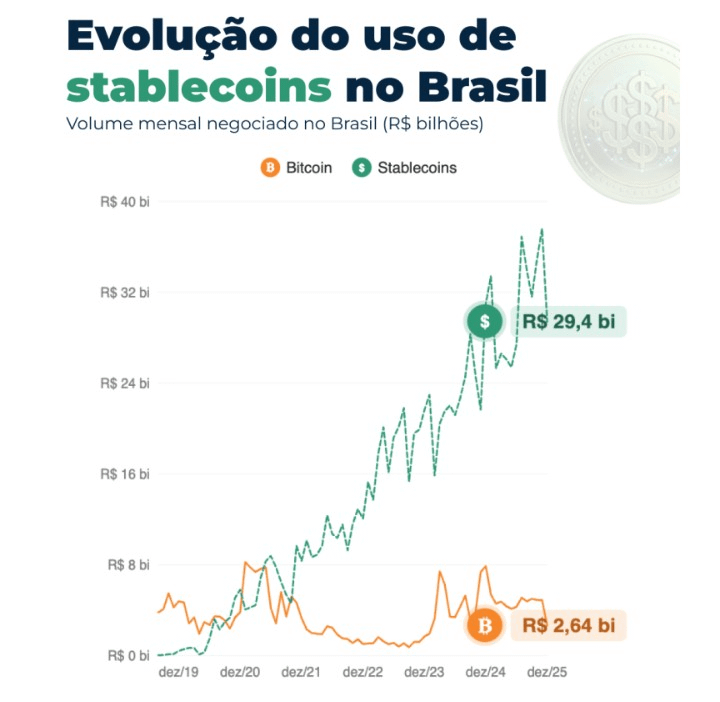
Nowadays, a lot of this inflow happens through stablecoins. They dominate the Brazilian crypto market and serve as an entry point. People get into them first and then eventually migrate part of their money to Bitcoin.
Well, the dollar still has its weight, you know… but it doesn't dictate Bitcoin like it used to.
The folks at Mercado Bitcoin say this relationship has kind of changed lately, especially after 2024, when more big money started flowing in, those institutional funds, via Bitcoin ETFs in the United States.
With this, Bitcoin started to see more solid, planned buying, not just depending on short-term market sentiment. Before, the link between the dollar and BTC was pretty strong — back between 2014 and 2020, it was around 0.7. Then, from 2021 to 2024, it dropped to about 0.45.
And there was a curious case in March 2026: the dollar was even rising, hitting a three-month high, and yet Bitcoin went on to keep climbing, surpassing 72k dollars. So, it doesn't always work the other way around.
According to MB, this shows that Bitcoin is becoming more 'mature', you know? It's not just that asset that goes up when there's extra cash floating around the world. Today, it's also starting to be seen as an alternative in more complicated economic times.
In summary: a weak dollar still helps, giving that little nudge… but Bitcoin is now starting to walk on its own.