
Market felt slow today — not the anxious kind of slow, just flat. I had a tab open with charts I wasn't really reading, and somehow I ended up going down a rabbit hole on Pixels, $PIXEL , #pixel , @Pixels — specifically this framing that keeps appearing around it. The "digital economy" angle. The idea that this thing, if you zoom out, looks like a country.
And I kept sitting with that. Not because it's wrong exactly. But because the word "country" carries a lot of assumptions that I don't think people are examining.
When someone says Pixels is a digital economy — or frames it like a nation-state with its own currency, labor, land, and GDP — the instinct is to nod along. It sounds sophisticated. It sounds like a thesis. But here's what actually snagged me: real countries have redistribution mechanisms. Taxes. Public goods. Some version of the surplus flowing back toward the people doing the work. The whole social contract thing.
Pixels doesn't have that. What it has instead is a remarkably clean extraction architecture dressed up in the language of citizenship.
I had to stop and reread that to make sure I wasn't being unfair. But no — I think it holds. Landowners in Pixels aren't landlords in the casual sense. They're more like the architects of a company town. You've heard of those — the 19th century industrial model where the factory owner also owned the housing, the store, the currency. Workers earned, but the system was designed so that earning and accumulating were two different things, and only one of them was actually accessible. Pixels, structurally, rhymes with that more than it rhymes with a country.
The farmer — the entry-level player doing the actual daily loop, planting, harvesting, crafting — moves real volume through the system. The energy caps, the land lease fees, the guild splits: each one is a toll. Not hidden, not illegal, just... baked in. The narrative says "you're building in a digital economy." The mechanism says "you're servicing someone else's asset."
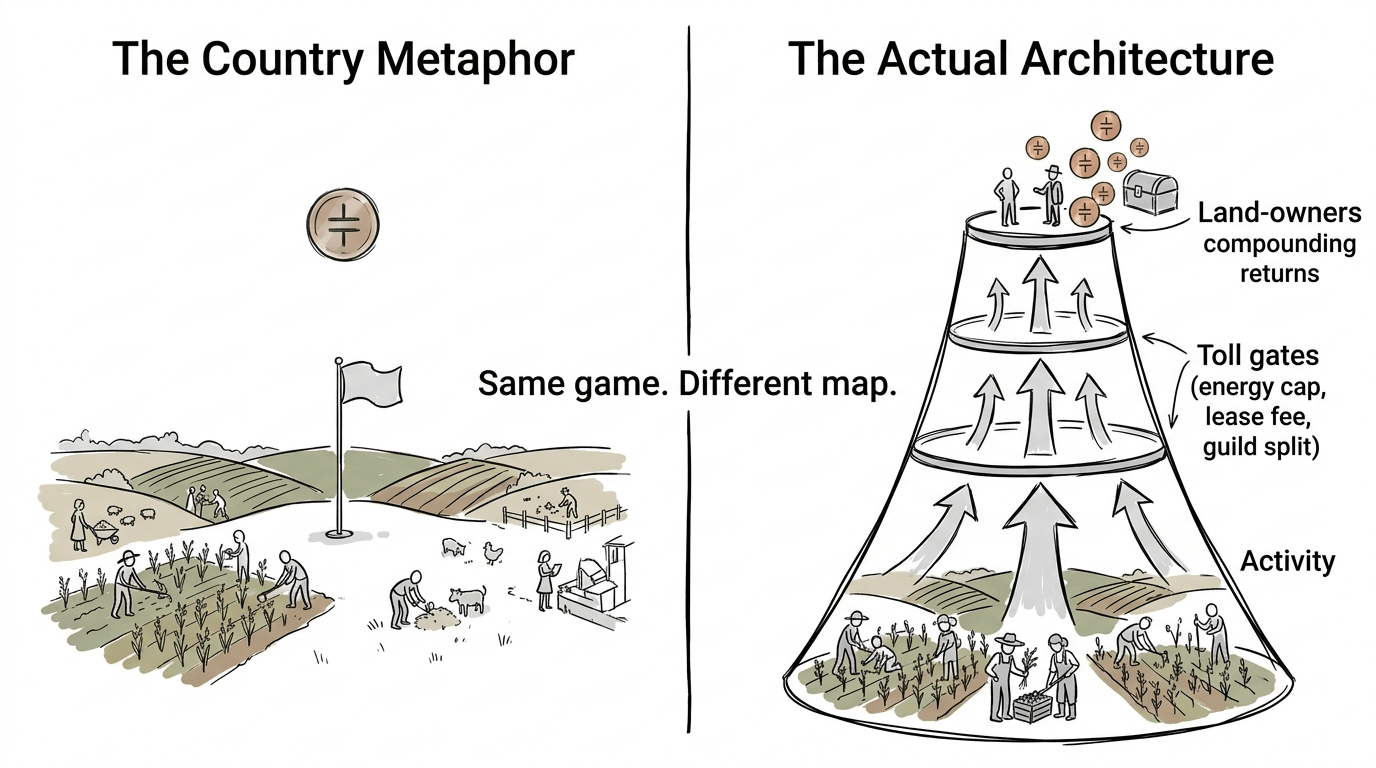
And people celebrate this. Which, okay, I get it — it's a game, it's opt-in, the land NFTs were publicly available. But I think the "country" framing is doing specific work here. It makes the hierarchy feel like geography instead of design. Countries have mountains and valleys — you don't blame the mountains. If Pixels is a country, then land concentration is just terrain. If it's a company town, the design choices become visible and the questions get sharper.
Here's the part that bothers me though, and I want to be honest about this because I don't think I've fully resolved it: what if the people who designed this system knew exactly what they were building, and the country metaphor was never meant to describe reality — just to make the pitch comfortable enough that people would participate? That's a different kind of uncomfortable. Because then the ones actually profiting aren't confused about what Pixels is. They're just fluent in the metaphor in a way the average farmer isn't.
I'm not sure that's cynical. It might just be accurate.
What changes if you hold this frame? Probably your entry point calculus. Landless participation in Pixels reads differently when you stop calling it "farming in a digital economy" and start calling it "labor within someone else's yield-generating infrastructure." Same actions, different implications. The token still moves. The game still runs. But the question of who is building equity versus who is generating volume — that answer doesn't change just because the framing is cheerful.
The people I know who are genuinely patient about crypto projects always say the same thing: follow the surplus. Not the revenue. Not the TVL. The surplus — what's left over after the mechanism runs, and where it goes. In Pixels, I think that trail is shorter and cleaner than the country metaphor wants you to believe.
Anyway. $PIXEL has been doing its own thing lately regardless of any of this. Maybe the metaphor doesn't matter to price. It rarely does, short term.
I'll probably just keep watching how the land concentration numbers shift as the game scales. That'll tell me more than any framing will.