

The Brent crude oil price crossed $102.50 per barrel on April 23, 2026, as the second round of US-Iran peace talks collapsed without agreement, leaving Iran’s demand for a $2M security transit fee on every tanker passing through the Strait of Hormuz, a chokepoint through which roughly 20% of global oil supply transits daily, as the central unresolved flashpoint.
The de facto closure of the strait, which previously handled approximately 20 million barrels of oil and gas per day, has already cut regional exports by an estimated 10 million barrels daily, a supply shock the International Energy Agency’s head Fatih Birol characterized as “absurd but real” and the worst energy supply crisis in history.
The transmission from geopolitical deadlock to equity market opportunity is direct: sustained $100-plus oil fundamentally reprices free cash flow generation across the domestic energy sector, and the war premium injected into energy markets is now forcing a capital allocation conversation at every major US producer.
The sections below examine the Hormuz mechanism, the domestic producer windfall math, and whether this price environment accelerates the sector’s next major share repurchase cycle.
Tehran’s Tollbooth: The Hormuz Transit Fee Demand and Its Supply-Side Arithmetic
NEW: SCAMMERS ARE PROMISING “SAFE PASSAGE” THROUGH THE STRAIT OF HORMUZ TO STRANDED SHIPS FOR CRYPTO – GREEK FIRM MARISKS BELIEVES THAT AT LEAST ONE OF THE VESSELS, WHICH TRIED TO EXIT THE STRAIT ON SATURDAY AND WAS HIT BY GUNFIRE, WAS A VICTIM OF THE FRAUD SOURCE:… pic.twitter.com/7zV8IyACyf
— DEGEN NEWS (@DegenerateNews) April 21, 2026
Iran’s 10-point peace proposal, deemed a non-starter by Washington, requires vessels transiting the Strait of Hormuz to pay a fee of up to $2M, in Chinese yuan or cryptocurrency, and to disclose cargo details to Iranian authorities.
This system was recently trialed at $1 per barrel for a 2-million-barrel tanker, with Iranian Revolutionary Guard Corps escorting approved vessels. Ships from Malaysia, China, Egypt, South Korea, and India have been allowed passage, though it’s unclear if tolls were paid.
The geopolitical risks extend beyond fees alone. The think tank Bruegel estimates a price impact on world oil of only $0.05 to $0.40 per barrel, but Gulf producers may bear 80% to 95% of the cost, potentially amounting to $14Bn annually.
Legal and operational challenges add to financial strain: Western companies face sanctions, insurers raise premiums for hazardous routes, and seafarers in the area are entitled to double pay. Analysts now predict the oil price near $100 per barrel into 2027, as infrastructure damage from the strait’s closure makes a quick return to pre-crisis levels unlikely.
Domestic Producer Windfall: How $100 Brent Oil Price Reprices Energy Sector Free Cash Flow
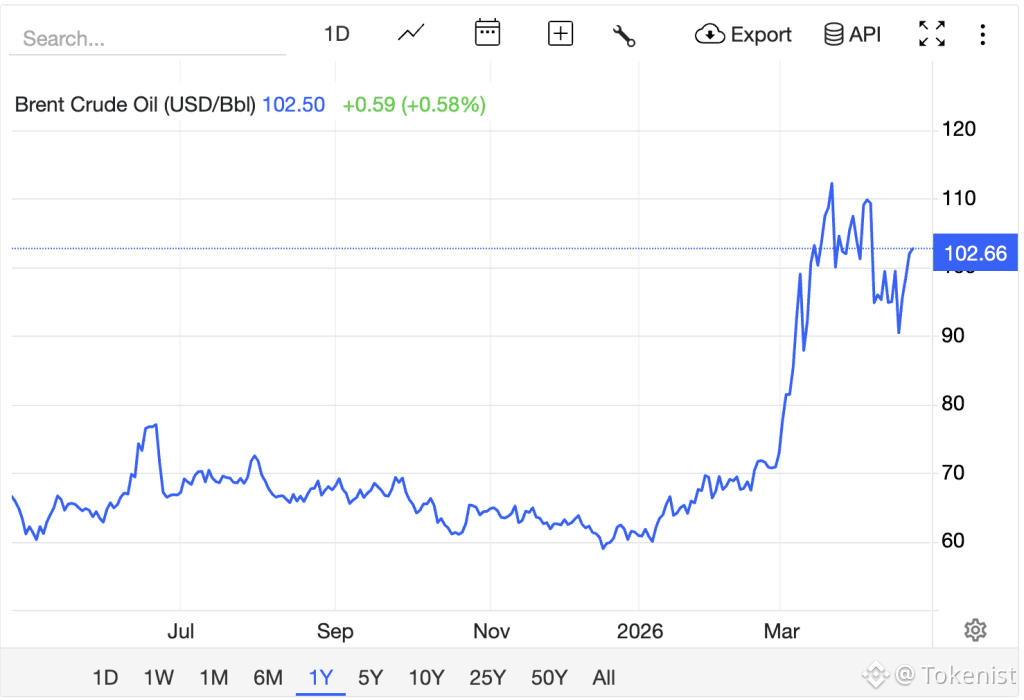 SOURCE: TradingEconomics
The transmission from the Strait of Hormuz to domestic producers is evident. Permian Basin operators have break-even costs of $45 to $55 per barrel, while Bakken and Eagle Ford producers are slightly higher at $50 to $60 per barrel.
With Brent at $102.50 and WTI at a $4 to $6 discount, US shale producers enjoy margins between $40 and $55 per barrel, significantly boosting free cash flow compared to when oil was around $70 in late 2025.
ExxonMobil (NYSE: XOM) and Chevron (NYSE: CVX) are central to this repricing. XOM expects about $15Bn in annual free cash flow at $65 Brent, with each $10 increase adding approximately $4Bn more. At $100 oil, XOM’s annualized free cash flow could reach $27 to $30Bn, surpassing its capital needs.
CVX reports a similar sensitivity: each $10 increase in the oil price results in around $2Bn in additional cash flow, yielding substantial free cash flow at $100 oil. Smaller domestic operators are also benefiting from higher equity prices amid concerns about Middle East supply.
Share Buybacks and Capital Return Acceleration: Whether $100 Oil Repeats the 2022 Playbook
The 2022 analog is relevant as Brent crude averaged over $100, prompting XOM to execute $15Bn in share repurchases and CVX to return over $11.6Bn to shareholders through buybacks. Both companies have active repurchase programs: XOM with $20Bn and CVX with up to $75Bn through 2024.
The market is assessing whether sustained $100-plus oil till mid-2026 will prioritize buybacks over debt reduction or capex. Goldman Sachs noted that major producers might accelerate buybacks in Q2 if prices hold above $95, as they aim to return at least 30% of operating cash flow to shareholders.
This creates tension between capping reinvestment and the profitability of new Permian wells, with buyback acceleration likely to dominate Q2 earnings calls, reflecting historical trends in large-cap tech companies during high-cash-flow periods.
Disclaimer: The author does not hold or have a position in any securities discussed in the article. All stock prices were quoted at the time of writing.
The post US-Iran Negotiation Collapse: $100 Oil Price and Energy Sector Buyback Speculation appeared first on Tokenist.