
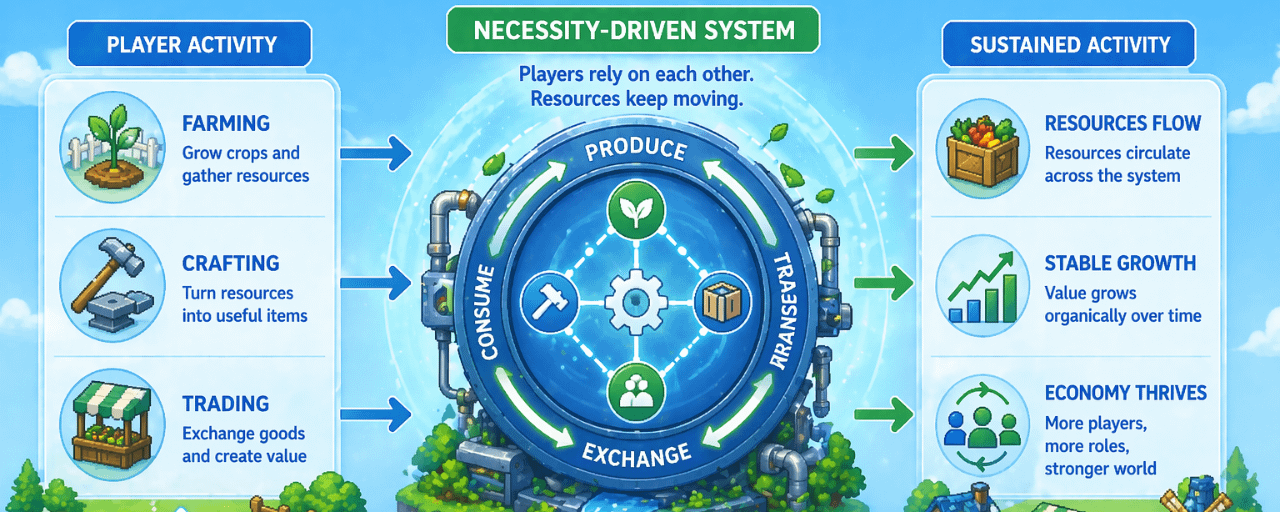
Most Web3 games focus heavily on what players do, but I used to overlook something equally important—how systems respond back to players over time. In many cases, the relationship is one-directional. You act, the game rewards you, and the loop continues without much variation.
The system itself remains fixed, and players simply learn how to operate within it as efficiently as possible. So when I first started exploring Pixels, I assumed it would follow that same structure—consistent inputs, predictable outputs, and a system that doesn’t really change based on how people interact with it.
At that point, it felt like just another environment where activity drives rewards, but the underlying structure stays the same.
But the more I observed how things actually unfold inside Pixels, the more I began to notice something different—a sense that the system isn’t just reacting in isolated moments, but gradually adapting based on accumulated player behavior.
It’s subtle at first, almost unnoticeable, but over time it becomes clearer that the system reflects patterns rather than just actions. It doesn’t simply respond and reset. It absorbs what’s happening. It shifts based on how players engage collectively. And that introduces a powerful idea: the system starts to behave as if it has memory.
That changes the experience in a meaningful way. In most games, what happens today doesn’t really carry weight into tomorrow. Each session feels like a fresh loop where past activity is largely irrelevant.
But in @Pixels , there’s a growing sense that history matters, even if it isn’t explicitly shown. When players concentrate on certain activities for a period of time, the effects begin to ripple through the system. When attention moves elsewhere, new patterns begin to form. These changes are not always dramatic, but they accumulate. And as they accumulate, they create momentum—an underlying direction that shapes how the system evolves over time.
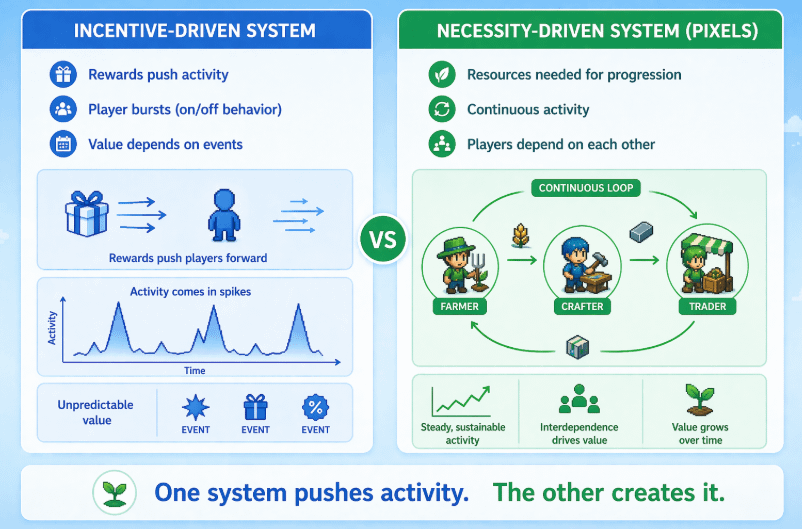
Once that becomes noticeable, the way you approach the game begins to shift. Instead of focusing only on what to do in the moment, you start paying attention to what has been happening and where things might be heading.
You begin to recognize patterns in behavior, shifts in activity, and changes in how value moves through the system. That awareness introduces a different kind of engagement—one that isn’t just about participation, but about observation. The more you pay attention, the more you start to see.
And that’s where the feature becomes especially interesting. Because now, progression isn’t just tied to effort—it’s influenced by understanding. Two players can spend the same amount of time performing similar actions, but the one who understands the system’s recent behavior will often position themselves more effectively.
They anticipate changes rather than reacting to them. They align with emerging patterns instead of following outdated ones. And over time, that difference compounds. It’s not about doing more—it’s about seeing more clearly.
This also changes how value is perceived within the system. In static environments, value is largely predefined and stable. But in a system that adapts over time, value becomes more fluid. What was useful yesterday might not be as important today.
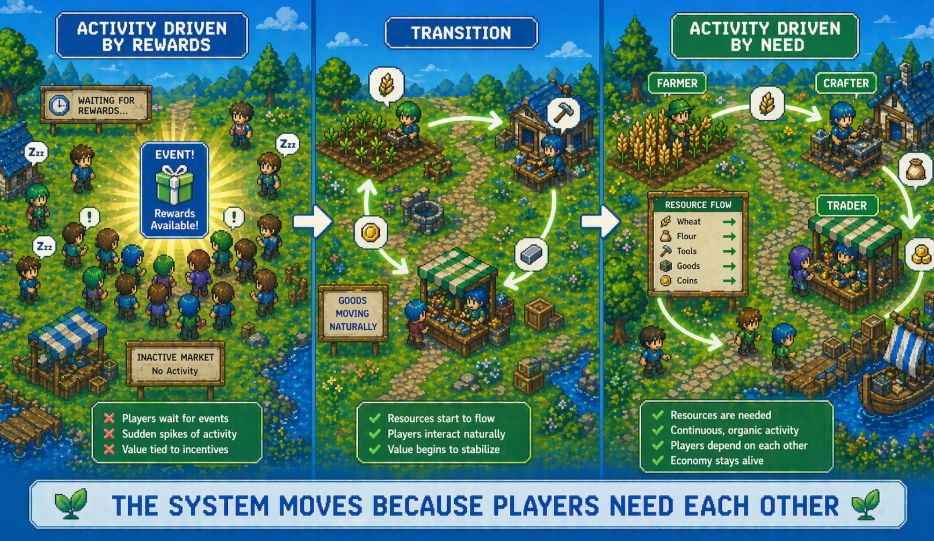
What seems insignificant now might become valuable later.
That fluidity creates both opportunity and uncertainty. Players who can read the system gain an edge, but that edge is never guaranteed to last. It evolves along with the system itself.
Of course, this kind of responsiveness introduces its own challenges. A system that adapts over time can be harder to predict, especially for newer players. It requires a deeper level of attention and patience to fully understand what’s happening beneath the surface.
There’s also the risk of imbalance, where certain patterns dominate for a period before correcting themselves. Maintaining stability in a dynamic system is always more complex than maintaining it in a static one. But even with these challenges, the direction is compelling because it moves away from rigid loops and toward something more alive.
Looking at it now, I don’t see Pixels as a system that simply reacts to individual actions in isolation. It feels more like a system that remembers, adapts, and evolves through the collective behavior of its players.
Every action contributes to something larger, even if the effect isn’t immediately visible. Over time, those contributions shape the environment itself, influencing what becomes valuable, what becomes scarce, and how players choose to engage.
And that raises an interesting question. If a system begins to reflect its own history and evolve based on how people interact with it, does that make it more engaging because it feels alive, or does it introduce a level of complexity that only certain players will fully understand?
