

I have seen many games try to scale by adding more content, more rewards, more noise. But very few step back and ask a harder question: what actually keeps a system growing without constantly feeding it external fuel? That is the question I keep coming back to with Pixels. Because beneath its calm farming surface, it is quietly experimenting with a different kind of growth engine.
At first, Pixels feels deliberately simple. You farm, you explore, you interact with other players. The loop is familiar and intentionally low pressure. This is not accidental design. It creates an environment where players can enter without friction and build habits without resistance. The game earns your attention before it tries to optimize it.
But as you spend more time in the system, the structure begins to reveal itself.
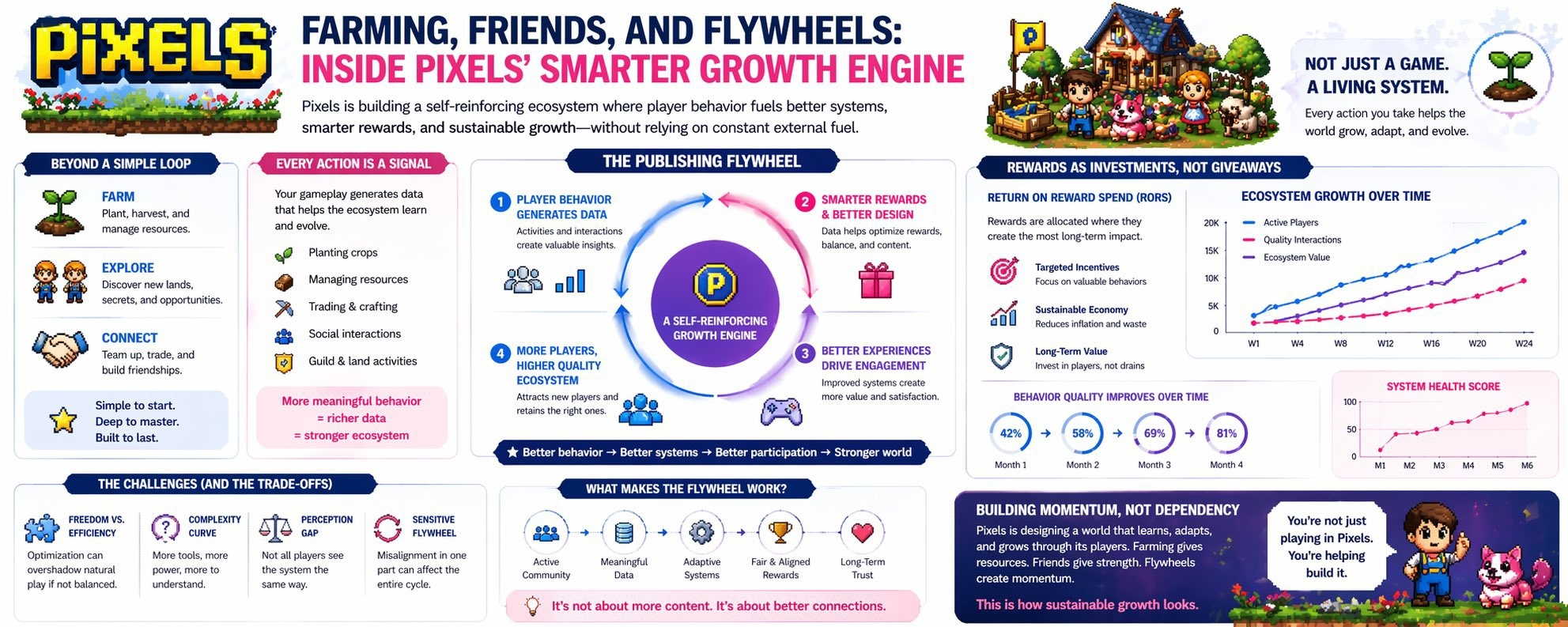
Farming is not just a loop. It is a signal.
Every action, whether it is planting crops, managing resources, or engaging with others, contributes to a broader dataset that shapes how the ecosystem evolves. This is where Pixels starts to diverge from traditional games. It is not only tracking progression. It is learning from behavior.
The social layer plays a critical role here. Players are not isolated units moving through a static world. They form guilds, collaborate on land, exchange resources, and indirectly influence each other’s outcomes. These interactions are not just features. They are inputs into the system. The more players engage with each other, the richer the ecosystem becomes.
This is where the idea of the flywheel begins to make sense.
Pixels’ litepaper introduces the concept of a publishing flywheel, where player behavior generates data, data improves reward targeting and game design, and improved systems attract more players and higher-quality experiences. It is a loop designed to feed itself. Not through inflation, but through refinement.
Better behavior leads to better systems. Better systems attract better participation.
That is the theory.
In practice, this creates a subtle but important shift in how the game feels. You are not just playing within a fixed design. You are participating in something that is continuously adjusting around you. Rewards are not static. They are increasingly shaped by what the system identifies as valuable behavior.
This is where Pixels becomes more strategic than it first appears.
The reward layer is no longer just about distribution. It is about allocation. Instead of asking how much to give, the system is trying to decide where rewards create the most long-term impact. This aligns closely with the idea of Return on Reward Spend, where incentives are treated as investments rather than giveaways.
I find this shift particularly significant.
Because it moves the game away from the typical Web3 pattern of over-incentivizing early activity and then struggling to sustain it. Instead, Pixels is trying to build a loop where growth is tied to meaningful engagement rather than raw participation.
But this approach comes with trade-offs.
The more the system optimizes around behavior, the more players may begin to optimize their behavior in return. What starts as a relaxed farming experience can gradually feel more structured, more calculated. Players begin to sense that certain actions are more “valuable” than others, even if the game does not explicitly say so.
That creates a tension.
Freedom versus efficiency.
I think Pixels is at its best when that tension is balanced. When the system quietly rewards meaningful play without making players feel like they are being directed toward specific behaviors. The moment optimization becomes too visible, the experience risks losing its natural rhythm.
There is also the question of accessibility. While the surface layer remains approachable, the underlying logic of the flywheel is not always obvious to players. Many will engage with the game without fully understanding how their actions feed into the larger system. This is not necessarily a problem, but it does create a gap between design intention and player perception.
Some players will simply farm. Others will start to see the system.
And those two experiences can feel very different.
In my opinion, what Pixels is building is less about a single game and more about a framework. A way of connecting gameplay, community behavior, and economic design into a loop that can sustain itself over time. The farming, the friendships, the progression systems, they are all part of that larger structure.
What makes it compelling is not that it is perfect, but that it is coherent.
The ideas connect.
The real challenge will be maintaining that coherence as the system grows. Flywheels are powerful, but they are also sensitive. If one part of the loop becomes misaligned, the entire system can lose balance. Rewards that feel unfair, systems that feel too optimized, or communities that fragment can all disrupt the cycle.
Pixels is still navigating those risks.
But I think it is moving in a direction that is worth paying attention to. Not because it guarantees success, but because it is asking the right questions about how games can grow without relying on constant external incentives.
In the end, Pixels is not just about farming or social play. It is about building a system where those activities generate momentum on their own. A game that learns, adapts, and evolves through the behavior of its players.
That is a more difficult path.
But if it works, it changes what sustainable growth in games can actually look like.@Pixels
