
Pixels has been showing up in a very specific corner of the market that most people still underestimate. It doesn’t sit cleanly in the usual narratives like DeFi or Layer 1 competition, and it doesn’t behave like the short-lived GameFi cycles that came and went in previous years. What caught my attention is not the surface-level idea of a farming game on Ronin, but the timing of why something like this is gaining traction now.
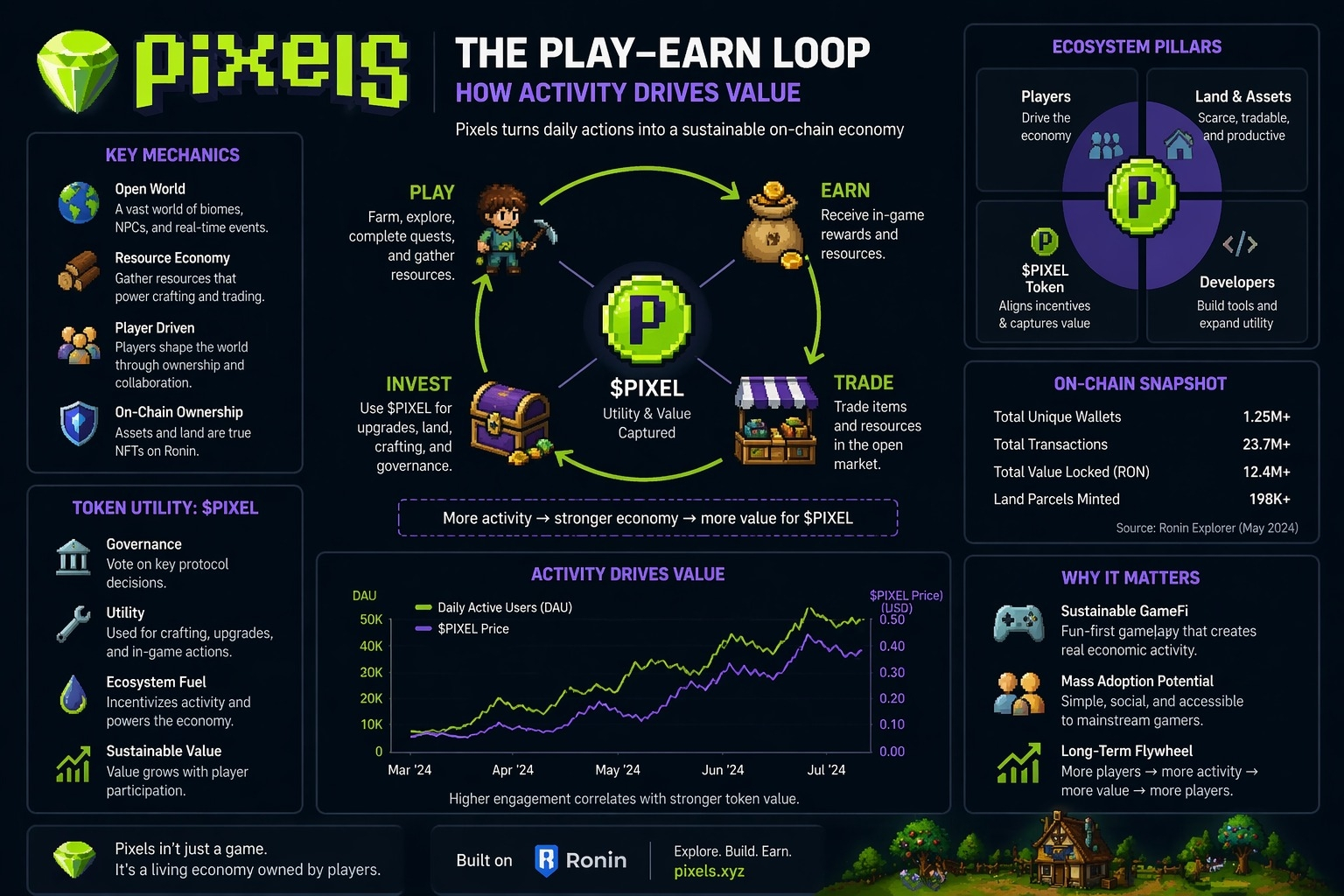
I’ve been watching how user behavior in crypto has shifted over the last couple of cycles. Speculation is still there, but it’s no longer enough on its own to sustain attention. People don’t just want upside—they want something to do while waiting for it. Pixels fits directly into that gap. It doesn’t try to reinvent financial primitives. Instead, it builds a loop where activity itself becomes the anchor, and the token sits on top of that activity rather than trying to force it into existence.
At a basic level, Pixels is simple. You farm, explore, gather resources, and interact with an open world. But what matters is how these actions translate into an economy. The system quietly turns time and engagement into measurable output. That output—whether it’s resources, items, or progression—feeds back into a broader loop that eventually connects to the token. It’s not a new idea in gaming, but in crypto, the difference is that these loops are visible, tradable, and financialized.
What I find interesting is how the Ronin ecosystem shapes this experience. Ronin already proved that it can onboard users who don’t necessarily come in for speculation first. That changes the quality of engagement. Instead of short bursts of capital rotating through narratives, you get slower, more consistent participation. Pixels benefits from that environment because it doesn’t rely on immediate token hype to justify its existence. It relies on retention.
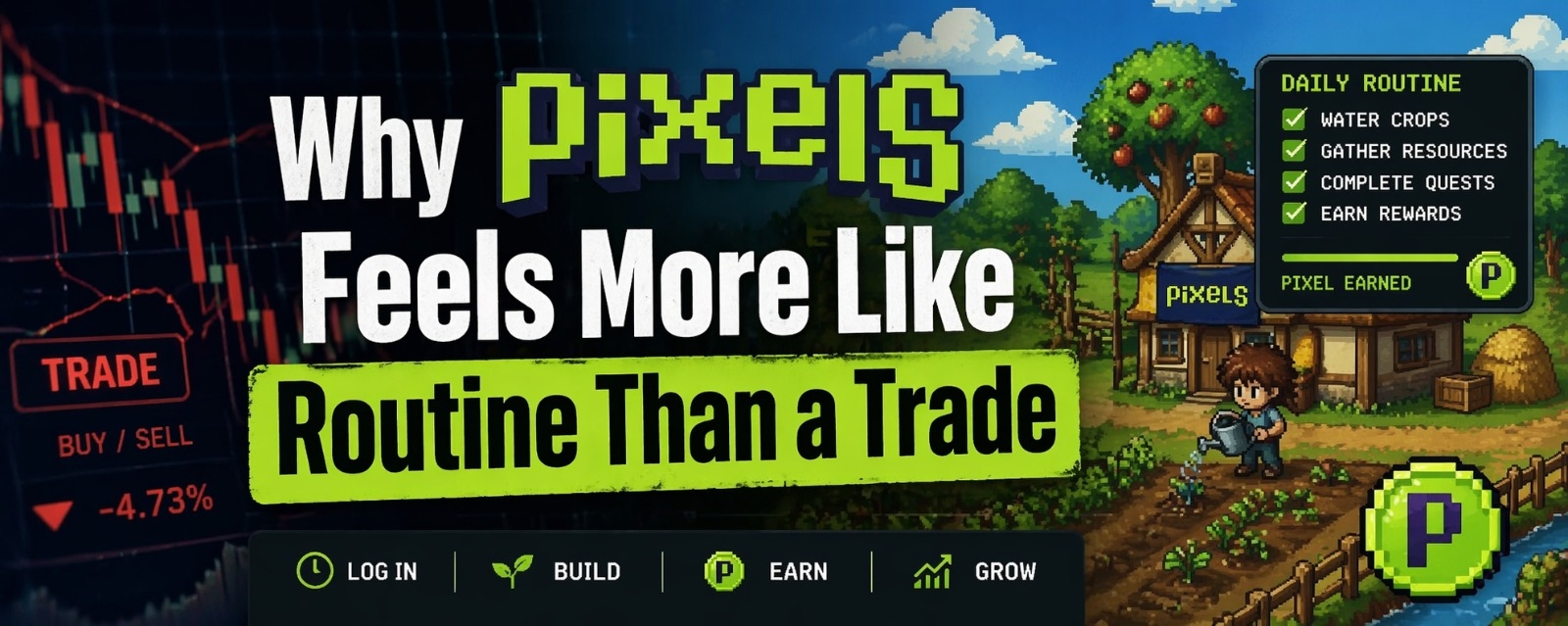
When I look at how users interact with Pixels, it feels less like trading and more like routine. People log in, complete tasks, build progression, and gradually accumulate value. This creates a different kind of pressure on the system. In most crypto projects, the main question is “who is buying?” In Pixels, the more relevant question becomes “who is staying?” That distinction matters because retention creates a baseline of demand that isn’t purely speculative.
The token, PIXEL, plays a role that is subtle but important. It acts as a bridge between in-game activity and external markets. But unlike many GameFi tokens from the past, its value doesn’t come solely from emissions or rewards. It is tied to participation. If activity grows, the token has a reason to exist. If activity drops, the weakness becomes visible very quickly. This creates a kind of transparency that many projects avoid.
There are trade-offs here that shouldn’t be ignored. The biggest one is that Pixels depends heavily on sustained user engagement. If the gameplay loop becomes repetitive or loses its appeal, the entire economic structure weakens. There’s no complex financial engineering to hide that. Another issue is that onboarding large numbers of users can dilute the experience if not managed carefully. More users don’t automatically mean a better economy—they can also create imbalance.
I’ve also noticed that the reward structure can attract the wrong type of attention during certain phases. When rewards are visible and measurable, it’s inevitable that some participants will try to optimize purely for extraction rather than engagement. That tension between players and extractors is something every on-chain game eventually faces. Pixels is not immune to it, and how it manages this balance will likely determine its long-term stability.
From a market perspective, the behavior of $PIXEL reflects these underlying dynamics. When activity increases, you tend to see more consistent accumulation rather than sudden spikes. When engagement slows, the impact is immediate. It’s less about narrative-driven pumps and more about whether the internal economy is functioning. That makes it a different kind of asset to watch. You’re not just tracking price—you’re tracking behavior.
Recent developments around creator campaigns and structured participation incentives suggest that the team is actively trying to shape how users engage with the ecosystem. This is where things get interesting. Instead of relying purely on organic growth, there’s a layer of guided activity being introduced. That can help in the short term, but it also raises questions about how much of the engagement is natural versus incentivized.
In the broader market cycle, Pixels feels like part of a transition phase. We’re moving away from purely speculative narratives toward systems that require ongoing interaction. Not because the market suddenly became more rational, but because attention itself has become harder to capture and keep. Projects that can hold attention without constant hype have a different kind of resilience.
What I keep coming back to is how unexciting @Pixels looks at first glance. There’s no dramatic promise, no aggressive positioning, no attempt to dominate headlines. And yet, it continues to build a user base that interacts with it daily. That kind of quiet consistency is rare in this space.
I don’t see Pixels as a guaranteed success, and I don’t think it’s trying to be. It feels more like an experiment in whether engagement can replace speculation as the primary driver of value. The answer isn’t clear yet. But if it works, even partially, it could reshape how people think about utility in crypto.
Right now, Pixels sits in that uncertain space between game and market, between routine and opportunity. And from what I’ve seen, the outcome will depend less on how exciting it becomes, and more on whether people keep coming back when there’s nothing new to chase.