Back in elementary school, I used to play marbles with the neighbor kid. One time, I won a round, and he went home to tell his dad. The next day, his dad confronted me and said that day’s game didn’t count because I supposedly stole from his son, insisting I had to return the marbles. I was furious and never played with that kid again because I realized that as long as his dad was around, the rules were always skewed in his favor—my wins didn’t mean anything. Over twenty years later, I still remember this because it taught me something important: the fun of the game isn’t what matters most; what truly matters is whether the rules are fair for everyone involved.
The most valuable thing, in fact, is this.
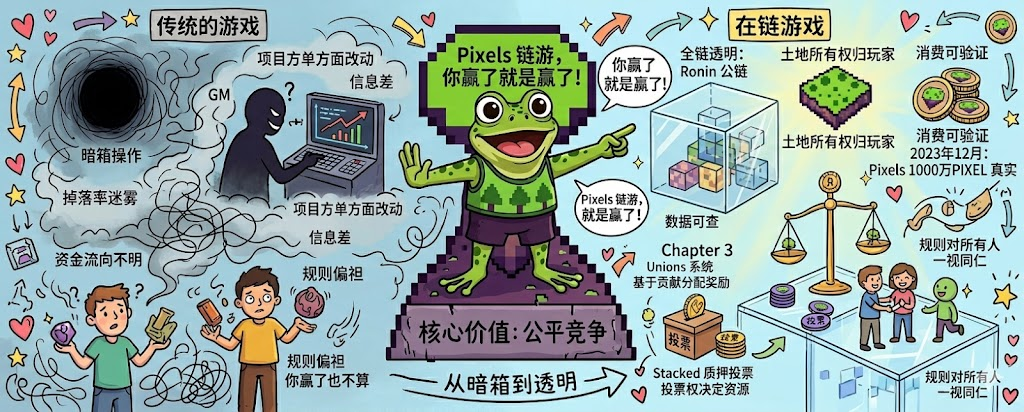
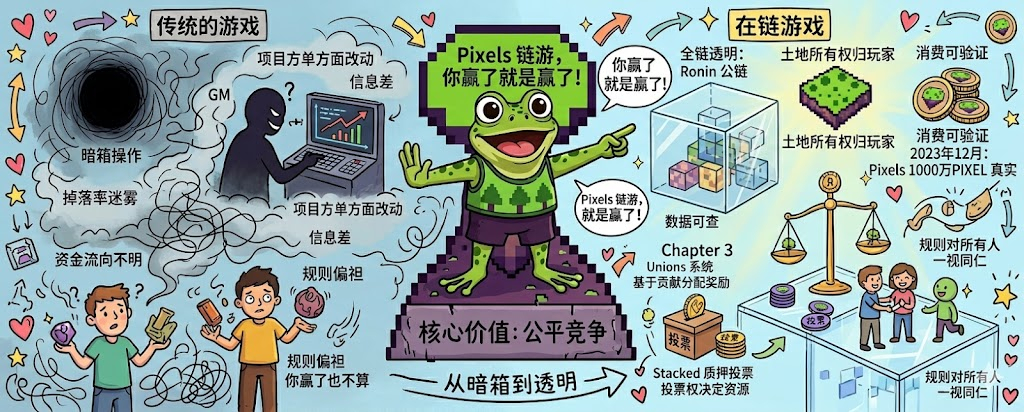
In traditional games, there's an information gap between players and operators. You have no clue how backend data is calculated, whether the drop rates are really as advertised, and where your money actually goes is a total mess. Everyone knows GMs might give certain players a leg up, but no one can clearly define it. Running on the Ronin blockchain, every transaction, land transfer, token flow, and staking record is on-chain and verifiable. Anyone can sift through this data on the blockchain explorer; the project can't secretly alter data or give special treatment to insiders, nor can they change your assets without you knowing.
This is way more important than it seems on the surface. That monthly consumption data of 10 million tokens in December 2024 is compelling because it’s not just some random number thrown out by the officials; it's accumulated on-chain, transaction by transaction. If you don’t believe it, you can check for yourself. What the project says on-chain is what it is; they can't change it later. This verifiability is something traditional games can't provide. In traditional games, if the project says DAU is 1 million, you just have to trust it; in blockchain games, you can count the addresses yourself.
Fair competition has another layer: equal opportunity among players. Pixels' land NFTs, PIXEL tokens, and in-game assets all have their ownership recorded on-chain. It's crystal clear who owns what, and the project can't sneakily distribute more assets to insiders or reclaim land from a player without them knowing. I know an old Pixels player who bought several plots in 2023 and still holds them. One reason he can hold onto them is that he knows the ownership won't be unilaterally changed by the project, and that sense of security is something you just don't get with paid items in traditional games.
The Unions system from Chapter 3 takes this fair competition mechanism a step further. The competition among the three guilds is entirely based on the actual contributions of players—Yieldstone's collection volume, Hearth's accumulation progress, and the distribution ratio of rewards are all calculated transparently on-chain. There are no backdoors; those who contribute more get more, and there's no way to get extra rewards by cozying up to the project. The Stacked system’s staking reward distribution works on the same principle: PIXEL holders vote on which game gets resources, with voting weights and results all publicly available. This turns participation from just a slogan into a verifiable right.
However, just because it's transparent on-chain doesn't mean it's absolutely fair. The blockchain can record outcomes, but it can't capture the information gap during the process. For instance, if someone knew the same news ten minutes earlier on social media, that ten-minute trading advantage is invisible on-chain. This issue exists in any open market, and Pixels is no exception. The funding advantage for big players is still there; a player with a hundred bucks worth of land versus one with just a single plot is technically fair, but in reality, it’s unequal. This isn't something that on-chain transparency can fix. Also, smart contracts themselves can have vulnerabilities; the Ronin hack in 2022, which cost $325 million, is a prime example. In such cases, on-chain transparency can actually magnify problems. So, fairness on-chain is a relative fairness, not an absolute one.
So, my neighbor's kid had a follow-up story. After his dad went out of town for work, he reached out to me, wanting to play some marbles again. I declined because once you've experienced that feeling of someone changing the rules unilaterally, it's hard to forget. Blockchain games solve this issue: when you win, you really win. No one can come back and say it doesn't count. What you own is yours, and no one can sneak in at midnight to take it away. This certainty is actually worth more than any game content in a world where we're all used to being betrayed by rules. Pixels isn't the most thorough project in this regard, but it does a better job than most blockchain games, making it a noteworthy example in terms of fair competition.