At first glance, nothing about Pixels feels unusual. It’s active, constantly moving—crops growing, items circulating, players grinding through familiar loops. You could scroll past it and assume it’s just another system designed to keep people occupied.
That’s exactly how I saw it in the beginning.
But the longer I paid attention, the less consistent it started to feel. Not in a way that suggests something is wrong—just not evenly distributed.
You can mirror someone else’s routine almost perfectly and still end up somewhere completely different. Same time spent, same actions repeated, yet the outcomes don’t align. At first, it’s easy to blame chance or timing. But after watching it happen repeatedly, that explanation starts to feel incomplete.
So the question shifts.
Not “what are players doing differently?”
But “when does what they do actually start to matter?”
That’s where things begin to look different.
Most of the system runs quietly in the background. Players are constantly producing—growing, crafting, moving resources. It’s smooth, almost too smooth. There’s very little pressure to act decisively in those moments. You’re participating, but nothing feels critical.
Then, without much warning, the pace changes.
A limited opportunity appears. A meaningful upgrade. A moment where something can be locked in permanently. And suddenly, the environment tightens. It’s no longer about how much you’ve been doing—it’s about whether you can respond immediately.
That transition is where $PIXEL starts to matter.
Not as something you accumulate passively, but as something you need ready.
If it’s there when the moment arrives, you move forward without friction. If it’s not, the system doesn’t stop—you just fall slightly behind. And over time, those small delays don’t stay small.
They stack.
What’s interesting is that the game never explicitly frames it this way. It still presents itself as open and accessible. Everyone can participate, everyone can progress. And that’s technically true.
But participation isn’t the same as conversion.
Some actions circulate endlessly within the system. Others get elevated—turned into something permanent, something that actually defines position. The difference between the two isn’t effort alone.
It’s access at the right moment.
That dynamic feels familiar, just not in a typical gaming context.
In financial systems, for example, outcomes aren’t only determined by how much effort you put in. They’re shaped by whether you can act precisely when conditions shift. Being present matters more than being active.
Pixels seems to mirror that behavior in a subtle way.
The token doesn’t dictate what you can do. It determines whether your actions translate into something that counts when it matters most.
And that changes how the entire system feels.
Instead of value being evenly distributed across all activity, it becomes concentrated around specific points. Moments where the system decides what gets carried forward and what stays behind.
It’s likely not even a deliberate design choice in the strict sense. It could simply be the result of combining large-scale off-chain activity with limited on-chain finality. Not everything can be processed equally, so naturally, a filter emerges.
Once that filter exists, something has to regulate access to it.
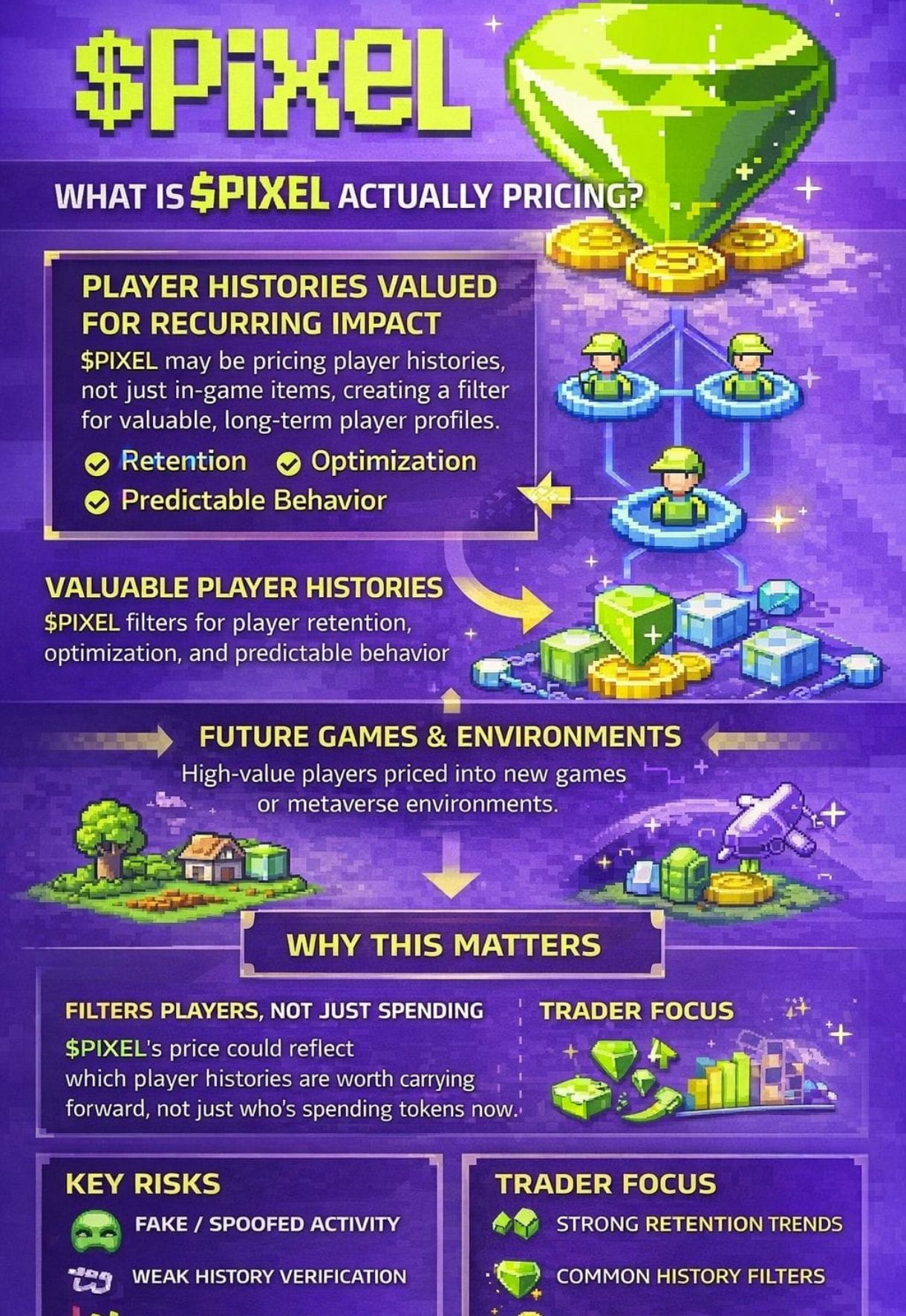
That’s where $PIXEL fits in—not as a reward layer, but as a kind of gateway.
There’s a practical benefit to this. It prevents overload. It keeps the system from trying to finalize everything at once. It introduces rhythm—spacing out when value actually materializes.
But there’s also a side effect.
Players begin to adapt.
They stop treating the system as a continuous experience and start recognizing where the real inflection points are. Over time, behavior shifts toward those points. Less wandering, more precision. Less experimentation, more positioning.
And once that happens, the system starts to narrow.
Not visibly, but structurally.
Those who understand the timing—or who consistently hold $PIXEL ready—begin to show up at the same critical moments again and again. They’re not necessarily doing more work, but they’re present when it matters.
Others are still active, still contributing, still part of the ecosystem. But their actions don’t always translate into the same level of impact.
That gap doesn’t scream for attention. It’s quiet.
You can still see growth. More players, more movement, more activity overall. On the surface, everything looks healthy. But the actual points where value is finalized remain selective—and possibly become even more selective over time.
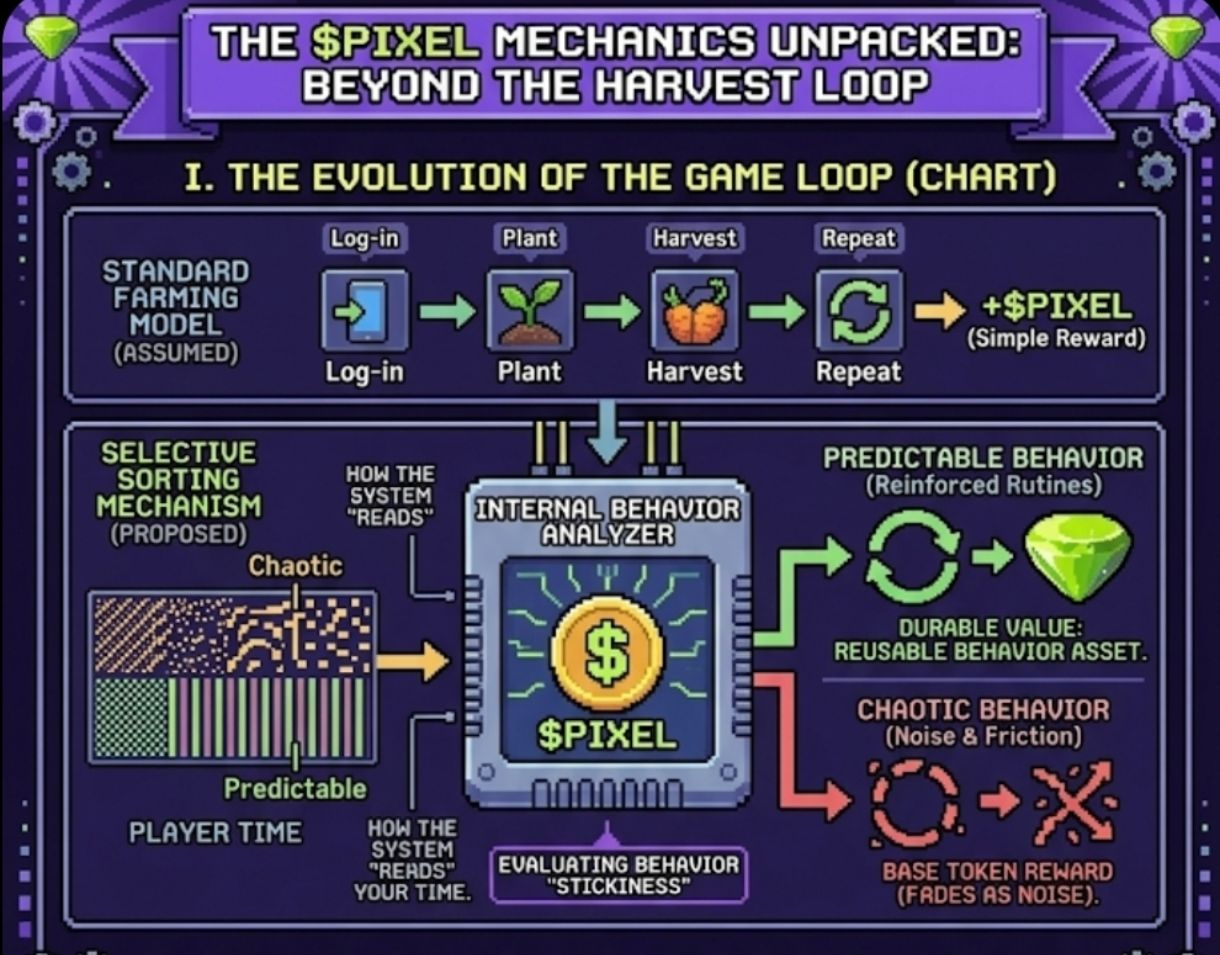
That’s why it feels inaccurate to describe $PIXEL as just a reward mechanism.
It behaves more like a layer that sits between effort and outcome, deciding which actions pass through and which ones remain unresolved.
And that distinction is easy to miss if you’re only looking at the usual indicators.
User numbers, engagement, activity—they all tell part of the story. But they don’t capture who consistently arrives at the exact moment when the system turns participation into value.
That might be the more important signal.
Not how many players are inside the system…
But who actually manages to matter when it counts.