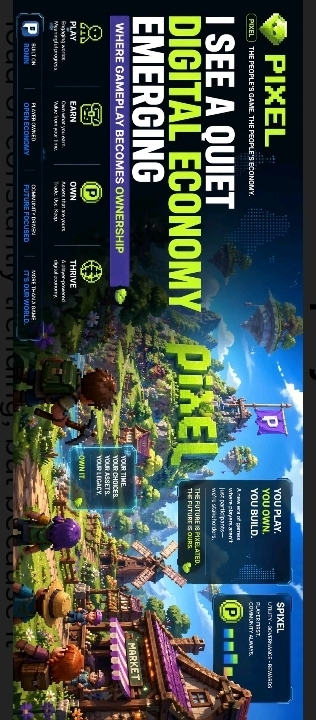
I keep coming back to Pixels not because it’s loud or constantly trending, but because it feels like something is slowly forming beneath the surface. At first glance, it looks like a simple farming and exploration game, almost nostalgic in its design. But the more time I spend understanding it, the more I realize it’s not just a game it’s an evolving digital economy built on Web3 principles that are still finding their shape.
What draws me in is how naturally blockchain is integrated into the experience. Pixels runs on the Ronin Network, which I see as a practical answer to one of Web3’s biggest problems: usability. Traditional Layer-1 chains can be powerful, but they often come with high fees and slower transactions. Ronin, acting more like a specialized Layer-2 environment, removes that friction. It allows players to interact, trade, and build without constantly thinking about gas fees or delays. For me, that’s important because real adoption doesn’t happen when users are forced to understand infrastructure it happens when they don’t even notice it.
Inside Pixels, I notice that everything revolves around ownership and participation. Land isn’t just a visual asset it’s a productive one. When I think about it, owning land in Pixels feels similar to owning a small piece of digital infrastructure. Other players interact with it, farm resources, and contribute to its value. That creates a loop where ownership is not passive it’s active and tied to the behavior of others.
This is where I start seeing a connection to real-world asset structures. Even though Pixels doesn’t directly tokenize physical assets, it mirrors the logic behind them. In the real world, assets generate value based on usage and demand. In Pixels, land, resources, and time follow the same pattern. I see players investing effort, optimizing their production, and thinking strategically about how to maximize returns. It’s not just gameplay anymore it’s economic behavior.
The tokenization layer adds another dimension to this system. PIXEL isn’t just a reward token it plays multiple roles inside the ecosystem. I see it being used for governance, NFT minting, premium features, and deeper engagement within the game. What stands out to me is how the system separates everyday gameplay from higher-value interactions. There’s a soft in game currency used for basic actions, and then there’s PIXEL, which operates on-chain and represents more meaningful value.
This dual structure makes sense to me. If everything was on-chain, the experience would become slow and expensive. If nothing was on chain, ownership wouldn’t matter. Pixels sits somewhere in between, and that balance feels intentional. It allows the game to remain accessible while still giving players a sense of real ownership.
When I step back and look at the broader Web3 architecture, I see Pixels as part of a layered system. At the base, there’s blockchain security connected to Ethereum through Ronin. On top of that, there’s a scaling layer that makes transactions efficient. And above everything, there’s the application layer the game itself where users interact without needing to understand the complexity underneath.
This abstraction is something I believe is necessary for Web3 to grow. Most people don’t want to think about wallets, private keys, or transaction mechanics. They just want a smooth experience. Pixels hides most of that complexity behind gameplay, and I think that’s one of its strongest design choices.
Another thing I find interesting is interoperability. Pixels allows integration with external NFT collections, which means players can bring in assets and identities from outside ecosystems. To me, this is where Web3 starts to feel open rather than isolated. Instead of being locked into one platform, assets become part of a larger network. That idea alone has long-term implications, especially if more projects move in the same direction.
But I also try to stay realistic when I think about it. The token economy still carries risks. Supply distribution, token unlocks, and market sentiment all play a role in how PIXEL performs. I’ve seen how quickly hype can drive prices up, and how equally fast things can cool down. Pixels is no exception. The token has already experienced volatility, which reminds me that this is still an evolving system, not a finished one.
What matters more to me is whether the underlying activity continues. And from what I observe, there is still consistent engagement. Players are interacting, resources are moving, and the in-game economy is functioning. It’s not explosive growth it’s steady movement. And sometimes, that kind of quiet consistency tells a stronger story than sudden spikes.
Privacy is another aspect I think about. Like most blockchain-based systems, Pixels operates with pseudonymous identities. Transactions are visible, but they’re not directly tied to real-world identities unless the user chooses to reveal them. This creates a balance between transparency and privacy, which I think is one of the defining characteristics of Web3 environments.
What really shifts my perspective, though, is how Pixels moves away from the traditional “play-to-earn” mindset. I’ve seen how earlier models focused heavily on extraction players would join, earn tokens, and leave. That kind of system doesn’t last because it depends on constant inflow. Pixels feels different. It leans more toward what I would call “play-and-own.” The focus is on engagement first, with ownership as a secondary layer.
For me, that’s a healthier direction. Economies built purely on rewards tend to collapse when those rewards decrease. But economies built on participation can adapt. If players enjoy the experience, they stay. And if they stay, the economy continues to function.
I also notice how time plays a central role in Pixels. Progress isn’t instant. It requires consistency, planning, and interaction. That creates a slower, more deliberate environment compared to fast-paced speculative markets. In a way, it filters out short-term thinking and rewards those who are willing to stay involved.
When I put everything together, I don’t see Pixels as a finished product. I see it as an early version of something larger. It’s experimenting with how digital ownership, gaming, and blockchain can merge into a single system. Not everything is perfect, and there are still uncertainties, but the foundation feels more thoughtful than many projects I’ve seen.
In the end, what keeps my attention is not hype—it’s structure. Pixels doesn’t try to force excitement. It allows the system to develop gradually, almost quietly. And in that silence, I see patterns forming: ownership becoming meaningful, time turning into value, and players behaving more like participants in an economy than just users of a game