
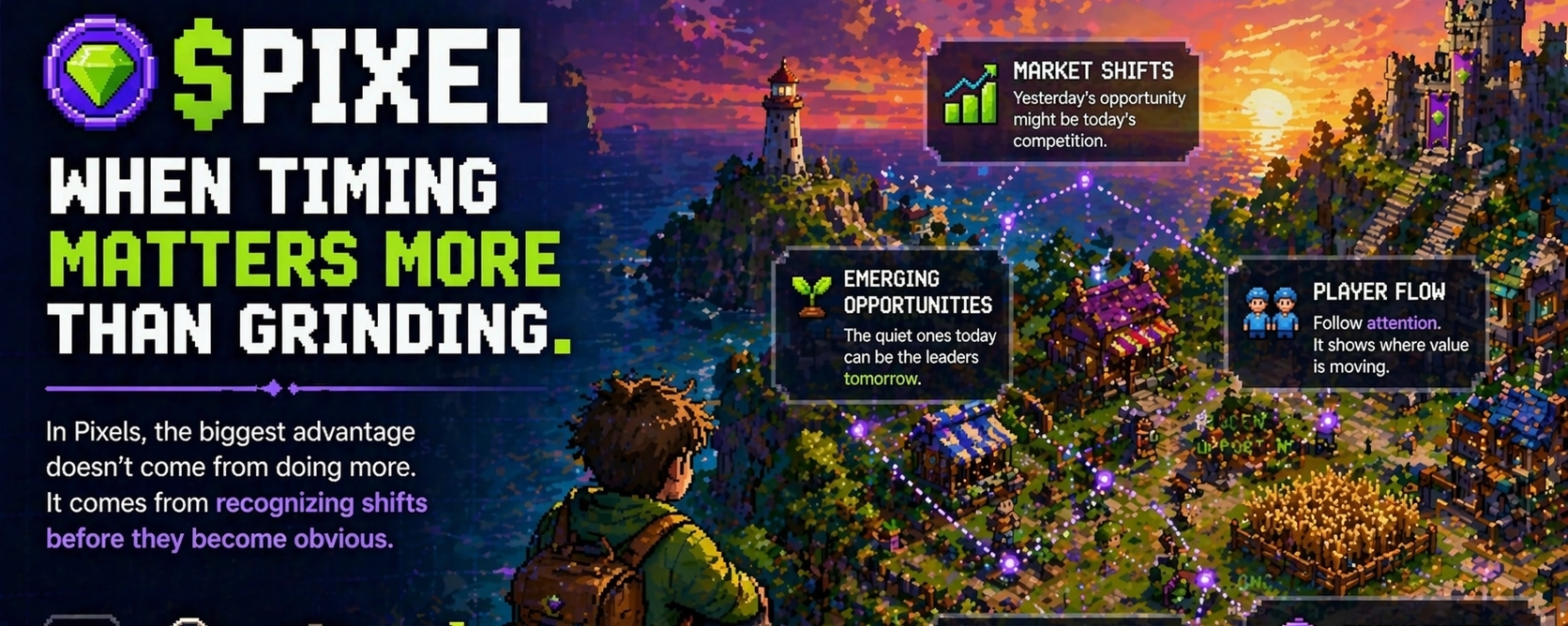
There’s a subtle shift that happens in Pixels, and it doesn’t arrive all at once.
In the beginning, everything feels straightforward. You follow the loops, stay active, and see progress. It’s easy to believe that the system is built around effort—that if you keep showing up and doing the right things, you’ll naturally move forward. And for a while, that belief holds.
But then something changes.
Not dramatically, not in a way that breaks the experience. It’s quieter than that. You start to notice that the same actions don’t always carry the same weight. What worked before still works, but not as well. Meanwhile, other players seem to gain ground in ways that aren’t immediately obvious.
That’s when the game starts to feel less predictable.
And more importantly, less immediate.
Because what you begin to realize is that outcomes aren’t always tied to what you just did. Sometimes they’re tied to when you did it. Or why. Or how it fit into something larger that was already unfolding.
That’s where $PIXEL starts to feel different.
It doesn’t always behave like a direct reward for effort. Instead, it can feel like a reflection of timing—of whether your actions aligned with a moment before it became clear to everyone else. And the uncomfortable part is that you rarely know that in advance.
So the way you play starts to shift.
You stop thinking only in terms of efficiency and start thinking in terms of positioning. You pay attention to where players are focusing, what’s becoming saturated, and what still feels overlooked. You begin to question whether the most obvious path is actually the most valuable one, or just the most visible.
And that’s not an easy adjustment.
Because it introduces uncertainty.
There’s no longer a clear answer to what the “best” move is. Some decisions take time to prove themselves. Some never do. And often, the difference between the two isn’t visible at the moment you make the choice.
But over time, patterns begin to emerge.
Not clean, predictable patterns—but signals. Small shifts in behavior, in demand, in attention. The kind of things you don’t notice unless you’re looking for them. And once you start noticing them, the game opens up in a different way.
It becomes less about repeating what works, and more about recognizing what might work next.
That’s a very different mindset.
It rewards patience, awareness, and a willingness to move without full confirmation. It also means accepting that you won’t always be right. Sometimes you’ll act too early. Sometimes too late. But gradually, those small judgments start to matter more than raw effort alone.
And that’s what gives Pixels its depth.
The mechanics themselves are simple, but the meaning behind them isn’t fixed. It shifts as the system evolves, as players move, and as attention flows from one area to another. What matters today may not matter tomorrow—and what seems insignificant now might quietly become important later.
In that kind of environment, progress doesn’t feel linear.
It feels uneven, sometimes even confusing.
But it’s not random.
It’s shaped by alignment.
By whether your actions matched where the system was already heading, even if you couldn’t fully see it at the time. And in that sense, $PIXEL feels less like something you earn step by step, and more like something that reflects how well you moved with the moment you were in.
That’s not always comfortable.
But it is what makes the experience feel alive.