
Pixels spent two years learning how to make P2E work. then they packaged everything they learned into a separate product and made it available to any game studio that wants it.
that product is Stacked. it launched publicly in late March 2026. and it might be more important than the Pixels game itself.
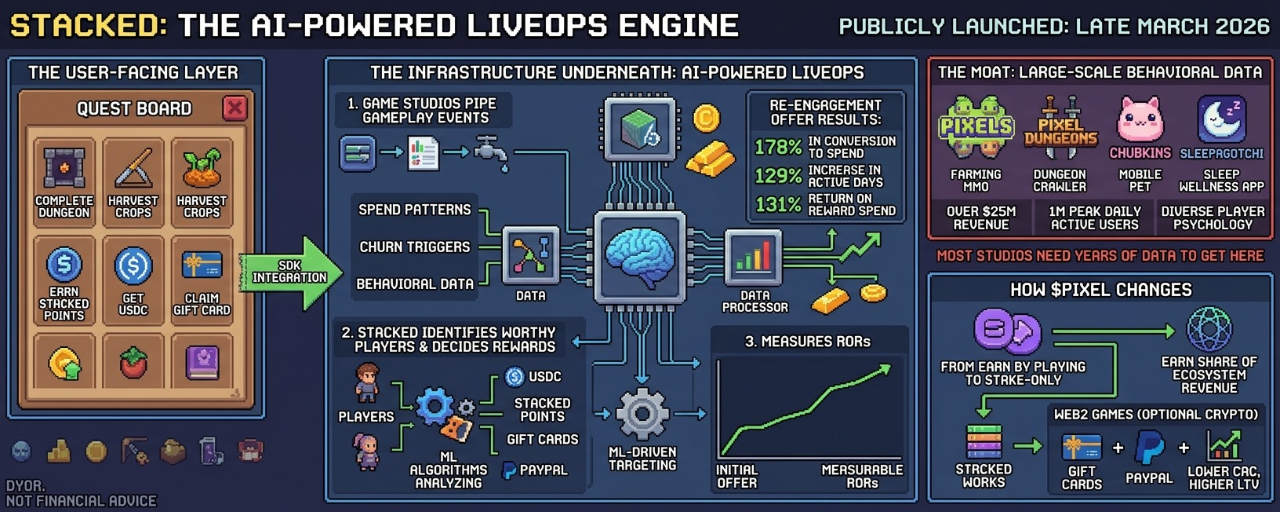
most people who've seen the announcement think Stacked is a quest board: complete tasks, earn rewards, simple. that's the user-facing layer. the infrastructure underneath is different.
Stacked is an AI-powered LiveOps engine. a game studio integrates via SDK, pipes gameplay events into the system, and Stacked does three things: identifies which players are worth targeting with rewards, decides what reward to send and when, and measures whether that reward actually improved retention or revenue.
the targeting isn't rule-based. it's ML-driven, trained on behavioral data from Pixels' own games: Pixels core, Pixel Dungeons, Chubkins, Sleepagotchi. when Pixels wanted to re-engage veteran players who hadn't made a purchase in over 30 days, instead of a generic comeback campaign, Stacked identified that specific cohort and deployed a personalized re-engagement offer. result: 178% lift in conversion to spend, 129% increase in active days, 131% return on reward spend.
that's not a quest board. that's a precision targeting system trained on real game data.
the reason no one has built this before isn't lack of ambition. it's lack of data. to train a reward targeting model that actually works, you need large-scale behavioral data from real players, ground truth on which reward types drive which player actions, and enough game diversity to generalize across different mechanics and cohorts. Pixels had all three. over $25 million in revenue generated, 1 million daily active users at peak, four games across farming MMO, dungeon crawler, mobile pet game, and sleep wellness app. each with different player psychology, different spend patterns, different churn triggers. the model learned from the full range. most studios trying to build something like this would need years of data to get there. Pixels arrived with the dataset already built.
Stacked also changes what $PIXEL actually does. Barwikowski confirmed the plan is to slowly transition PIXEL to stake-only. rewards through Stacked shift to USDC for the crypto audience, or Stacked Points redeemable for gift cards, PayPal, or converted to crypto with instant cashout. PIXEL moves from the thing you earn by playing to the thing you stake to earn a share of ecosystem revenue. less reward token, more equity instrument in the Stacked network. the value proposition stops depending on individual game health and starts depending on total transaction volume across every game Stacked powers. more games on Stacked means more RORS data means better targeting means more games want to join.
the most underreported part of Stacked is the studio-side pitch. Pixels isn't just offering this to Web3 games. the explicit roadmap targets Web2 game studios. the mechanics work without blockchain entirely. a Web2 studio integrates, sends events, receives targeting recommendations, deploys rewards: Stacked Points redeemable for gift cards or PayPal, no crypto involved, player never touches a wallet. from the studio's perspective: lower CAC, higher LTV, better retention, measurable RORS. from the player's perspective: complete tasks in a game you already play, earn real-world value. from Pixels' perspective: every Web2 partner that integrates generates data that improves the model for everyone else. the crypto layer is optional but available. studios that want NFT items or on-chain ownership can add it. studios that don't need that friction don't have to touch it.
what's not answered yet: Stacked launched three weeks ago. early numbers are strong, RORS 3:1 in Chubkins, 131% RORS on the re-engagement campaign. but three weeks is not enough to know whether the model holds at scale or across genres outside Pixels' own portfolio. the Web2 partnership pipeline is early. Barwikowski acknowledged there aren't that many Web3 games ready to take something like this yet. the initial focus is proving the model works within first-party games before opening to external studios. right sequencing, but it means the B2B revenue story is 6 to 12 months from being real.
there's also a competitive question. Unity, ironSource, and AppLovin already own the rewarded ad and LiveOps tooling market for mobile at scale. Stacked's differentiation is crypto-native infrastructure and RORS optimization, but those advantages mean less when pitching a Web2 studio with no interest in blockchain. the moat is the data. as long as Pixels keeps growing the first-party ecosystem and the model keeps improving, the targeting advantage widens. the risk is if growth stalls before the Web2 partnerships prove out.
Pixels spent 2024 losing money. spent early 2025 trying Web2 monetization that didn't work. spent mid-2025 rebuilding around sustainable RORS. came out the other side with a product that packages all of that learning into an SDK any studio can integrate.
Stacked is positioned as the shared rewards layer across the entire Pixels ecosystem and eventually any game that wants to plug in. it's a pivot from building a game to building the infrastructure that makes games sustainable.
that's a bigger bet. and as of three weeks ago, it's live....
DYOR / NFA...