
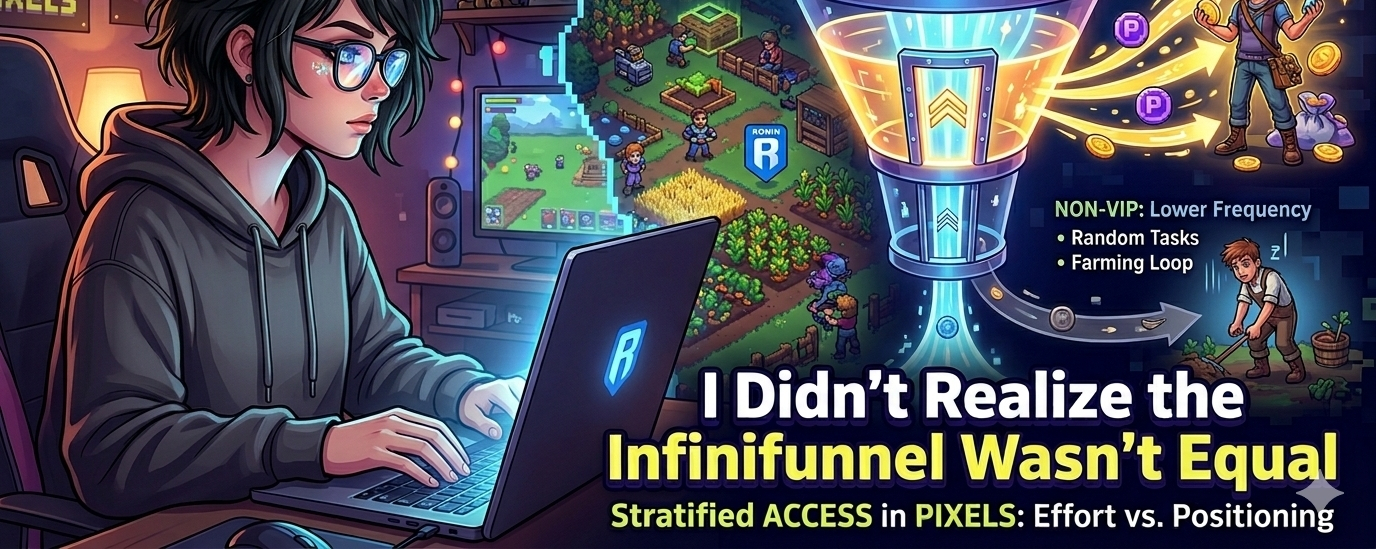

I’ve noticed players are no longer comparing how much they earn. They’re comparing how consistently they can access opportunity. The conversation has moved away from output and into positioning.
That’s where things start to feel uneven in a way that isn’t obvious at first.
Inside Pixels, the Infinifunnel looks fair on the surface. Tasks keep coming. You finish one, another appears a few minutes later. The board resets daily. It gives the feeling that effort is always rewarded, that there’s always something to do if you’re willing to stay active.
But the more time I spent inside it, the more I realized the system isn’t just infinite. It’s selective.
Two players can log in at the same time. They can farm the same land. Gather the same resources. Put in the same hours. And still walk away with completely different outcomes. Not because one played better, but because one had access to more tasks through VIP status.
That difference doesn’t feel loud on day one. It’s actually easy to ignore.
But over time, it compounds.
The Infinifunnel doesn’t just reward activity. It rewards access to higher frequency opportunities. More tasks means more chances to land PIXEL rewards. And since not every task pays in PIXEL, having more options quietly increases your probability of hitting the ones that do.
It’s not about working harder. It’s about rolling the dice more times.
I started noticing this while going through the usual farming loop. Planting crops, waiting, harvesting, repeating. On paper, this is the core of progression. You gather resources, upgrade, expand your land, and improve efficiency.
But the real acceleration doesn’t come from the farm itself. It comes from how often the system lets you convert that activity into token rewards.
Land ownership adds another layer to this. Owning land gives utility. It improves your production loop and opens up more structured gameplay. But even there, the Infinifunnel sits on top like a second economy.
Your land helps you produce. The funnel decides how often that production actually translates into earnings.
And that’s where the gap widens.
I’ve seen players with modest setups outperform others with better farms simply because they had better access to tasks. Not better strategy. Not better timing. Just more entries into the reward system.
The Ronin integration makes this even more interesting. Transactions are cheap. Movement is fluid. It removes friction from the system. But lowering friction doesn’t remove imbalance. It just makes the outcomes arrive faster.
You feel the difference sooner.
Social gameplay was supposed to balance things out. Collaborating, sharing resources, helping each other progress. And to some extent, it does. Communities form. Players coordinate. There’s a real sense of shared space.
But even within groups, the Infinifunnel creates invisible tiers.
Not everyone is pulling from the same pool of opportunities.
And I keep coming back to that thought. The system isn’t hiding this. It’s just subtle enough that most people don’t question it early. It feels like variance. Like luck. Like maybe today just wasn’t your day.
But it’s not random.
It’s structured inequality inside an infinite system.
What makes it more complex is that this design actually works. It keeps players engaged. It gives them a reason to upgrade. VIP isn’t just a status symbol. It’s access to more attempts, more exposure, more potential outcomes.
From a design perspective, it’s smart.
From a player perspective, it’s something you only fully understand after spending enough time inside the loop.
And then there’s the bigger question I can’t really shake.
If the Infinifunnel is infinite but not equal, what does that mean for long-term balance?
Because eventually, the players with more access don’t just earn more. They reinvest faster. They expand quicker. They position themselves ahead of the curve. And the gap that started small becomes structural.
At that point, it’s not just about daily rewards anymore. It’s about who gets to stay competitive.
I don’t think this breaks Pixels. If anything, it explains why it feels the way it does. The system isn’t trying to be perfectly fair. It’s trying to be continuously engaging.
But those two things don’t always align.
And I’m not sure the market has fully processed that yet. Whether players are comfortable with this kind of quiet imbalance, or whether they only notice it once the gap becomes too wide to ignore.