
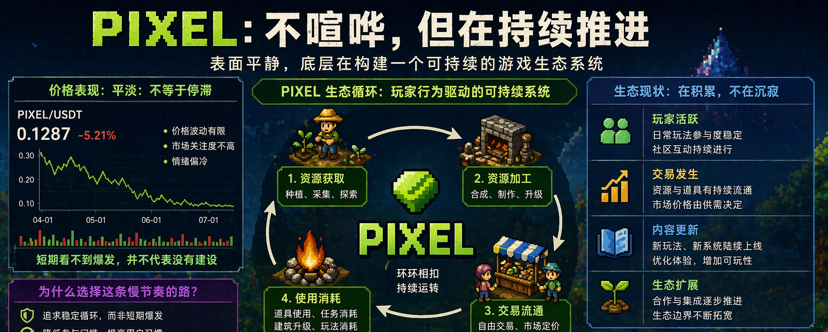
The past couple of days, the plaza has been buzzing, and I've taken another look at $PIXEL . It offers a unique perspective; it’s not the kind of project you can immediately spot as 'hot', but it’s definitely not stagnant either. It feels more like a line slowly advancing beneath the surface—calm on the outside, but constantly evolving underneath.
These days, a lot of folks still rely on price to gauge a project's status, but when it comes to PIXEL, that approach might not be entirely spot on. Right now, it's not in an emotionally driven phase; rather, it's in a steady construction process. In other words, it feels more like they're building a 'system' instead of just creating 'hype'.
From an ecosystem perspective, the core logic of PIXEL is quite clear: it's about building a sustainable environment around player behavior. The acquisition, processing, and trading of resources are not isolated events; they are interconnected in a continuous operating chain. Players are both participants and drivers, with each action making the system more complete.
The key point of this design is 'connection.' It's not about isolated gameplay, but creating relationships between different elements. Resources don't just get produced and stop there; they need to flow and create new demand through usage or consumption. As long as these elements can continuously connect, the ecosystem has the ability to sustain itself.
In contrast, many blockchain games face issues precisely here: either they only have output without consumption, or they rely on external incentives to maintain activity. Once those incentives fade, the entire system can cool down rapidly. What PIXEL is trying to avoid is this one-way structure.
Simply put, this 'structural building' approach also means it won't be particularly fast. True cycles aren't something you can just design; they require ongoing player participation and validation. This process may need multiple adjustments, even overhauling certain mechanisms. This is also why it may not appear 'exciting' enough.
From the current GameFi environment, this path is becoming increasingly practical. After several ups and downs, user trust in high-yield models has noticeably declined, and everyone is starting to focus more on whether projects can exist in the long term. In this context, the stability of the ecosystem and whether users are willing to stick around become more crucial indicators.
PIXEL's edge lies in its initial focus on this direction. By lowering the entry barriers with relatively lightweight gameplay and boosting user engagement through frequent interactions, it helps users gradually form habits. Once these habits are established, the ecosystem no longer relies solely on external stimuli but can maintain activity through internal cycles.
In fact, these challenges exist and are significant. First is the content aspect; blockchain games are essentially still games. If gameplay updates lag behind, users can easily churn. Next is the pacing issue; in a market that habitually chases trends, a too-slow developmental path can easily be overlooked. Finally, the economic structure needs constant adjustment to ensure resources generate value without causing excessive pressure.
These factors combine to put PIXEL in a relatively 'patience-testing' phase. There's no clear breakout, nor complete stagnation; instead, it continuously experiments in a middle ground.
For retail traders, this phase is often the hardest to judge. Unlike during an uptrend where things are clear, or a downtrend that is direct, it’s more of a 'watch and observe' state: checking if users are still around, if trading is ongoing, if gameplay is being updated, and if the whole system is becoming smoother.
If these signals are positive, it indicates the ecosystem is accumulating; if they gradually weaken, that's where you really need to be cautious.
Looking at it from a longer time frame, the blockchain gaming track is actually undergoing a shift. Previously, growth was incentivized, but now the focus is gradually shifting towards retaining users through content and structure. In this process, projects willing to refine their systems over time may not have a short-term edge but have better chances of succeeding in the long run.
In summary, what P@Pixels is currently presenting is a typical 'construction phase characteristic': no noise, no explosion, but continuous progress. It's more like refining a foundation rather than rushing to build height. This path may not be easily understood, but if it can persist and gradually form a stable cycle, the end product is often more solid.
Finally, when we look at it, rather than asking 'when will it heat up,' it's more worthwhile to ask: is this system becoming more complete? This might be closer to the essence of the issue.