
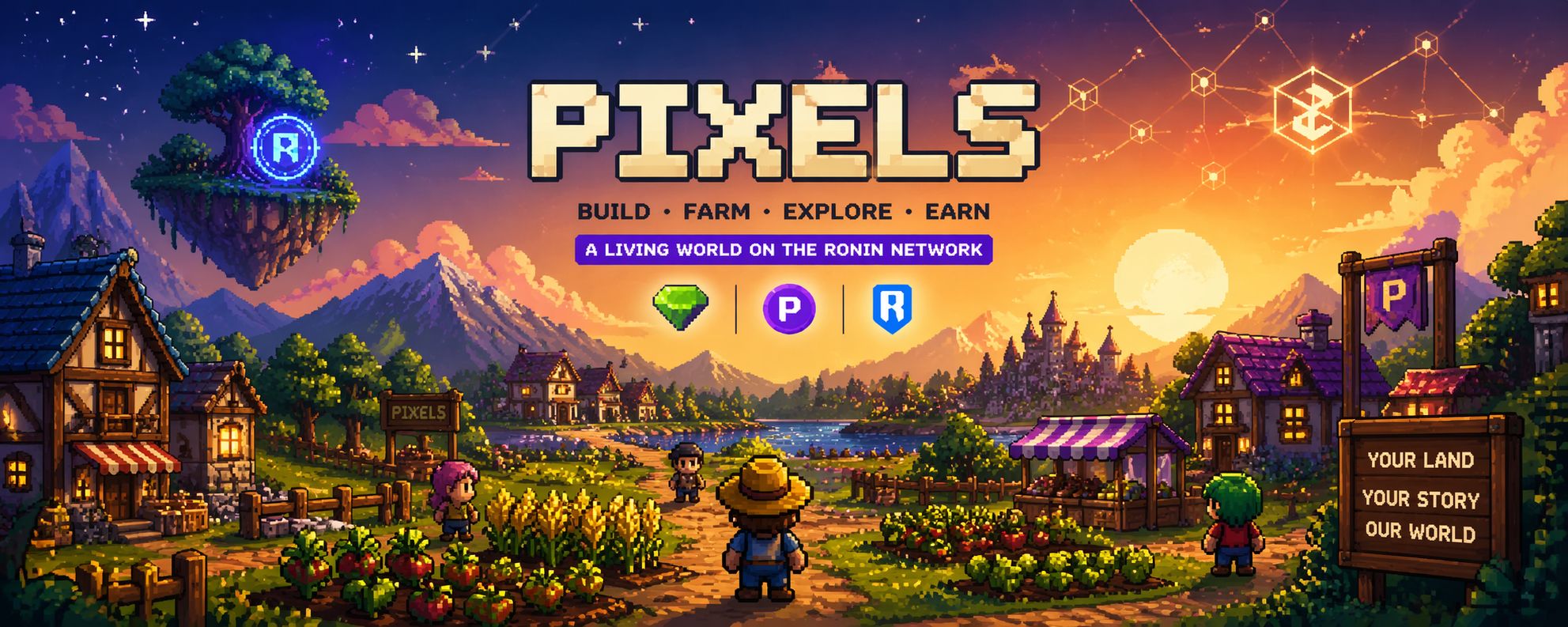
The first time I noticed Pixels, it didn’t look like something that should attract a large audience.
No cinematic battles.
No dramatic storyline.
Just small pixel characters walking across fields, planting crops, and collecting resources.
In a space where most projects try to look futuristic and complex, Pixels almost feels… old-fashioned.
At first, I assumed the attention around the project was temporary. Web3 gaming has seen many experiments rise quickly and disappear just as fast. Usually the excitement is built around rewards, speculation, or a short burst of hype.
But the more I observed the ecosystem forming around PIXEL, the more it felt like something slightly different was happening.
Not louder.
Just different.
A World That Moves at a Slower Pace
Most blockchain games follow a predictable rhythm.
Players rush in, complete tasks, earn rewards, and then move on to the next opportunity. The environment often feels temporary — like a short economic event rather than a world.
Pixels moves at a slower pace.
Players plant crops, gather materials, trade items, and gradually expand their land. On paper, none of these mechanics are new. Traditional games have used similar systems for decades.
But something about the atmosphere feels more relaxed.
Players are not always rushing to maximize profits or optimize every action. Many simply explore, interact with neighbors, and experiment with how they want their small digital space to look.
At times, it feels less like a competitive game and more like a quiet online village.
---
The Infrastructure Beneath the Simplicity
Of course, simplicity on the surface doesn’t mean the system behind it is simple.
Pixels operates inside the ecosystem of the Ronin Network, developed by Sky Mavis.
This network already has a long history in blockchain gaming, largely because of the massive rise of Axie Infinity.
That history brings both experience and caution.
Ronin has already faced the pressures of rapid growth, scaling challenges, and community expectations. Because of that, newer projects built within the ecosystem can start from a stronger technical foundation.
Pixels benefits from that stability.
Instead of struggling to build infrastructure from scratch, it can focus more on refining the player experience.
---
A Different Type of Community Energy
One of the more interesting things about Pixels isn’t the farming mechanics or the economy.
It’s the behavior of the players.
In many blockchain games, interactions between players revolve almost entirely around transactions — buying assets, selling items, or optimizing strategies.
Inside Pixels, interactions sometimes feel more casual.
Players visit each other’s land.
They discuss farming strategies.
They help newcomers understand the system.
These small social interactions slowly create something that resembles a community rather than just a marketplace.
And in Web3 gaming, that distinction matters more than people often realize.
Because economies can attract players quickly, but communities are what keep them there.
---
The Experiment Still Unfolding
Despite the growing interest around Pixels, it would be unrealistic to assume the project has already proven itself.
The Web3 gaming space is still unpredictable.
Many projects begin with strong momentum but struggle to maintain balance in their economies or sustain long-term player engagement.
Pixels will likely face similar tests over time.
Questions about economic sustainability, gameplay evolution, and long-term player motivation will eventually become unavoidable.
But for now, the project represents an interesting experiment.
Not an attempt to overwhelm players with complexity, but an attempt to create a world that feels simple enough for people to stay.
---
When Small Worlds Ask Bigger Questions
Sometimes innovation arrives loudly.
New technology, massive announcements, bold promises.
Other times it arrives quietly, almost unnoticed at first.
Pixels may belong to the second category.
A small farming world built with simple graphics has started attracting a surprisingly active community. Not because it looks revolutionary, but because it feels comfortable.
And that raises a larger question about the future of blockchain gaming.
Maybe the most successful Web3 worlds won’t be the ones that constantly remind players they are using blockchain.
Maybe they will be the ones where players simply enjoy being there.
And if that turns out to be true, then the quiet little farms inside Pixels might be testing something much bigger than they appear.