

To be honest, I’ve been watching people argue in the Pixels public channel lately, and the more I see it, the more it feels familiar.
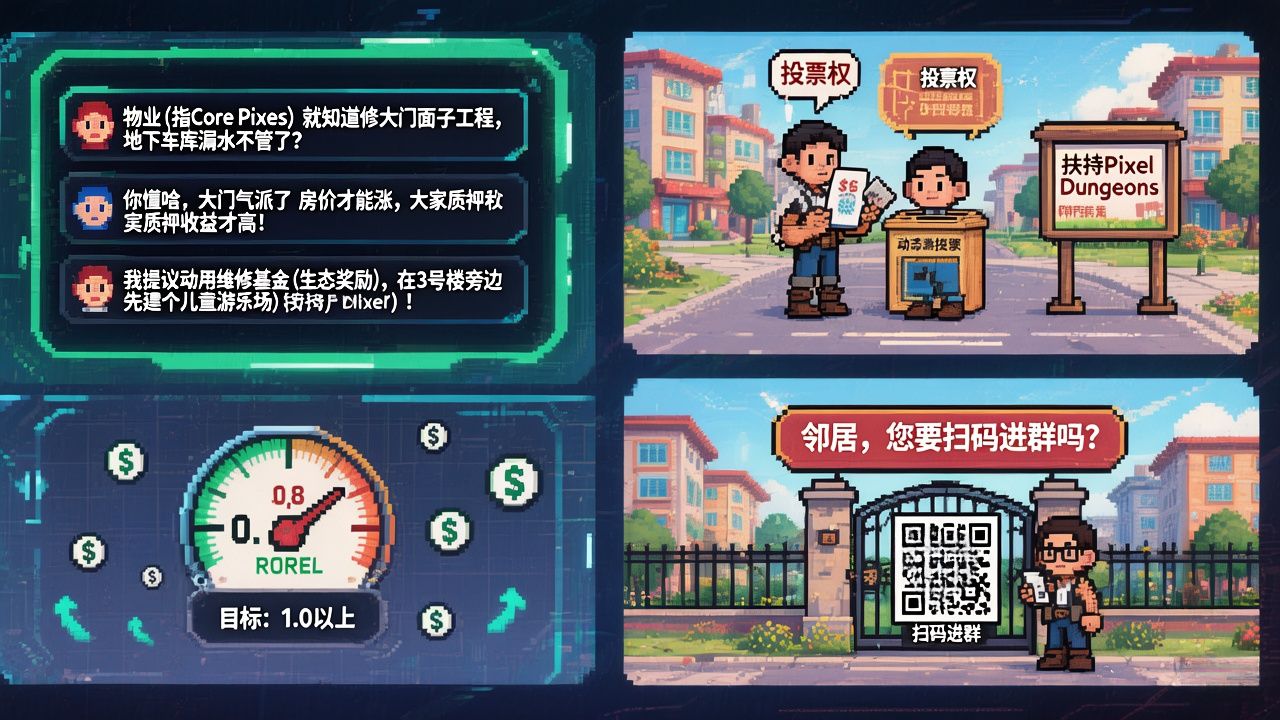
This feels less like a gaming chat and more like accidentally opening our community owner's group. Over here, someone says: "The management (referring to Core Pixels) only knows how to flex with facade projects, what about the leaking underground parking?" Immediately, someone counters: "What do you know? With an impressive entrance, property values can rise, and everyone’s staking rewards will be higher!" Then another person chimes in: "I propose we use the maintenance fund (eco rewards) to build a playground next to Building 3 (supporting Pixel Dungeons)!"
I suddenly found it amusing, then felt a bit dazed. How did I go from playing a farming game to worrying about 'community budgets', 'green coverage', and 'property value retention'?
What’s even crazier is that I found I actually have 'voting rights' just by staking in those game pools. It feels like the property management has suddenly declared that from now on, all neighborhood matters will no longer be managed by them but rather decided by us homeowners based on the size of our properties (staking amounts). I don’t even know whether to be happy or worried.
Let’s toss aside those impressive 'governance' buzzwords and just apply the straightforward logic of managing our own neighborhood to evaluate Pixels' gameplay.
Any neighborhood relies on three essential matters to function: where does the money come from (property fees), where does the money go (budget), and who makes the decisions (homeowners' committee). Pixels' staking system conveniently ties these three together.
A massive shift in the logic of 'property fees' collection.
Traditional games are like property management companies hired by developers; they set the prices, and we dutifully pay (either by spending money or contributing time and data). But in this Pixels 'neighborhood', that line in the white paper 'the game itself is the validator' translates to: 'from now on, which property management company can operate, we homeowners decide, using our property certificates ($PIXEL) to vote.' When we stake into pools for 'Core Pixels' or 'Forgotten Runiverse', it’s like raising our hands at the homeowners' meeting: 'I trust this property management, I’m staking my property certificate here to support them!'
The new rules for spending the 'public maintenance fund.'
This is the 'dynamic pool' mechanism set to land in Q3 2025. Each year, the neighborhood has a fixed 'public maintenance fund' (monthly $28 million PIXEL ecological rewards), but whether that money goes to repair Building A's exterior or install an elevator in Building B will no longer be decided by the property management company, but rather by the total value of the 'property certificates' staked by the homeowners of whichever building. You support someone, and you stake your property certificate on their proposal. The more you stake, the more that 'building' can access the maintenance fund. Basically, this is a 'property area-weighted voting system': the bigger your house, the louder your voice in neighborhood affairs.
Whether the entire neighborhood can appreciate in value and whether the property fees are sufficient is a matter of life and death.
No neighborhood can survive on homeowners constantly donating money. Pixels has staked the economic health of the entire 'neighborhood' on a metric called RORS (Reward Outflow Return Rate). Right now, it’s around 0.8, meaning the money currently coming in (in-game revenue) isn’t enough to cover the benefits and maintenance costs (player rewards) being paid out. The goal is to push it above 1.0, achieving a balance or even a surplus. This forces all activities in the 'neighborhood'—whether hosting community festivals (in-game events) or renovating gardens (version updates)—to be economically calculated: Will this raise our overall property value (ecological value)? Will it attract more new homeowners (players)?
$vPIXEL, in this analogy, is like the 'internal consumption vouchers' issued by the property management. You exchange cash ($PIXEL) for these vouchers and can buy groceries, work out, or hire help (in-ecosystem consumption) in the neighborhood without fees. The property management's intention is clear: they hope you keep the money circulating within the neighborhood and not cash out at the drop of a hat. The more vouchers you exchange, the more deeply you’re bound to life in this neighborhood, and the more active the internal economy becomes. Honestly, this tactic is quite clever, but also a bit 'binding'.
This beautiful blueprint of 'homeowner governance' has so many pitfalls, it’s like the uneven paving stones in the neighborhood.
I am extremely skeptical of the judgment of us 'amateur homeowners'. Previously, when selecting property management, at least we could check qualifications and past performance. Now? We determine whether a 'game property management company' is good based solely on a few promotional images (game marketing), some 'enthusiastic homeowners' (KOLs) in neighbor groups shouting, and a constantly shifting 'expected dividend rate' (historical APR). I can’t even figure out what model the water pipes in my building are, and now you want me to evaluate whether the drainage system of 'Core Pixels' (economic model) will get clogged in the next decade? Isn’t that a joke? The end result is that everyone might just blindly follow the loudest or flashiest homeowners (whales), and what we choose might not be the most capable, but rather the best at PPT and community marketing.
Checks and balances are practically empty. In our neighborhood, if the property management does poorly, the homeowners' committee can supervise, question in meetings, and even initiate processes to replace them. But what about in Pixels? The game studio (property management) decides how much 'dividend' (rewards) to distribute to their 'homeowners' (stakers), and they can change that on a whim! One day it’s a barrel of oil, the next it might be a bag of rice. As small homeowners, aside from getting mad and selling our houses (withdrawing investment), we have almost no other means of checks and balances. This is not homeowner governance; it’s clearly 'property-friendly dictatorship.'
The most critical issue is that everyone can’t even agree on 'what constitutes the common interest of the neighborhood.' Some believe there are too many kids and want a playground (supporting innovative mini-games); others think there are too many elderly and want to expand the medical room (optimizing core game economy); some only care about their own property values and insist on spending all the money on renovations (everything aligned with RORS). Right now, the entire system seems to only recognize the last indicator—property value (RORS). To push RORS above 1.0, will the property management only cater to those willing to pay high prices for houses or flip properties (paying players) and ignore those who quietly reside and maintain community atmosphere (casual players)? Over time, the neighborhood could become a shiny facade with indifferent neighbors, a 'flipping demonstration zone' devoid of the essence of home.
To see the future of this 'digital neighborhood' clearly, we need to review the experiences and lessons of real neighborhood management.
We can refer to the successful management of common resources (like fisheries and irrigation systems) studied by Nobel laureate Elinor Ostrom. She summarized a few key principles: clear member boundaries, equal contributions and benefits, recognized decision-making rules, accountability for violations, and a place to resolve disputes. Looking back at Pixels as this 'neighborhood': Are the boundaries between homeowners (stakers) and tenants (casual players) clear? Does the risk I take by staking (if the game flops and the coin value drops) match the potential benefits? If the game studio arbitrarily changes the rules, do we have reliable channels for complaints? It seems many aspects are still blank, or rely solely on the integrity of the founding team as this 'super homeowner committee' and the algorithmic model as this 'AI caretaker', so we’re far from a mature, self-sustaining community.
Let's take another look at the real neighborhood committees around us. When they first form, everyone is pumped up, but when it comes to actual work, how many people avoid the hassle and don’t even show up to the homeowner meetings? In the end, it’s often just a few overly enthusiastic (or self-interested) folks who hold the power. Could Pixels end up the same way? The majority of players are here to chill and have fun, not to attend homeowner meetings. Ultimately, will this complex 'staking voting' governance turn into a game for a select few 'professional homeowners' (whales and savvy investors)? Our staking amounts as average players are so small that they might as well not exist; this so-called 'self-governance' might just be for show.
A more direct lesson comes from some early attempts at 'player governance' in online games. For example, some games let players vote on plot developments, but it often devolves into a frenzy of jokes; others have democratic elections within guilds that frequently collapse due to infighting and disputes. Imposing the dirty work of governance on users who just want to have fun—isn't that a bit 'wishful thinking'?
What does this 'neighborhood homeowners' committee' simulator mean for each of us 'player-homeowners'?
It’s a forced initiation into 'community consciousness.' It compels us to shift from merely being residents who shut the door to living our lives, to peering out into the hallway, caring about the lawn, and pondering the public accounts. It gives us a faint sense that, in this digital world, we might actually have a little bit of a voice regarding our environment.
But this also comes with a 'sweet burden.' While we might feel pleased about those 'dividends' (staking rewards), we may not realize that we’ve implicitly taken on some responsibility and risk for 'neighborhood public affairs'. Our leisure time has quietly mixed in a bit of 'homeowner duty' sand.
Pixels might just succeed. It will prove that using blockchain and tokens to simulate small-scale community cooperation and resource allocation among strangers is feasible. It could become a model for various 'digital communities' in the future metaverse.
Yet, in my heart, there’s always a small doubt: when the most intense discussions and biggest emotional swings in a game no longer come from the joy of conquering a dungeon or the thrill of fighting alongside friends, but rather from the petty and practical disputes over 'should property fees be raised' or 'why does Building 3 get more maintenance fund than Building 5'—are we gaining a more profound sense of belonging in this digital home, or are we just replacing leisure with an 'online neighborhood committee duty'?
I can't say for sure, but I know that from now on, every time I stake in a game pool, it’ll feel different. It’s no longer just a simple investment. It feels more like signing my name and house number on some initiative posted on the neighborhood bulletin board. What I stake is not just a few tokens, but my small yet specific hope for 'how a bunch of strangers can collaboratively manage a little piece of digital green space in the algorithm age.'
The neighborhood gates are wide open, and the QR code for the homeowner group is right on the wall. Neighbor, do you want to scan in?