
In early December 2025, I had the chance to attend a small offline gathering of the Pixels game community. The conversation that day was quite relaxed, nothing too intense; everyone talked about finding advantages in the game as if there were still plenty of things left to explore.
I asked a question: 'Is the biggest risk of Pixels when players understand the game too well?' No one reacted immediately; there was just a brief silence, as if that question slowed down the conversation in the room. Then someone replied very lightly, but I still remember it: 'If you understand everything, then what’s left to play for?'
At that time, I just laughed, but as time went on, I began to see that this wasn’t just a joke; it was like a small crack revealing how systems like Pixels operate. I used to think that games, especially GameFi, always had an 'untapped layer,' with strategies yet to be optimized, and the player’s job was to find that gap between the system and the crowd. But as I played longer, I started to doubt this assumption.
I often think simply like this: in a system that is transparent enough and has enough participants, the gap doesn’t disappear; it only exists for a very short time before being discovered and copied faster than it can create an advantage. Maybe the issue isn’t that the meta breaks, but that in systems like Pixels, the meta always appears, but its lifespan is so short that it only exists in a very small window before being fully absorbed by the market.
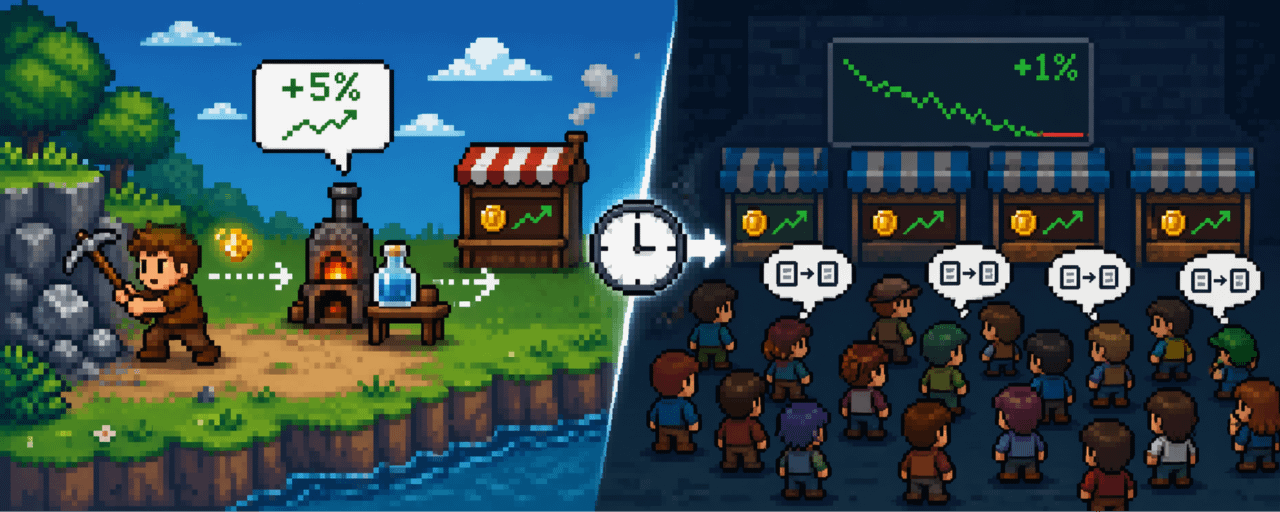
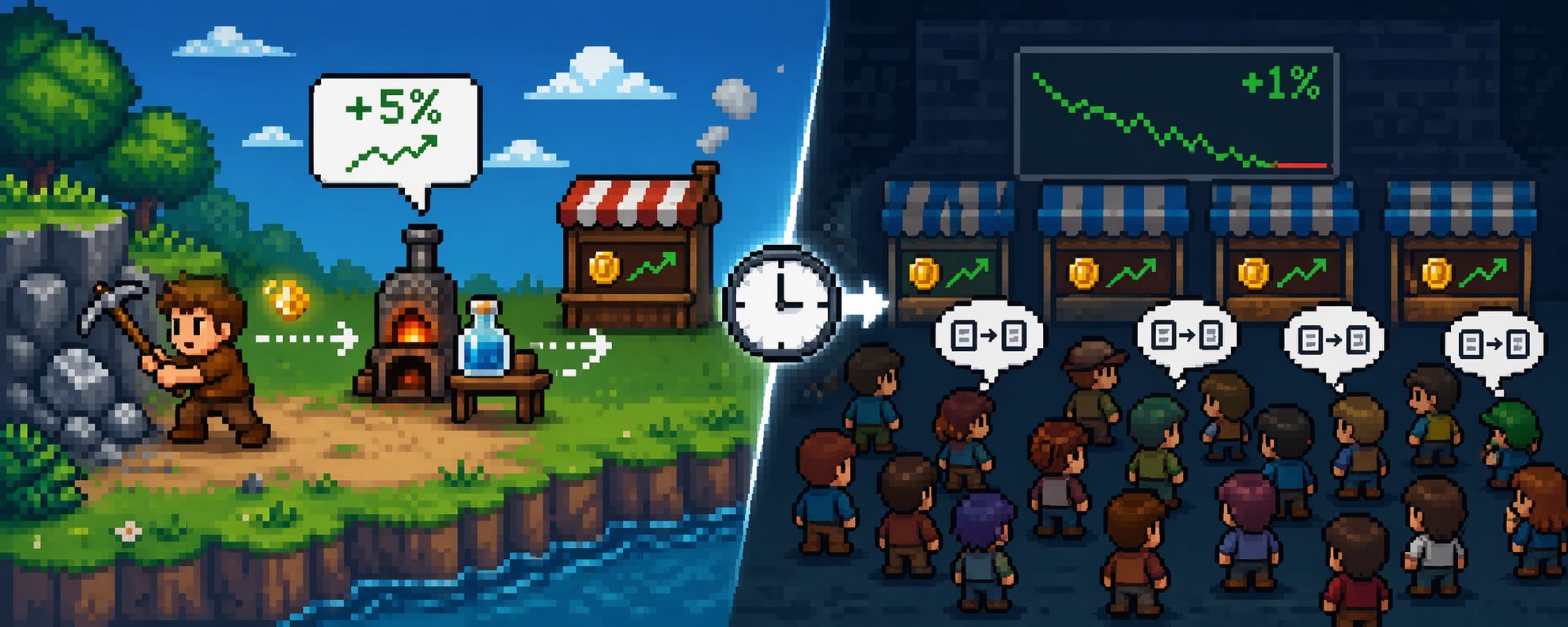
In Pixels, this isn’t just theory. There was a phase I remember clearly, where understanding a simple flow like mining Stone and then crafting a Glass Bottle could create an arbitrage opportunity. But what’s noteworthy is that the lifespan of this arbitrage was very short. In the first 3–7 days of a new economic loop, price spreads of around ~4–6% could still appear, enough to create arbitrage opportunities. But as more participants joined the same flow, this spread usually got pulled down to below 1% within just a few hours, as strategies were observed, learned, and copied almost instantly.
The clearest moment for me was in the early cycles, where an opportunity could last a few hours to a day. But as the player density increased, that window shrank to just a few dozen minutes before completely disappearing. However, that advantage almost never lasted long, because shortly after, the market self-corrected everything back to a state of equilibrium. Players behaved similarly, timing was the same, behavior was the same. No one needed to coordinate, but the system still synchronized itself because price information and behavior were observed almost in real-time by all participants.
I used to think this was a sign of a good economy because it was efficient. But the more I observed, the more I noticed a somewhat contrary thing: the higher the efficiency, the lower the space for short-term differentiation. When I looked deeper into the design of Pixels, I began to see it resembling a closed supply chain system, where every layer connects directly to each other. Resources go from mining, through processing, to the market, and then back as motivation for the next loop, and all those layers are reflected almost in real-time to all players.
To put it simply, it’s like a market where the information delay is almost zero. In such a system, the issue is no longer 'whether there’s an opportunity,' but that opportunities only exist for a shorter time than the majority of players can recognize, react, and copy before being absorbed by the market.
Looking more broadly at other GameFi systems, this pattern is also quite clear. With The Sandbox, the early cycles of land speculation created significant discrepancies between primary and secondary prices, but as expectations about utility and land valuation spread, speculative flows quickly synchronized, causing profit margins from 'early positioning' to shrink rapidly. With Illuvium, the early stages of asset discovery and farming loops also created advantages for those who understood the system early, but as the battle meta and reward loop were optimized and shared quickly by the community, the advantage shifted to competition based on speed and capital rather than exploration.
The common point isn’t in the game’s format, but in the speed of transitioning from 'possible to exploit the arbitrage' to 'no significant arbitrage left,' a process that happens much faster than the initial expectations of the participants. And this is where I think many folks misjudge GameFi.
Maybe the issue isn’t that the meta breaks, but that the meta doesn’t last long enough to become a stable state because the speed of understanding the system and the speed of copying strategies always outpace the lifespan of that advantage.
The biggest risk of Pixels isn’t that players understand the game too well, but that when the system is transparent enough and there are enough participants, every strategy that can create an advantage only exists for a shorter time than it takes to become a stable meta before the entire market synchronizes.
