
I've seen way too many new models for GameFi, too many times this industry claims to have figured out how to retain players, and then… everything just reverts back to the old ways. People join for the gains, and they dip when the prices drop. That cycle repeats so much that it's not even an issue anymore; it's just the default state.
What catches my attention isn't the new stuff but the things that remain unchanged. That feeling of logging into a game, grinding through some quests, collecting rewards, and then asking myself: "Am I gaming or working?" It sounds simple, but that's the part I always come back to.
The issue with Play to Earn, at least from my perspective, has never been about tokenomics. It’s not due to a lack of sinks, nor because of faulty emissions, but because of behavior. Players don't stay for the game; they stay for the rewards, and when the rewards become the only reason, all optimizations lead towards exploitation rather than experience.
These systems try to fix that by adding layers, mechanisms, tasks, and limits, but they seem to be solving the wrong problem. They think that if the system is complex enough, players will engage more, but in reality, it’s the opposite. Players learn to optimize; they find the shortest routes, turning gameplay into a checklist.
Too many games operate like a reward distribution system wrapped in a 'game' shell. Too many loops revolve around what to do to get tokens instead of what to do to come back.
And then we have a pretty clear paradox. Systems designed to retain players… end up making them leave faster because everything becomes repetitive, there are no surprises, and the rewards aren't attractive enough to mask the boredom.
That's the boring but persistent part that the industry hasn't really tackled.
In that context, Pixels emerged. Not as a solution but more like a long-term experiment, and recently they've been talking more about 'Stacked'. It sounds like a feature, but it seems to be their way of reapproaching the entire loop.
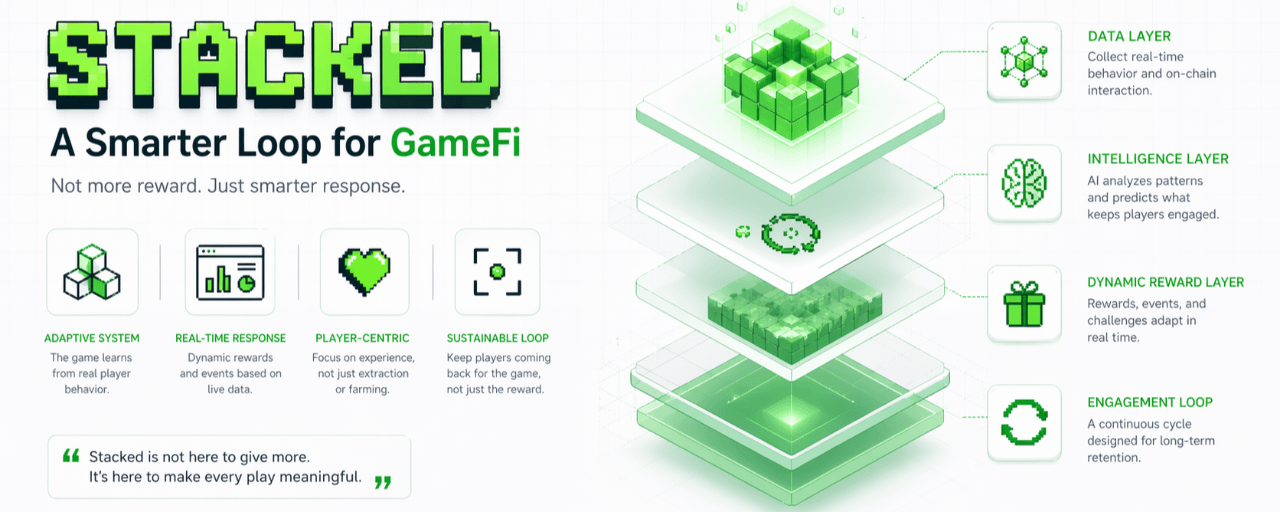
Stacked, at least from my understanding, isn’t about adding rewards but adjusting how rewards appear. It's not about giving more but distributing differently, not forcing players to work but tracking how they play and then responding in real-time.
It’s not trying to turn the game into a yield machine; it seems to be doing the opposite, bringing back the element of 'unpredictability'. A sort of LiveOps but driven by data and possibly AI. This might not sound new, but the application could be different.
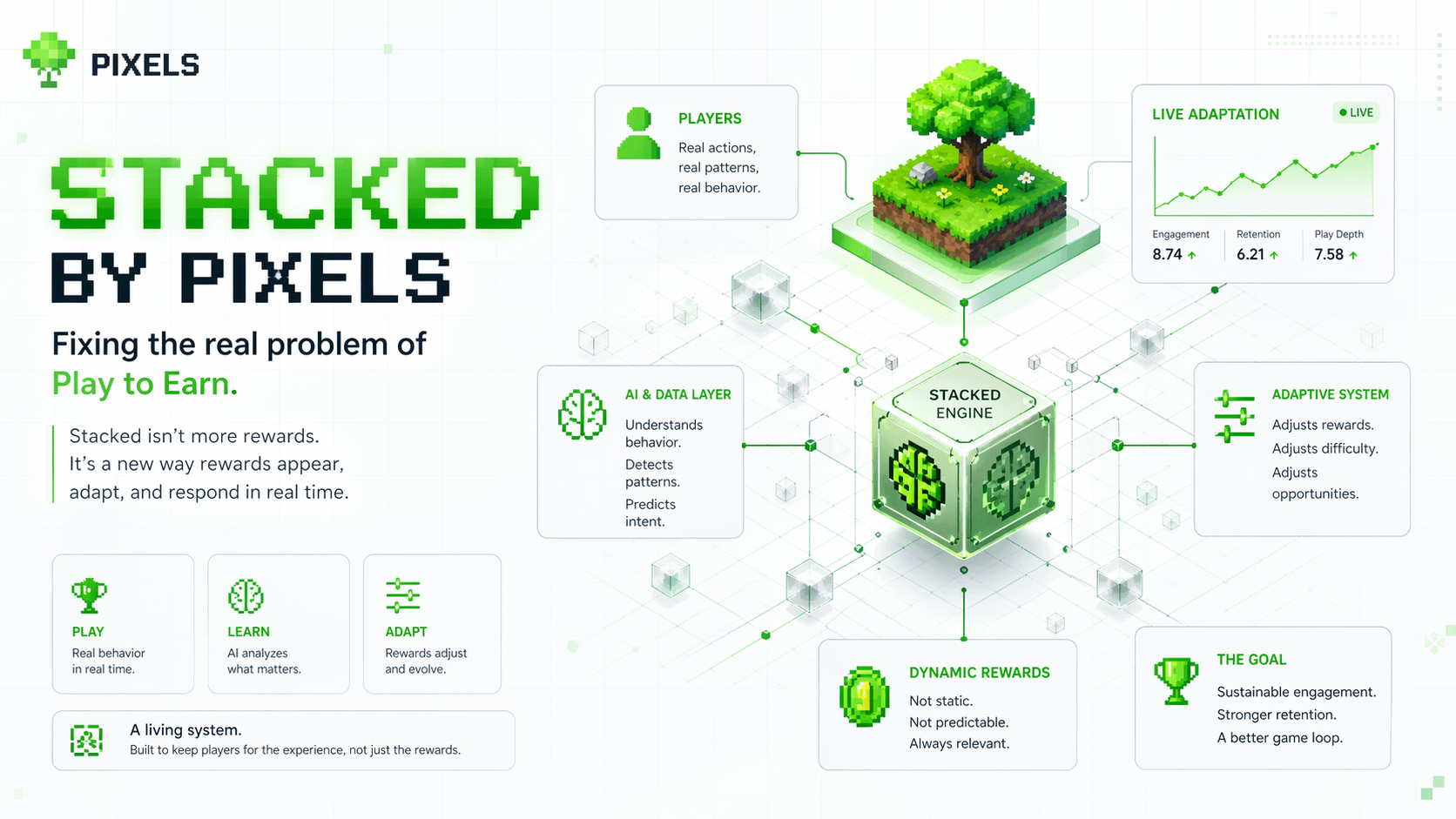
Previous systems were often static, with fixed tasks and fixed rewards. Players learned the system and optimized it, but here it seems the system is learning from the players, and if that's true, the relationship starts to change.
It's not that players exploit the game, but rather the game adjusts to keep players. However, I don't think this is the solution, or at least not yet.
Because everything boils down to one point: usage. Will players return? Will they stay when the rewards decrease? Will they play when there’s no clear incentive? Those questions can't be answered by a whitepaper or a dashboard, only by time.
Pixels has distributed hundreds of millions in rewards, and their revenue isn't small, but as I've seen many times, distributing a lot doesn't mean keeping them for long. Rewards can pull people in but won’t keep them.
What makes me observe Stacked isn't because it's new, but because it's trying to touch the right spot that GameFi usually avoids: the real behavior of players. Not ideal behavior, not pre-designed behavior, but how they actually interact when no one is watching.
It seems they’re trying to build a responsive system instead of an imposed one. A system that knows how to adjust rather than being fixed, but that also carries its own risks. When a system becomes too smart, it can optimize in the wrong direction; it can maintain engagement but fail to create an experience, and that's a pretty thin line.
I don't think Stacked will 'save' GameFi, and I don't think Pixels has solved the problem, but at least they’re trying a different direction. Less focus on tokens, more on the loop.
This part I'm still monitoring because if there's anything worth watching in GameFi right now, it's not who promises more but who dares to change how the system reacts to players.
But whether that's enough... I'm not sure; I'll keep monitoring...!