
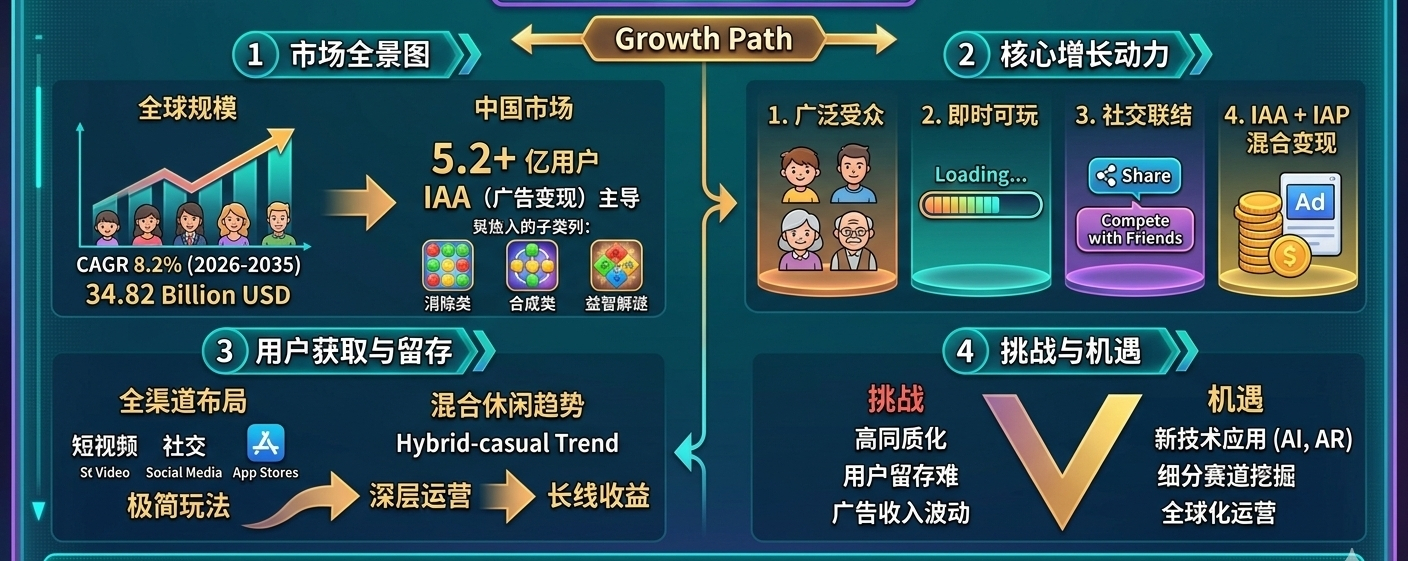
I spent years trying to explain crypto to those around me. In the end, it was a text-based game that quietly achieved what I couldn’t. It didn’t even explain anything.
April 2026
About 13 minutes
Personal observations and analysis
For a long time, I thought the issue with this whole thing was about "understanding." If people could really grasp what Layer 2 is and why self-custody is crucial, they would naturally get on board. So, I explained, and re-explained, to friends, colleagues, anyone who would give me five minutes. The results, well—let's just say—were "pretty much zero." Most people would nod and say "that's interesting," then go back to scrolling on their phones. I started to wonder if it was the tech itself: too abstract, too ahead of its time, too far removed from the average person's life.
Then last September, my neighbor's daughter—23 years old, working at a coffee shop, and who had never mentioned anything related to blockchain—casually told me that she had recently been redeeming gift cards using a mobile word game. She said it as casually as if she were saying, "I recently discovered a great noodle shop." She didn't care about blockchain, nor did she intend to. She was just quite happy because she had earned about fourteen dollars in shopping credits.
But I was completely stunned at that moment. Because during the ten-odd days she spent playing the game, she quietly accomplished something—something I had spent two years explaining to countless people countless times, yet never truly encouraged anyone to do: she genuinely gained value through an on-chain system and genuinely used it. There was no education, no persuasion, and not a shred of patience for any complexity. For her, the game was simply useful. It was that simple, and that was enough.
Her name is Maya. She represents the kind of people the industry has failed to reach for the past decade—not because she rejects new technologies, but because every existing entry point requires her to first "decide to come in" before she can experience anything. This prerequisite is too heavy for most people.
I've experienced that kind of pressure firsthand. When I first started doing this seriously, I manually tracked liquidity positions, stayed up late setting price alerts, and handled everything myself because I didn't trust automated tools. Back then, I had to "want" it enough to endure the real friction—the process of backing up my mnemonic phrase, the frustration of having a third of my first transfer eaten up by gas fees, the long wait when a certain version of MetaMask just wouldn't open. I got through it all because I already believed in it before I even started. I made that decision first, and then I went through all of this.
Most people can't make that leap of belief before they've experienced anything. They need to see "something good happening" before they're willing to take the next step. But Maya didn't need to make any decisions. The wallet was quietly created in the background, and the rewards slowly accumulated as she played games every day; redeeming them was just a matter of clicking a button. There was no friction, no choice, and no need for any trust in the unknown.
One thing I noticed while observing projects: the most reliable predictor of failure for consumer-grade crypto products isn't the token design or the chosen blockchain—it's the degree to which the product's onboarding process requires users to "trust first, then provide a reason." Maya's experience is the clearest counterexample to this logic I've seen. Reverse the order: provide value first, trust grows naturally through the experience, and understanding comes later. Even never needing understanding is possible—that's perfectly fine.
3.2 billion
Global mobile game players
(Newzoo, 2025)
Approximately 420 million
Global cryptocurrency user estimates
(Chainalysis)
<1%
Daily active on Web3
Internet users
When these figures are put together, the disparity is hard to ignore. Globally, 3.2 billion people play mobile games at some frequency. Fewer than 420 million have ever used encrypted wallets. And of those, only a small fraction of that 420 million are actually using them daily.
This isn't a technical issue. I want to make this clear because I've seen this diagnosis get wrong far too many times. The infrastructure has matured in recent years—L2 transaction costs are down by more than 90% compared to three years ago, account abstraction is already live on mainstream chains, and developer tools are now truly user-friendly. The system side is ready.
What's unprepared is the surface that users actually touch. Almost every consumer-grade dApp I've encountered pushes complexity outwards instead of swallowing it inwards. They require users to know they're engaging in something "new" before they develop any interest. This is essentially a communication problem, but it's being treated as a technical one. The entire industry is constantly looking for answers to the wrong questions.
Mobile games mastered this in the early 2010s. Billions of people participate in a system every day—including real-world economic activities—without ever needing to understand how it works. The monetization design of free-to-play games, daily login rewards, and in-game currency are essentially cycles of financial participation, just not in the way it feels. That's the model. Its scale dwarfs all the promotional activities the entire crypto industry has undertaken to date.
Marcus works as a logistics coordinator in Lagos. He's 41, has two school-aged children, a stable mobile plan, and changes his phone roughly every two or three years until the battery fails. He plays games during his lunch break, not because he's addicted, but because he genuinely needs that time to catch his breath. He doesn't consider himself a "gamer." He sees himself simply as "someone who plays games during his lunch break"—a distinction that's real for him.
A game called Pixel Rush launched on his site, featuring a "play and earn" mechanism that allowed him to accumulate rewards without any wallet setup. His cousin recommended it, and he switched within a week, for the simple reason—the game was fun. Initially, nothing special happened. But a month later, something surprised him: he discovered that the tokens could be sent directly to his cousin, who lived in another city. No banks, no remittance services that would take a hefty cut. It happened within the app, in less than a minute.
His previous bank transfers cost him nearly a quarter of the transaction in fees and took two or three business days. The in-game transfer, however: 30 seconds, full amount received. He didn't call it "encrypted," he called it "the function of in-game coins." But what he was actually doing—transferring value peer-to-peer through blockchain on a high-fee intercity remittance channel, without any intermediaries—was exactly what this technology claimed to achieve from the beginning. It was just a casual game that made it happen naturally.
Maya in the US, Marcus in Nigeria. Different games, different applications, completely different economic circumstances. But one fact remains: the thing that had been impossible to achieve for years and countless efforts was quietly accomplished in their respective chosen endeavors.
core contradiction
Our consistent approach
First, understand,
Come in again
The data speaks for itself.
Try it first.
Slowly understand
There's a tension I want to clarify because it's very real; bypassing it renders this article useless. The crypto industry has always had a fundamental assumption: widespread adoption must follow understanding. Explain the logic well enough, articulate the value clearly enough, and people will come in. I've spent most of my time working in this field under this assumption. This assumption has also resulted in an industry that, after fifteen years, still having less than 5% of the world's internet users as regular users.
Casual games offer a different approach: experience first, understand later. They allow users to feel the value of the system before they fully comprehend it. This makes many people uncomfortable—and not without reason. Informed consent is a real issue. Users participating in a financial system without complete understanding is a real issue. What does so-called self-sovereignty truly mean when the system is designed to be "invisible" is also a real question. These aren't obstacles to be designed out, but rather concerns that need to be taken seriously.
But I think this discomfort needs to be weighed against another reality: billions of people will never be reached through the "educate first, then enter" approach. They have real needs, and this technology could have served them, but because the entry point was designed for "those already interested," they remain forever outside. Both failures have a cost. The cost of "exposing complexity too early" is simply that it's easier for those already inside to see it.
The real question isn't "Is simplification a compromise?" but rather "Is the price we pay to preserve complexity worthwhile?"
What truly made me understand this was witnessing firsthand several GameFi projects go from launch to losing momentum, then transforming, or quietly disappearing. I followed them closely during that period. I studied Axie Infinity's economic model, saw how scholarship programs created real income that changed the lives of some families in the Philippines, Indonesia, and Venezuela—and also saw how it all collapsed when the token economy couldn't hold up. Those players who built their daily lives on those rewards ended up leaving with tokens that had drastically depreciated. Real people were truly hurt. This isn't a footnote that can be glossed over; it's the most important lesson of that time.
Almost every developer I've spoken to in this wave of new projects has brought up 2021. The lessons they've summarized, which I've heard countless times, are essentially the same: a game must retain users even when the token's value is zero. If no one plays without money, then it's not a game—it's a job where you're paid with tokens. When the pay stops, the "players" leave because they weren't there for the game in the first place.
The real difference in this generation of projects I've observed and evaluated lies in the fact that game retention and economic incentives are designed as two independently functioning layers. The game cycle must be able to operate even without the reward layer. The reward design is conservative, sustainability-first, and not packaged as a "revenue stream." This is a genuine divergence in design philosophy from 2021. It is this divergence that makes this matter worth taking seriously—rather than treating it as a repeat of another cycle.
I want to clearly define what this category is and what it isn't—because this framework is crucial when evaluating any project claiming to belong here. This isn't GameFi 1.0 in a fancy new package. It's not token mining disguised as entertainment. Nor is it a rebranded metaverse concept. These have all been tested by the market; their failure conditions are documented and worth studying.
What's emerging should be given a separate name: native crypto casual games. Its definition consists of three things: the game itself is genuinely fun even without a reward layer; the on-chain economic design is geared towards long-term sustainability, rather than betting on token price appreciation; and the user experience is superficially indistinguishable from a regular mobile app. The blockchain is the backend. The game is the product. The significance of the on-chain layer is to make rewards real, transferable, and belong to the players—not something the platform authorizes for temporary use.
This distinction isn't just playing with words. All truly important design decisions—token structure, customer acquisition methods, regulatory stance, how to tell users what they're participating in—flow down from here. Projects built in the wrong order might look exactly the same as those built in the right order during the release cycle. But they'll quickly go their separate ways later.
01
Unnoticed wallet creation
Players register using Google, Apple, or email, just like with any regular app. A wallet based on MPC or smart contracts is quietly generated in the background. No mnemonic phrase is needed for beginners, and no decisions need to be made regarding keys. The wallet is already there, unbeknownst to the user. This single design choice eliminates almost the biggest hurdle in almost every previous crypto onboarding process I've analyzed.
02
Abstracted benefit layer
Game achievements, daily login combos, and leaderboard rankings generate rewards denominated in tokens. The interface displays "coins" or "stars," while the underlying assets (usually stablecoins or low-volatility tokens) are deliberately hidden. The user interacts with the game logic, while the financial logic runs underneath. This is the same model as the paid currency in free-to-play games—the only difference being that the rewards here have real, portable value.
03
Exit to the real world
Accumulated rewards can be redeemed for gift cards, phone credit top-ups, peer-to-peer transfers, or exported to a self-custodied wallet. This is the moment the entire system becomes "real" for the user. It's also the moment, in my observation, when users start asking, "Where does this money actually come from?" That question is the true starting point for understanding encryption—not just a prerequisite for entering it.
Three weeks after Maya redeemed her first gift card, she downloaded the platform's accompanying app—not the game, but the platform itself. She wanted to trace the origins of her money. She found the entry point for "deepening her understanding" and completed the setup process for her non-custodial wallet herself. She had no prior experience with DeFi, hadn't staked anything, and hadn't even looked at a price chart. But she had an on-chain identity, a wallet address, and had completed the receipt and transfer of value through a blockchain system—and she did it out of curiosity, not because someone explained anything to her first. This sequence, in my opinion, is very significant.
Marcus took a completely unexpected path. He started using Pixel Rush as an informal remittance tool. Small amounts—three or seven dollars—were sent directly to family in another city. Previously, he used bank transfers, where fees could eat up almost a quarter of the money, and the process would take several days. In the game, it was a 30-second, full amount. In Marcus's eyes, the game is now infrastructure. He doesn't call it that; he calls it "the function of in-game coins." But infrastructure is precisely the role it actually plays.
The effortless experience you get with Maya and Marcus is actually quite difficult to build. I've had close contact with several teams working on this technology stack and have truly felt how much engineering investment is required to make the experience "feel like nothing happened".
The current foundation is built upon several layers working in tandem. The ERC-4337 account abstraction—and its updated derivatives—allows wallets to be controlled by social login credentials without requiring the original private key. This eliminates the need for mnemonic phrases at the start, but doesn't preclude users from self-custody later on. The Paymaster contract allows the platform to cover gas fees for users, meaning new users will never see a gas bill—not because it doesn't exist, but because someone else has paid it for them. L2 infrastructure (Arbitrum, Base, Optimism, and other Rollup technology stacks) has reduced the cost per transaction to a level where a micro-reward economy is commercially viable, something impossible with L1 two years ago. MPC key management provides a secure and recoverable custodial method, eliminating the vulnerability of traditional mnemonic phrases—the vulnerability of users taking screenshots and saving them to their albums, only to have them stolen someday.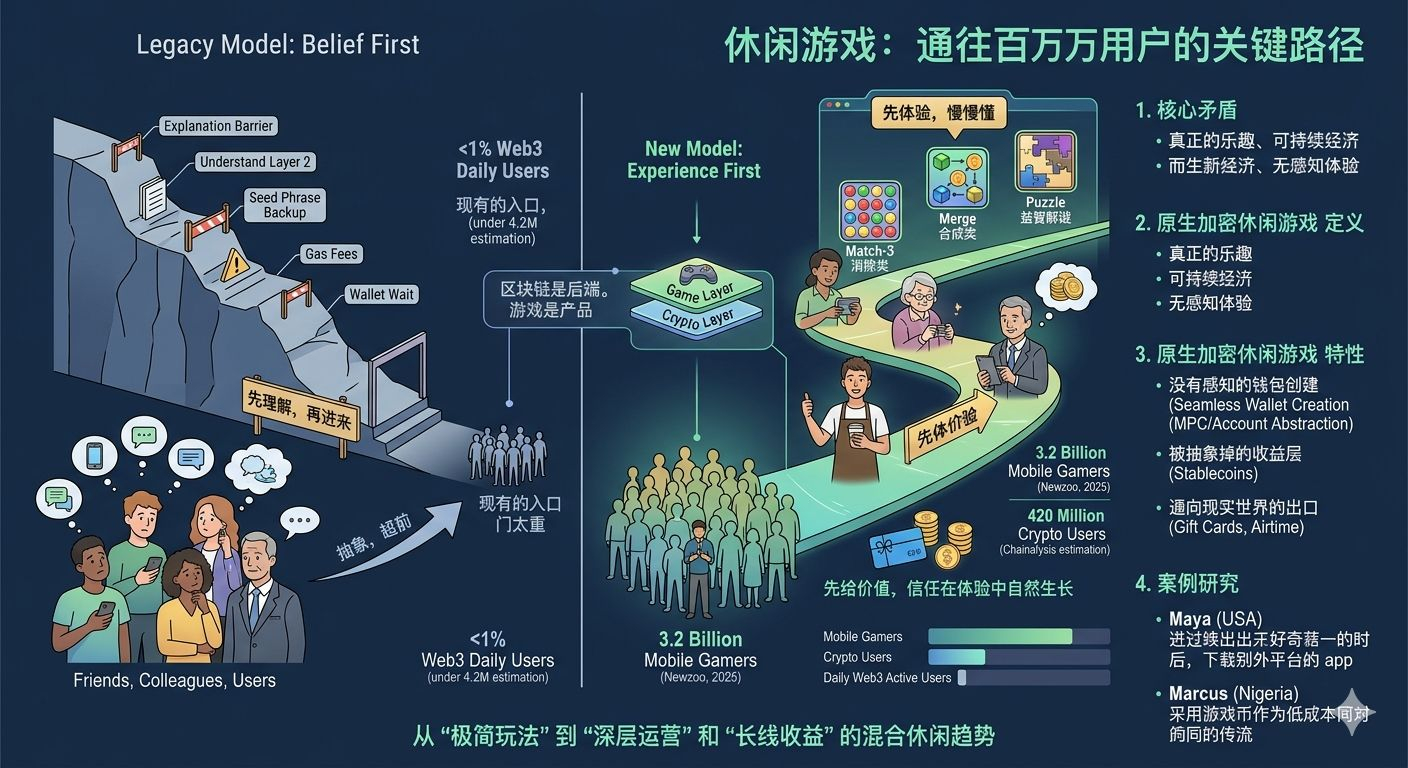
These are not magic. Each layer has its trade-offs. But put together, they create something that didn't exist three years ago: a Web3 backend that Web2 users will never need to see.
An analogy keeps coming to mind, one that comes to mind every time I think about this topic. When you walk into a hotel and tap your keycard on your room door, you don't think about the RFID frequency, the AES encryption protocol, or the access control system running in some server room in the building. You swipe, and the door opens. The technology is real, complex, and important—but to you, it's invisible, and just the right amount of invisible. You get what you came here for: the door is open.
Crypto casual games are creating that gateway to Web3. The chain is real, ownership is real, rewards are real, portable, and belong to you—a fundamental difference from V-Bucks in Fortnite. But from the user's perspective: you play, you earn, you redeem. The door is open. Everything behind that door is infrastructure—and good infrastructure remains invisible forever when you don't need it.
The industry has spent ten years trying to get users to appreciate the pipes. Games are finally starting to build houses outside the pipes.
What sets this path apart from all the previous crypto entry strategies I've seen or participated in is not a single technological innovation. Rather, it's three things that have never been combined in this way before: an existing daily habit, a familiar reward psychology, and a real benefit attached to something the user already wants to do.
Mobile games already have that habit cycle. People play them every day, without any external motivation—they play because the cycle itself is satisfying. They already understand how in-app currency, daily logins, season rewards, and leaderboards work. The only new thing is that the reward at the end of the cycle is real and can be taken away. From the user's perspective, this is a small change. From an ecosystem perspective, it's a big change.
All other ways to get started with cryptography presuppose a change in behavior. Download the new wallet, learn the new concepts, accept the new logic of risk. Casual games, on the other hand, embed a pre-existing behavior. They don't require users to change; they subtly create a possibility of discovery within what users are already doing. This is the difference between "building a door" and "tearing down a wall"—I think we've been building doors for far too long.
→
The rewards that truly belong to you—platform points—may vanish when policies change or the company is acquired, but on-chain rewards will not. They are transferable and have value outside the game. This is the ownership foundation that makes everything else possible.
→
Frictionless onboarding—the same registration process as any free mobile app. No wallet decisions are required upon starting. Complexity is postponed until users have a reason to confront it—which is precisely when they are ready.
→
Peer-to-peer transfers without intermediaries—earned rewards can flow directly between users across the globe, without banks or payment institutions taking a cut. For users living in the high-fee remittance corridor, the impact of this is quiet yet profound.
→
A natural path leading deeper—for players who start casually and continue exploring out of curiosity, there's an organic path leading to self-hosting, DeFi, and deeper engagement. Games are the entry point, not the destination.
→
Real utility in under-banked regions—in markets where traditional financial infrastructure is expensive or nonexistent, mobile-centric reward systems can fulfill real financial functions. Marcus's remittance use case isn't a marginal case—it's a market.
I want to spend more time on this section because too much optimistic analysis about this category has become hasty here. Regulatory and trust issues aren't speed bumps; they're load-bearing walls. Projects that take them seriously will go down drastically different paths from those that don't.
The regulatory landscape is truly complex. Once in-game tokens can be redeemed for real-world value—gift cards, cash equivalents, cross-account transfers—they enter a legally contentious zone in most jurisdictions. The line between in-game rewards and financial instruments is currently blurred and actively debated in multiple regions. Several major regulatory bodies are developing specific frameworks for digital asset rewards in gaming scenarios, and these frameworks are currently contradictory. Studios operating across markets are making case-by-case legal judgments, some of which may be incorrect. Users should be aware of this. This is not a stable area.
The same principle applies to user trust: people who earn rewards through games need tangible and accessible information—what they actually earned, where it's stored, who controls it, and what will happen if the studio changes direction or closes down. Platforms that bury this information in their terms of service and claim "we're very transparent" aren't being transparent; they're protecting themselves. True trust requires genuine disclosure—proactively presenting it in language that ordinary people can understand, rather than only making it visible to users who know where to find it.
The model I've seen consistently work is a progressive decentralization approach with clear disclosure at every stage. Start with hosting—and clearly explain that it's a hosted model and what that means. Once users are ready, give them the tools to migrate autonomously. Don't rush them to "upgrade" before they understand what they're upgrading to. This is slower than a completely frictionless deployment, and early conversion numbers may be lower. But it's also the only version I believe can hold up over a five-year timeframe.
To build a truly long-term user base in this category, disclosure standards need to be proactively set above legal requirements. Platforms that consistently do this—not just at the time of launch—are the ones worth watching in the long run.
Special investment in game infrastructure
Several L2 and SDK middleware providers focused on GameFi completed institutional-level funding rounds between 2024 and 2025—not for token speculation, but for long-term bets on the infrastructure itself. When institutional capital starts investing in pipelines, this is a signal worth taking to heart.
The Quiet Entry of Traditional Game Studios
Several mid-sized mobile game studios have already integrated on-chain reward layers into their existing games without using any GameFi label. They haven't told users it's encrypted; they've simply built it in. This strategic silence speaks volumes.
Actual usage of account abstraction
On-chain deployments of ERC-4337 have increased significantly since 2023, with gaming dApps consistently being one of the most frequently used scenarios for smart account infrastructure. Infrastructure-level adoption is ahead of consumer-facing narratives.
Depth of participation in emerging markets
Participation rates in the "earn while you play" model are significantly higher in Southeast Asia, sub-Saharan Africa, and Latin America than in Western markets—especially in regions where mobile phone penetration far exceeds bank coverage. This isn't a market segment; it's the core of the reachable population.
If this category continues to move in the direction the signals suggest, I think something like this will happen: the next large influx of people into the crypto space won't be driven by bull market narratives or viral token hype. They'll come in because something is genuinely fun, the rewards have proven real, and at some point, they'll look up and realize they've crossed that threshold. This group will be fundamentally different in character from all those who came before—not speculators, not tech enthusiasts, and not ideological believers. They will be participants. They will be those who own wallets because of "what they've earned," not because of "what they've bought."
This shift in the personality of this demographic will create different pressures across the entire ecosystem. They will demand stability, not volatility—because they didn't come here expecting volatility. They will demand ease of use, not ultimate performance—because they came through a product that prioritized ease of use. They want products to integrate into their lives, not for their lives to be reorganized to accommodate those products.
And each of these people is a potential user of all other applications in this field. Those who come through games may also become users of remittance products, savings agreements, digital identities, and payment tracks. Games are the door. But what the door opens is an entire infrastructure—and the quality of what's behind that door will determine whether these people stay or turn away.
Last month, Maya did something I really didn't expect to happen so quickly. She figured out the platform's "Learn More" entry point on her own—a question mark icon she'd been avoiding for weeks—and then went through the entire non-custodial wallet setup process herself. Nobody told her to do it. It was because she was curious enough about where her rewards were going that she wanted to figure out what the next layer was.
She transferred about forty dollars from the platform's escrow system into her own wallet. Then, she sent ten dollars of it to a cousin in the Philippines—half as a test, and half because she had been annoyed by bank transfer fees for months.
She sent me a message: "Oh my god, this is amazing!" She didn't know which blockchain it used, nor did she know what MPC meant. What she did know was that the money arrived faster than any other method she had ever used, and it was all hers—not platform points, not "pending settlement balance," it was hers. If this experience could be replicated on a real scale, it would change the face of the industry.
Marcus has become the unofficial "crypto consultant" in the office. He never uses the word "crypto"—and I suspect he'll still be avoiding it a year from now. His approach is: "Have you played Pixel Rush? It has a coin feature." Two of his colleagues registered accounts. Two more people joined the ecosystem, earned, not bought. These two joined with a sentence devoid of any technical jargon.
This is the image that comes to mind whenever I imagine what widespread adoption will look like in the next ten years. It's not about a bull market, not about a viral moment. It's about two people who, through something they already wanted to do, found their own way in.
The next million users probably won't come from a better white paper, a more sophisticated token economy design, or a larger marketing investment. They'll come because something is genuinely enjoyable, the rewards prove real, and at some point in the process, they look up and realize they're in a system they never intended to join. This isn't a marketing ploy. This is what early data showed.
The question I keep revisiting—which I think is more important than whether games can bring a large-scale user base onto the blockchain—is: what kind of ecosystem awaits them when they arrive? Because Maya and Marcus didn't enter through the front door. They were on their way to doing something else, opening a side door. They deserve an infrastructure that takes them seriously, as seriously as it would take someone who has read all the documentation. @Pixels
Building that infrastructure—building it honestly, with genuine information disclosure and real user protection—is the job that determines whether this category can be sustainable. I believe it can be sustainable. I also believe it won't be automatically. Someone needs to actively choose to make it that way.
They're already playing with it. What are we building for them?
The next wave won't arrive through meetings and marketing campaigns. They're already on their way—in word games and puzzle apps, in the habitual cycle of lunch breaks, in that ten-dollar transfer that arrives in six seconds. The door is open. What lies behind that door is still being decided.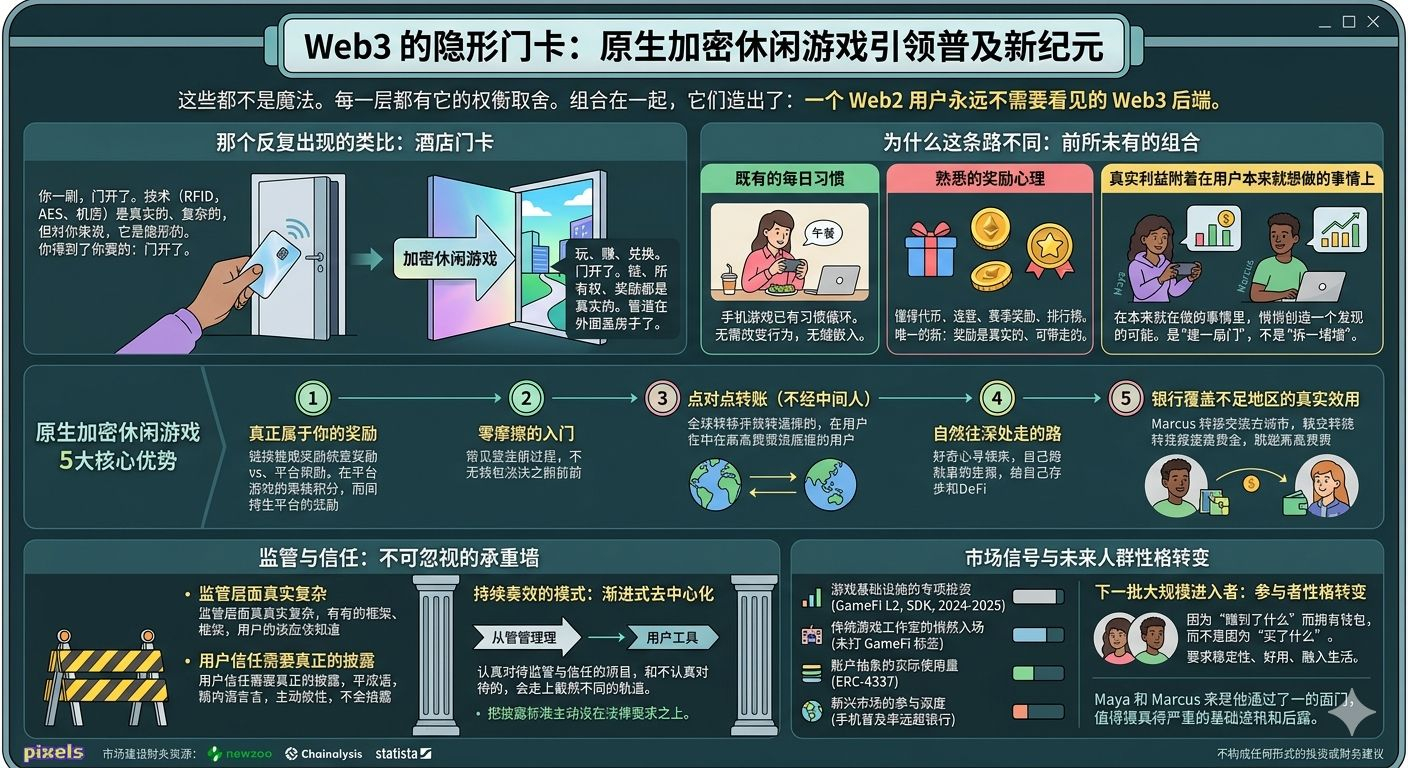
Think carefully. Build honestly.
Market data is cited from the Newzoo Global Games Market Report (2025), Chainalysis Cryptocurrency Popularity Index, and Statista Mobile Game User Data, all of which are publicly available sources. The characters Maya and Marcus are representative figures created based on research into real user behavior and do not represent any single real individual, nor do they constitute a description of any person. All analyses are subjective judgments based on the author's personal experience. This article does not constitute any form of investment or financial advice. The past performance of any token or game economy is not indicative of future results. Readers considering participating in any crypto-related products should conduct their own thorough research and consult qualified financial and legal professionals if necessary.