
I’ve watched GameFi go through countless “new models,” with every project claiming they’ve finally solved retention. But the pattern rarely changes. Players arrive for profits, and the moment token prices fall, they leave. At this point, it feels less like a problem and more like the standard cycle of the industry.
What stands out to me isn’t innovation for the sake of innovation, but the core issue that keeps repeating. You log into a game, complete tasks, collect rewards, and eventually start wondering whether you’re actually playing a game or just doing digital labor. That question says a lot.
From where I see it, the weakness of Play-to-Earn has never been purely tokenomics. It’s not only about emissions, sinks, or reward balance. The real issue is player behavior. When rewards become the only reason to stay, players stop engaging with the game itself and start optimizing purely for extraction.
Many projects try to solve this by adding more systems, more layers, more restrictions, and more mechanics. But often they’re fixing the wrong thing. Complexity doesn’t create engagement—it creates optimization. Players quickly identify the fastest path and reduce the experience into a routine checklist.
A lot of games end up functioning like reward distribution engines disguised as games. The gameplay loop becomes centered around “how do I earn more?” instead of “why do I want to come back tomorrow?”
That creates a strange paradox: systems built for retention often accelerate player exit. Once the loop becomes too predictable, repetitive, and reward-driven, boredom wins faster than incentives can compensate.
That’s the long-standing problem GameFi still struggles to solve.
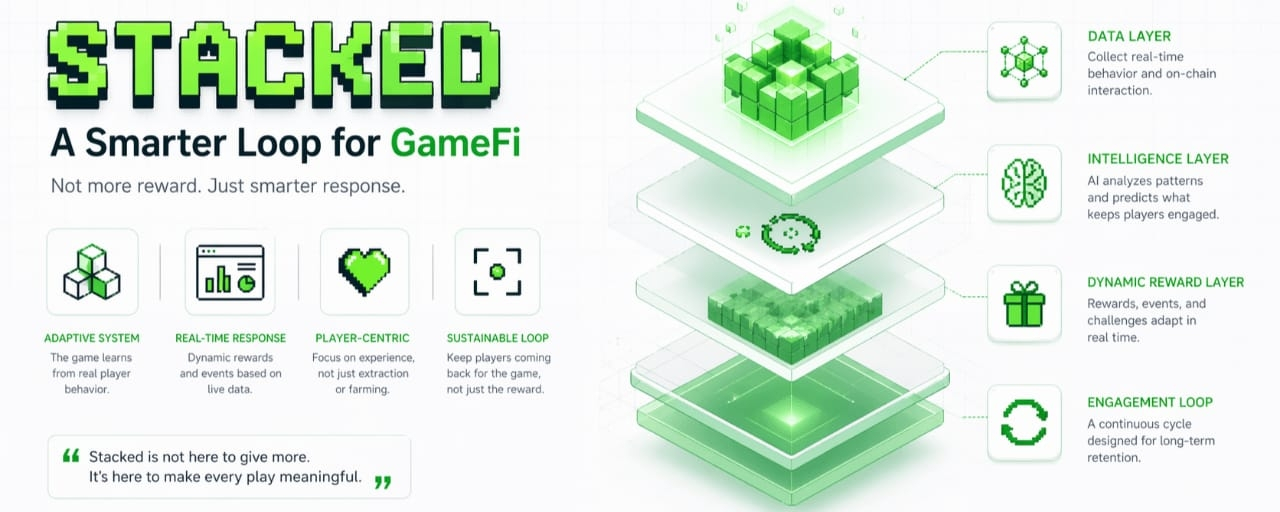
This is where Pixels becomes interesting—not necessarily as a final answer, but as a long-term experiment. Their recent focus on “Stacked” feels less like a simple feature and more like a redesign of how the entire reward loop works.
From my understanding, Stacked isn’t about increasing rewards, but about changing how rewards are delivered. It’s less about paying more and more about responding better. Instead of forcing players into fixed tasks, it seems designed to observe player behavior and adapt rewards dynamically.
Rather than turning the game into a pure yield machine, it appears to be trying to reintroduce unpredictability. Something closer to LiveOps powered by data and possibly AI. That idea itself isn’t new, but the way it’s applied here could be.
Traditional systems are static—fixed missions, fixed rewards, fixed patterns. Players study them and exploit them. But if the system starts learning from players instead, the relationship shifts. Instead of players constantly beating the system, the system adjusts to keep engagement alive.
That said, I don’t see this as a guaranteed solution.
Everything still depends on real usage. Will players return consistently? Will they stay once rewards become less aggressive? Will they keep playing when there’s no obvious short-term gain? Those answers won’t come from dashboards or whitepapers—they only come with time.
Pixels has already distributed massive rewards and built significant revenue, but history shows that large distributions alone don’t create loyalty. Rewards can attract attention, but they rarely create attachment.
What makes Stacked worth watching is that it seems to focus on something GameFi often avoids: actual player behavior. Not idealized behavior, not designed assumptions, but what players truly do when left alone inside the system.
It feels like they’re trying to build something responsive instead of something imposed—a system that adapts rather than one that demands compliance. But that also introduces risk. A system that becomes too efficient at optimizing engagement can accidentally sacrifice actual fun, and that balance is incredibly fragile.
I don’t think Stacked will “save” GameFi, and I don’t think Pixels has fully solved the problem. But at least they’re moving in a direction that feels more honest—less obsession with tokens, more focus on gameplay loops.
That’s the part worth paying attention to.
Because in GameFi, the projects that matter most won’t be the ones promising bigger rewards—they’ll be the ones brave enough to change how games respond to players.
Whether that will be enough… I’m still watching.