
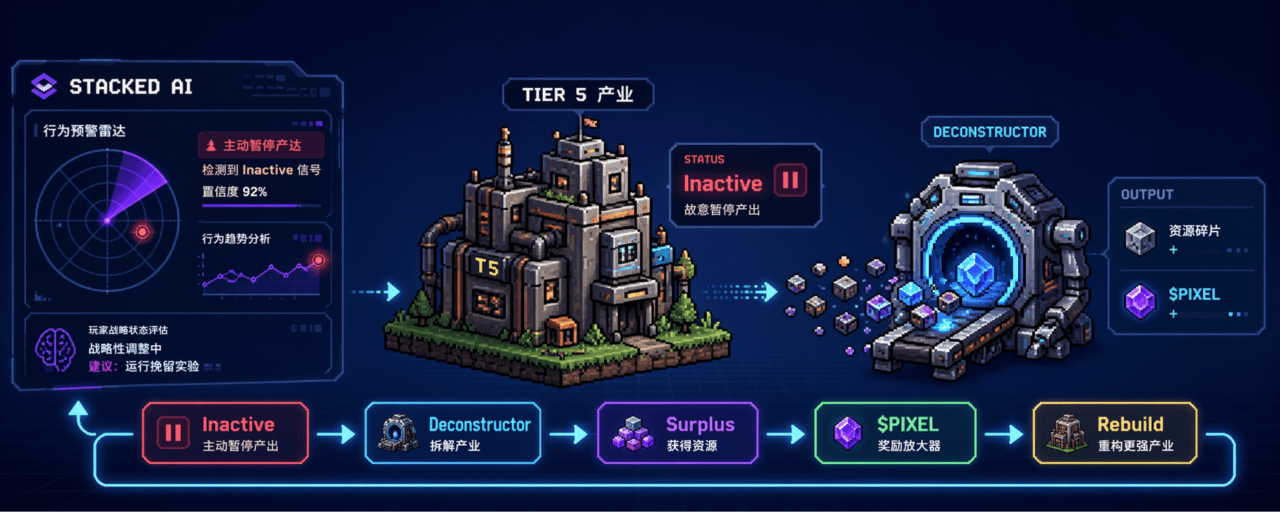
I've noticed an issue; the Tier 5 'active shutdown' at @Pixels is actually the best strategy.
Turning a freshly built Master Metalworking Kit or Verdant Soil industry into an Inactive state and tossing it into the Deconstructor might seem like a waste of time and a sacrifice of immediate output, but it actually becomes one of the most subtle and clever signals in the entire game economy.
The AI economist from Stacked treated this 'active pause on production' as a concept in behavioral economics—it's more accurate and timely in capturing when players are making strategic adjustments than any task completion rate or daily login duration.
First, let me clarify that this is not a bug, but rather an unexpected 'data flywheel' born from the deep coupling of Deconstructor mechanics and Stacked's reward engine post Tier 5 updates.
Layered mechanism of Tier 5 and Deconstructor: Why must we first transition to Inactive?
The Deconstructor is the only way to obtain exclusive T5 materials; the process looks simple but hides intricacies.
On the small machine to the right of the Deconstructor, manually turn the working T5 industry to Inactive Industry.
Consume 1 Hearth Fragment to activate the Deconstructor.
Place the industry after it goes Inactive, and wait for the timer.
Receive 2-5 rare materials for 105 new recipes and higher-tier tool crafting.
This step of 'transitioning to Inactive' is not optional; it is a mandatory prerequisite.
Why? Because the Deconstructor only accepts assets with 'paused output.'
It freezes 'living economic units that are creating value' into 'reconstructable material packs.'
This small operation creates the purest 'active downtime' event in the game—players choose to pause the current output chain to exchange for rare materials for future restructuring.
Here lies the first data hook that allows Stacked to 'understand players.'

Inactive state signals: 'Strategic pause' radar in behavioral economics.
Traditional game data analytics love 'completion rate', 'online duration', and 'output efficiency', but these metrics can severely distort in the late stages of the game—highly active players might be in a restructuring phase, with output temporarily zeroed, yet they are the most loyal group with the highest willingness to pay.
Stacked's AI economists regard the Inactive signal as a golden indicator of 'display preference' in behavioral economics.
Why? Because it meets three criteria:
Atomic-level traceability: Every transition to Inactive is a manual action by the player, complete with timestamps, industry types, land Slot status, and player historical cohort tags. Stacked can pinpoint 'this player turned the Y-th Master Stove Kit to Inactive X days before the Slot expiration.'
Active vs. passive distinction: Passive Inactive is a negative signal, indicating churn risk; while actively transitioning to Inactive is a positive signal, representing players 'investing in the future.' The AI can immediately flag the former as churn warnings and the latter as 'strategic adjusters.'
Leading indicators ahead of task completion rates: Task completion rates are a lagging indicator—players only reflect this after completing high-multiplier tasks. Inactive is a leading indicator: when players actively stop work before Rune expiration, it's like shouting to the system, 'I’m planning the next round of empire upgrades, not trying to run away.' Stacked’s AI economists can use this signal to predict 'this player is entering a restructuring window' 3-7 days in advance, triggering the studio's 'retention experiments'—like pushing targeted high-multiplier tasks, $PIXEL bonuses, or small USDC incentives 48 hours before Rune expiration.
This is precisely the gamified application of 'status quo bias' and 'sunk cost fallacy' in behavioral economics.
Players clearly understand that stopping work will result in short-term output loss, yet they still choose to do so, revealing their subjective valuation of 'long-term restructuring value' far outweighs immediate gains.
Stacked quantifies this 'subjective value bias' into cohort profiles, more accurately than a simple RFM model.

How Stacked AI economists turn Inactive data into 'retention experiment' fuel.
Stacked is a composite of 'rewarded LiveOps engine + AI game economists' that reads player full-chain data in real-time, running multiple models and outputting three types of recommendations:
Churn warning radar: When multiple T5 industries are consecutively transitioned to Inactive, and the player hasn't triggered high-value tasks recently, the AI will mark it as 'strategic fatigue' rather than 'soon to churn,' distinguishing it from merely offline players.
Personalized reward suggestions: For instance, if the AI detects that a player’s last three Inactive actions focused on the 'Master Woodworking Kit,' it will infer their preference for 'resource restructuring flows' and proactively push 'Woodworking exclusive $PIXEL multiplier tasks' during the Rune expiration window.
Experimental closed loop: The studio can allow the AI to automatically A/B test the retention effects of 'incentives pushed 2 hours vs 6 hours after going Inactive,' creating a data flywheel.
'Pushing high-multiplier tasks before Rune expiration' is a classic case; the 30-day cycle of the Preservation Rune is tied to Slot Deed. To avoid letting T5 industries 'expire without use,' players often concentrate on Inactive + Deconstruct actions before expiration. At this point, Stacked can convert potential 'frustration' into 'understood surprise,' significantly enhancing long-term retention.
I believe the Inactive signal helps AI distinguish between 'whale players' and 'grinders.' The former regularly use Inactive for 'industry rotation,' while the latter hardly touch the Deconstructor, relying solely on T1-T4 for volume. AI economists use this characteristic to precisely direct the limited $PIXEL/USDC reward pool towards players who genuinely contribute to the economic cycle, avoiding the collapse of traditional P2E 'reward farming.'

$PIXEL plays a dual role in the positive cycle of 'pause → deconstruct → restructure → reward.'
$PIXEL plays a dual role of 'consumable + amplifier' here, perfectly closing the loop.
As a decomposing material consumable: Although the core of Deconstructor consumes Hearth Fragments, the entire T5 restructuring chain heavily relies on $PIXEL—synthesizing the Preservation Rune requires $PIXEL-driven Quantum Recombinator materials, and materials like Collapsed Core obtained post-Deconstruct also need $PIXEL as a catalyst or trading medium during T5 tool crafting. Actively going Inactive is essentially 'exchanging current output for scarce materials within the $PIXEL ecosystem.'
As a Surplus output amplifier: The restructured new T5 industry will generate higher Surplus (output surplus). Stacked will dynamically amplify $PIXEL reward multipliers based on the strength of the Inactive signal—like raising the $PIXEL output coefficient from 1.0 to 1.8 for 'Surplus in the first week post-restructure.' The more strategically players pause, the easier it is to get recognized amplifiers by AI.
Thus, a positive cycle forms: pause → deconstruct → restructure → reward → higher Surplus.
This loop is exponential—because Stacked's AI marks players who 'successfully complete a loop' as 'high strategic value cohort,' automatically granting them higher priority experimental rewards, creating a self-reinforcing positive feedback loop.
Why is this the smartest yet most underrated data source for Stacked?
Almost nobody has noticed the deep value of the Inactive state for three reasons:
Information asymmetry: Regular players see only 'stopping work and losing output,' missing how the backend AI translates this action into a 'strategic signal.'
Behavioral economics: Traditional game design relies on 'positive incentives'; few study 'active downtime' as a display preference's value. Stacked integrates behavioral economics directly into LiveOps, a rare fusion of 'cognitive science + AI' in web3 gaming.
The invisibility of the data flywheel: Studios won't openly say 'we're running retention experiments based on Inactive events,' and players rarely flaunt 'stopping work' as a highlight. The result is that surface-level discussions always stay on 'material grinding guides,' overlooking how underlying mechanisms reshape the player-AI-studio tripartite game.
For players, learning to utilize the Inactive signal equates to mastering a new language to converse with AI: the more regularly they strategically pause, the more Stacked understands their empire blueprint and the more willing it is to provide customized rewards. For studios, this is the key to solving the dual deadlock of 'churn + economic collapse' in web3 games—matching 'timing + targets' smarter.
---------------------------------------------------------------------------------------------
Deliberately halting industries in Tier 5 is not a setback but the smartest advancement.
Stacked truly understands where you want to lead your empire through your most secret operations—those moments of active pauses.
And when the AI knows what you're going to restructure before you do, that's when the game truly begins.
*Disclaimer: This is personal analysis and does not constitute investment advice. DYOR.